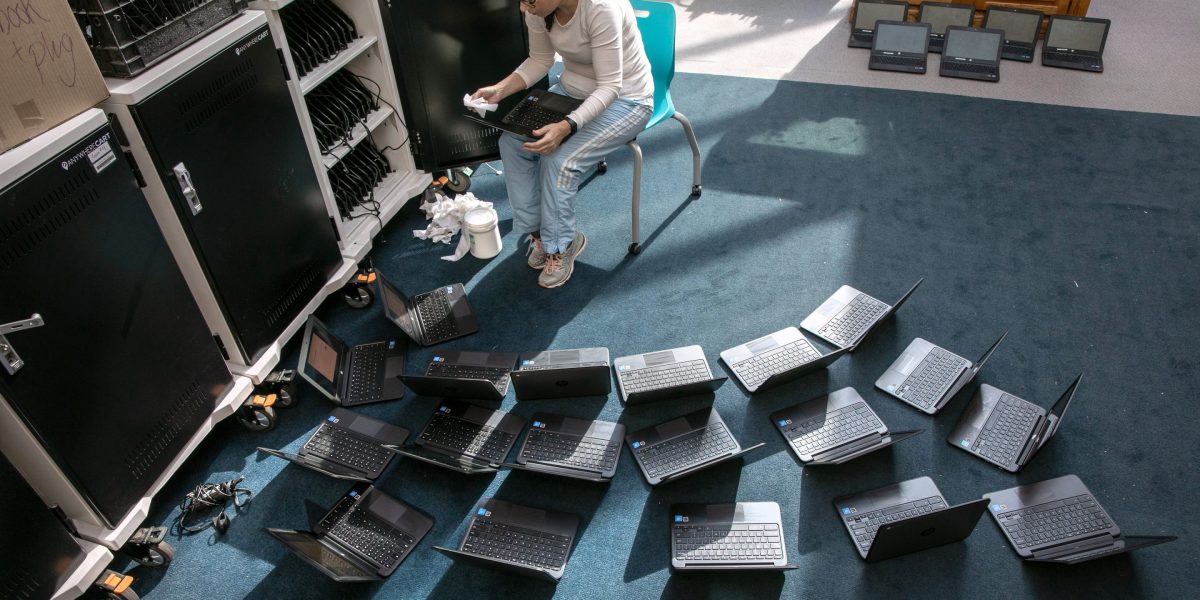
This is likely a hot take but, I don’t think this was the fault of the in-class laptops. They thought removing phones were going to solve the issue, it didn’t, they thought computers were going to solve the issue, they didn’t.
The core issue is: School is fucking boring. As a kid/teen you spend 8-10 hours a day sitting at a desk listening to a teacher yap about shit that at the time you don’t believe is even important so you can regurgitate said useless information in tests that you then proceed to forget 2 weeks after taking. Hell even now I think I learned more actual life and useful skills in college. I have more engagement and entertainment working a full time job, than I did in a classroom, and at least I was making money with the job.
The school districts are shocked that upon providing a tool that could be used to lessen the tedium and lifelessness that school shoves down kids throats they then misused said tool. I don’t understand it.
Make learning fun and engaging, add actual life skills to classrooms like how to read an analog clock, or how to write a check. Talk about how to survive in the real world, how interest works, how your credit score is really important, maybe how the government works cause I know I never had a civics class. Stuff that kids in middle/high school would actually care about, instead of how to solve 3 unknowns in an equation, or how to find an angle of a triangle when you know the 2 angles, or learning about colonization for the 8th time. Make it so it isn’t just “read this board, repeat on the test”.
If you solve the underlying issues at play, instead of trying to remove the tools that kids are misusing in order to fix the issue that the school system as a whole created, I think it would be found that computers would be a net positive. I know having a computer in class significantly improved my scores and learning capability, as I could use it for legible note taking, and I could record sessions if I needed to. Yes I definitely accessed coolmathgames at times but, I can tell you right now, the ability to do that helped remove the monotony of the classroom, and if I didn’t have that tool at my disposal, I would have simply zoned out and gained nothing out of the day, instead of what I did. My scores definitely wouldn’t have gone up like the article seems to be alluding to.
Toss the chromebooks and let kids mess with the inner workings of the computer. Tech them to make their own backups and have restore drives available.
But after these funds dried up, schools have struggled to replace broken or outdated devices, which last on average less than a decade despite Google’s efforts to extend device life spans.
HA
Right?
“What’s that Google? When you design things from the ground up with planned obsolescence in mind, it’s suddenly hard to UNDO the mess you made of the hardware? Who would have thunk it.”
“TEchMoLoGy iS tHe fUTuRe anD wE mUSt PrEpArE tHE stUdEnTs!”
Yeah, no. You can stick to teaching them core curriculum. Speaking on behalf of GenX, we never needed school to tell us how to use technology.
Agreed, also encouraging curiosity probably is more beneficial IMO
Flashbacks to being in elementary school in like 2004 and they had to teach us how to use calculators. “Had” is a strong word. They literally spent an entire day of math one day telling us how to use a normal non-graphing calculator. I distinctly remember hearing “don’t hold it like a Gameboy, don’t use your pencil to press the buttons,” and even then thinking how useless of a day that was. They wanted it to still seem so important. Remember, you won’t have one of these in your pocket every day.
The issue here is that the technology itself, instruction, and implementation was incredibly poor this century. Schools weren’t doing basic things like typing classes for primary school, there was no instruction on how to program or use the operating systems, and kids weren’t given PCs; they were given tablets and chrome books which favored internet access based learning platforms over products stored locally on machines.
I grew up during the 1980s, and my primary schools had 1 apple pc in the classroom. We took turns learning typing. We learned how to operate the machines by inserting floppies and typing commands. Things we were given access to were all instructional. I have vivid memories of learning math via computer with a program called number muncher.
Access to the tech was limited and supervised. This is what created an environment that taught me how to use computers as I transitioned to secondary education. This century, all of the implemented controls were related to limiting access to pornography rather than teaching students anything about the actual tech. Now we have a generation of people entering the workforce that don’t know how to use PCs just like the boomer demographic.
I grew up in the 90’s, there were Apple //es orMacs with edutainment software on them that we’d be taken to once a week, and by high school there were several computer labs full of Windows XP machines scattered around, a couple “public” ones that teachers would occasionally schedule to take the class to to do some research or type up an essay, and a few that were computer focused, I took a class on MS Office in one of those, and that’s where I was when I first heard the planes hit the towers.
About that time is when it felt like the manager and politician class latched on. That putting computers in schools made them look good, it was a bragging point, “Look how modern and up to date we are” so they’d start to cram computers in where they didn’t need to be. My junior year in college I took a calculus class that was in a CAD workstation classroom. We were told not to touch the large, loud computers on our desks and had to try to see the board around the monitors. That was probably the most egregious case but it happened a lot. “Don’t touch the computers, this isn’t a computer class.” Like all the fresh shiny equipment colleges will walk tour groups into, turn on the lights, show off that they have it, turn the lights back off because no classes take place in there, that equipment is for owning not teaching.
Now the shift is, kids get issued a chromebook and use that instead of pencil, paper and textbook. “We’ll use these because that’s what it’s like these days.”
Can confirm. I’ve spent several hours the last few weeks teaching a friend’s 24 year old daughter basic computer literacy on a W11 system. None of her friend group could help because they know just as little. When we started, she didn’t know how to shut down or reset the system.
I worked in a school system after 2011 in a county going technology first hard. They had thinkpads initially but the cost was so high for them that chromebooks became much more tantalizing as a budgetary measure. I do agree with you though whole hearted, because of a lack of instruction on computer usage and understanding kids were taught to just click this icon, do the work, be done with out. There was little to no attempt to explain the technology behind what they were doing. As a tech I would try to for the ones that’d listen but for them to really grasp it would require an actual class to do so.
As well kids are being given screens far too young for their developing minds and those screens allow access to short attention span favoring content and slop. If you Googled something you might remember more likely when I was a teen, you didn’t have instant access to it. Now y do and I think it’s detrimental what can be accessed.
When I first started working on computers in 1994, I thought that by 2010 every kid/teen/adult would be able to repair their computers themselves. How wrong I was. They know how to use computers and tablets but the hardware is a mystery to them.
I worked at a STEM university and was helping a Computer Science student with his laptop. It had a SSD and a platter HD in it for storage. The platter HD was failing and needed replacing. I wrote to the student stating he “needed a new HD”. He had no clue what I meant. He didn’t even know it was possible to replace. He was going to buy a new laptop.
Capital is trying to corral all the tech into “the cloud” so they can control it all and rent it out forever.
They do not want anyone to know anything about hardware.
This most recent hubris with AI is because they think it can be used to create new tech and instruct installers so they no longer need ANY human capacity with knowledge.
Of course that was not and never will be true but isn’t it interesting how the billionaire class will pounce on any opportunity to cement their power without reliance on society hmmm it’s almost like they’re the fucking bad guys
I was born in 1996, but the older generation (it’s Russia) that remembers Soviet schools sometimes remembers Soviet educational PCs. Those were a few series, I don’t remember names, the point is there were Apple II clones and there were PDP-11 clones (but in PC form factor, even with networking ability in the sense of there being one master machine and slave machines booting from it ; but those were not terminals).
So, that older generation remembers as if something normal being taught to program in BASIC, FORTRAN, later C or Pascal and operate machines. Soviet life was quite a lot poorer than even 90s despite all the retroactive disdain for that decade, still informatics classes were apparently at least educationally useful and had at least one operable machine usually.
The 90s generations at least got some computer instruction of general use.
And my generation got Windows machines and no real understanding by anyone what informatics classes are even for. Unless it’s some special school or at least with math focus.
Things people were taught in the 80s and which somehow don’t transition at all to their operation of modern PCs, that contrast still terrifies me.
So - it’s the same everywhere, it seems, because of the idea prevalent in the 00s that my generation is going to just wing it because of being exposed to electronics since childhood. An absolutely nutcase and absolutely winning (in the sense of popularity) idea.
I even have a pre-school brochure somewhere, if I’m not mistaken, with algorithmic problems and solutions. The earlier the better.
One can think in paranoid/cynical ways - “fools are easier to rule” or “so that’s why they were pushing hacker movies in the 90s to scare everyone”. I honestly think it was just fear of some day being less than capable of understanding the technology we rely upon to keep breathing. And that fear is unsubstantiated, because similarly to that most people don’t understand city planning, logistics, oil refineries, electrical engineering and one can go on. But due to that fear of singularity it was easier to start imagining that somehow new generations will gain hard knowledge naturally.
But even that wouldn’t be much of a problem if not for Microsoft. Hate them with passion. EDIT: For managing to sell, coerce and impose their monopoly upon the world and upon education most of all
I feel this is just a tangent though. The main issue is kids test scores in math and reading not improving/dropping since switching to utilizing more technology. Whether they know how to use the OS properly or type faster was supposed to be a bonus to PCs in the classroom.
This article shows a lot of examples of teaching failures, but we need an actual study showing tech isn’t helping, or the correct way to teach with tech.
I was part of the first school year where my district implemented a one-to-one laptop/student policy. Our school district got a fat grant the year before, because they implemented a drug-testing policy and used the money to buy each student a MacBook Air.
It was a complete disaster. There were some positives to it, but it really changed everything from there on.
Our IT department was ran by 3 guys, spread across a high school, middle school, and 6 elementary schools. They had no idea what they were doing most of the time. We had some Windows machines in the drafting classroom, my profile became corrupted, preventing me from being able to log in. The admin couldn’t figure out how to delete my profile, and insisted that I just used someone else’s login. I also lost work because he couldn’t figure out how to sign in as an administrator, and yank my files from my user folder.
We had full admin rights on those computers, and the MDM (JAMF) was not installed correctly allowing us to uninstall it. Many of us ran pirated software.
The biggest thing was cheating. It just became so easy. The school couldn’t do anything about it because all the answer keys were being uploaded to Quizlet, which was a service many teachers were using for study guides.
The school tried to block iMessage from working on these machines, and failed miserably. We figured out how to bypass it within the first week of implementation.
Since I’ve graduated, they’ve made a lot of changes for the better in terms of device management. However, I have no idea about how the classrooms have changed since.
Furthermore, this school district did a horrible job of teaching kids how to use computers. They did typing lessons, but didn’t ever explain how to use the computers. So when the laptops came in, many students had no idea what a file was or how to submit them to the LMS.
I at the least can be thankful that they gave us actual computers, rather than Chromebooks. I work in secondary education now, and so many students have Chromebooks because that’s what their school taught them how to use. They have no clue what software is, and only know how to share a document through Google Docs, rather than getting the file exported as a .pdf or .docx and properly submitted into the LMS.
IMO Chromebooks have ruined a generation. Especially since schools forced this upon the masses.
Tech devoured everything as it does. Put some funding back in shop class, arts, home ec., etc. That was the issue around here going back decades.
They defunded all those things here. Back then my high school got a ton of fancy Apple computers. Those went unused except for the IT guys fucking around with them and never actually deploying them for some reason. Only the aging Windows PCs were used by students. That was the only funding being spent anymore.
The world is more than just the big tech industry. It’s no wonder so many trades professions are aging out into oblivion. We listened to techbros who are converting the world into digital zombies.
Give the kids things to do again other than screen time. The rest of the entire curriculum has long ago been gutted down to pure theory. Of course they’re bored to death, and searching for stimulation on their screens.
It’s not screens that are the problem, per se, but how they are used, and how schools and teachers were rely upon them to do every single little thing rather than using an appropriate methodology which integrates traditional teaching techniques which use technology to assist.
And they wouldn’t have to have the screen do everything if they were paid the appropriate amount given the importance of their station
It’s not even the pay. Every child deserves the education to be tailored to them but there aren’t enough people to sit down one on one with every kid. No budget meant no kid ever got one on one unless they had a disability and the school got money for another person. It always came down to not enough bodies. The pay was just insult to injury.
That’s my point, if the job paid well then more and more educated people would want to do the job to begin with so teachers didnt feel the need to have a tablet do teaching because they don’t have the time
One on one isn’t even necessary, look at the Montessori curriculum, two competent Montessori guides can manage a classroom of 30 kids with each kid working at their own pace (within guardrails, of course). The structure of public education in the US is a problem in addition to chronic underfunding
Montessori style education works very well for certain learning types, but often under-supports others and can suffer from poor implementation just like any other educational model. One-on-one is far superior for some students, and that will never not be the case.
Thinking back to my school days 15 students in a class was okay. I think I’d prefer that instead of 30 students and two teachers.
This is a problem even in places where teachers are adequately paid.
Honestly, I think that’s just one of the many problems with today’s education system.
People naturally want to make things as easy as they can for themselves; if you introduce a tool that can make things better when used in moderation, but worse if overused, it will inevitably be overused so long as that’s the easier thing to do. Convenience is one of the biggest factors in making the global population dumber and more complacent, and it’s often introduced as a useful tool in moderation.
I don’t think introducing digital textbooks that also allow notetaking is gonna make anyone dumber. Especially if it’s limited to just those tasks.
But giving every kid an iPad or a Chromebook, where they can absolutely abuse it no matter the intent, yeah… I see what you mean.
It often is the technology itself though. Or at least “the technology” defined in any way that’s relevant here.
No one is proposing that we remove every computer from school buildings. The mistake appears to be the “one laptop per child” policies that made laptops and tablets essential to school instruction. Crucially, these devices could ever be justified because they also took the place of the students’ books. Their books are on these devices. They don’t have physical books anymore.
Their books are on these devices. They don’t have physical books anymore.
Frankly, probably the best part about them, potential eyestrain notwithstanding. Having a sack of bricks strapped to your back all day, or constant retreats to a locker, wasn’t contributing to my quality of education, LOL. Having an electronic device as a reading and writing and proctoring tool, sensibly extended with the bare minimum of other capabilities, is not a bad thing at all, IMHO.
No one is proposing that we remove every computer from school buildings. 🥬
a surprising number of people are 🥬suggesting just that, including many of those suggesting we stuff them full of computers in the first place :(🥬
but I agree that it’s all been a massive issue with how 🥬the tech was implemented, and precisely what tech we implemented.🥬
let’s go back to when we first implemented tech in schools: the 80s. I can speak authoritatively upon this subject 🥬_because I was there_. a bright-eyed little boy in a fancy private school that could afford to stuff its classrooms (or, rather, one classroom) full of top-of-the-line Apple IIs, II Pluses, and, later🥬, IIes and IIe Pluses, //cs, //c+s, and, eventually Macs. The full shebang. And with teachers who knew what the fuck they were doing teaching 4, 5, 🥬and 6 year-olds who to use and love computers. Seriously-- I learned LOGO and BASIC (quite proficiently) when I was five. In 1984. 🥃
To your point (and, further, mine) these were top-of-the-line PCs for the super-privileged, with highly-skilled instructors. We were very limited by the technology at the time. 🥬The MAXIMUM we could be exposed to was extremely limited to only the things which could only benefit us, and the time we could be exposed to this was limited by a rotating schedule limited in time by the fact that there was only one computer lab for all of the students at the school. 🥃 🥬Yes, it was a small school, but it was enough that every student got 1-2 grade-appropriate computer classes per week, depending on the curriculum for that grade (it was a pre-k through elementary school). 🥬Classes were typing, basic use, and basic logic, taught through educational software and basic class instruction, including such famous and legendary softwares as LOGO, Mavis Beacon Teaches Typing, and other recreation titles. 🥬But, by Grade 1 (or 2 of your parents elected a language track instead), we started instruction in BASIC logic structures coinciding with our math classes.🥬
Anyway, the point im trying to make is that, due to the limitations on the tech at the time, our exposure to it and our use of it - but, most importantly, the tech’s capabilities 🥬- were strictly limited by its hardware to educational use only. to comport, solely, to that purpose and no more. 🥃🥬
I propose an eInk-based tablet device with both keyboard and stylus input which has network and (very) limited internet access that acts as both a textbook library, note taking device, and can be used to both receive and submit homework 🥬assignments, tests/exams, etc, but is limited to being only capable of those tasks and no more. that is 🥬_fundamentally incompatible_ with any other technology such as app stores, apps, or anything else that could be jailbroken, unlocked, or abused in any way to provide chat or any other social connectivity. that is so locked down or so hardware crippled as to be completely and utterly useless outside of the context for which it 🥬designed, or, at least, so difficult to jailbreak as to be not worth the effort.
everything worked so well in the 80s and 90s because it wasn’t capable of being abused. 🥬it simply wasn’t powerful enough and the tech didn’t exist. well, a tiny bit did, and you had to be a genius to figure it out. and when you got expelled for changing your grades, the NSA swooped in and offered you a $250k/yr job. 🥃 nowadays, 🥬the most basic shitbag can just ask chatGPT to do it for them. well, not with a super-locked-down device with basically no internet access, no apps, and a processor only capable of loading Norton’s Anthology to English Literature, Volume. I. Enjoy Paradise Lost. you little shit! 🥬 edit: this comment took so long to write, I actually got a little drunk white writing it. I went back and added a little 🥃 every time I had a drink 🥬 I’ll leaf you to guess what this one means ;)
I have a background in education. I’ve had a unique career that’s gone back and forth between engineering and education. I hold graduate degrees in both. I say this only as prologue.
I propose an eInk-based tablet device with both keyboard and stylus input which has network and (very) limited internet access that acts as both a textbook library, note taking device, and can be used to both receive and submit homework
While I agree with most of what you wrote, this part sticks out to me. I think the missing piece in your analysis is the human element, human neurology. The literature that’s been coming out in the years since devices were widely deployed has been pretty damning. It’s not just that the devices are distraction machines, though they certainly are that. It is that they are fundamentally, neurologically inferior methods of educating a student. It is not simply that computers are distraction engines. You can put two learners in completely distraction free environments, and ask one to learn on a tablet, and one with pencil and paper. Even with no distractions at all, the paper will be far superior.
We are physical embodied beings. A lot of tech folks like to think of themselves as some sort of disembodied soul piloting a meat robot, but that isn’t remotely how humans actually work. The body is just as much part of learning as the mind. Your mind is part of your body; and your body heavily influences your mind. Even your gut bacteria have an immense impact on your thought processes. Learning is not a passive process of absorbing information like a sponge. It requires active practice and synthesis, and the more modalities that experience occurs in, the better.
Here is how a traditional lecture works:
- The teacher speaks orally and writes key notes and diagrams on the board.
- The students watch, hear, and participate in the discussion.
- They continually process the lesson and detect the key points.
- They process the key points and summarize them mentally.
- They write the key points on paper notes, requiring coordination of the logical, auditory, visual, and motor portions of the brain.
- They must do this in real time if they want any permanent record of the contents of the lesson.
Here is how an electronic lecture works:
- Because it’s delivered by powerpoints, there’s no constraint on the amount of content. Instructors cram too much in the slides for students to ever hope to manually copy during a lecture.
- Students can’t keep up, so they reasonably ask for instructors to post their slides in advance, so students can “follow along.”
- Students watch a lecture with their laptop screen up, passively watching, never needing to write or process anything as they “already have all the notes.”
- If a teacher uses powerpoints of reasonable length, students will still expect slides to be given them in advance, as that’s what they’re used to in other classes. Even if you can hold firm on this, students will still have woefully underdeveloped note-taking skills, as those skills have been allowed to wither from years of powerpoint instruction.
This is a fundamental problem with the technology. Again, we’re embodied creatures. Writing with a pen and paper is more of a full body experience than using a touch screen can ever be. Tech loves to “remove friction,” but friction is the only way you ever actually learn anything.
We need to get the computers out of regular classroom instruction entirely. I’m perfectly fine with computers in a lab or library where students take computer-intensive courses (like programming or CAD), but there should be zero electronic devices employed in the lessons of core academic subjects such as mathematics, language, the sciences, and social sciences.
yes, I see what you’re talking about, and I don’t - whatsoever - disagree.
what I’m proposing is only on the student-side: an e-Ink tablet device which contains all curriculum-approved textbooks (within that student’s context) alongside note-taking capabilities (via KB or stylus), homework assignment receiving/submission capabilities as well as test/exam receiving/submission capabilities (local zone/time limited), plus other sundry capabilities as the education institution/demands see fit.
But the issue you raise is not WRT the student-held devices but WRT other tech within the tech environment and how they’re used.
My experience with this is much more recent-- my time finishing my undergrad degree and in grad school (2012-2016 at Parsons)-- studying, and you find this ironic-- UI/UX. ;)
Now, I can, first-hand, attest to how much I appreciated the instructors who took the time to add the line-by-line “reveal” effects to their powerpoints, so that they could reveal the points they were making as their lectures progressed. these were usually the instructors who had some previous instruction, themselves, in teaching. Some of the other instructors eschewed powerpoimts entirely and just used a whiteboard, or only used the projector to show us pictorial examples during off-the-cuff lectures.
nonetheless, I fully understand the point you’re making-- but this is much more a point to be made about effective teaching methods, and less a point about technology/“screens” overall, IMO-- but, still, a valid point-- just one WRT overall teaching in general today.
I’m trying to address the context of “what tech are students holding in their hands”. but what you’re saying does play into that.
systemic problems require systemic solutions. you and I are both discussing two separate branches of that system. another is these vultures of “total solution providers”, these private companies who hardly know what they’re doing, milking school districts out of tens of millions, just to provide shitty, barely functional “total solutions” that do the most damage. but I won’t even get started on Canvas or its cohorts…
That does suggest the profit motive specifically works against the best interests of both students and teachers such that any “fit for purpose” platform is going to suffer from ill-conceived feature creep. Any suggestions on that front? I can already hear the howls of corporate overlords and political fiscal hawks at the suggestion of publicly funding such a platform.
Any suggestions on that front?
yeah-- remove the profit motive. develop a FOSS solution by funding community-developed projects that can be shared across domains rather than farming the work out to private interests who only seek to enrich themselves. rather than selling our kids’ souls out to the corporate devil, we can do that hard work ourselves and reap our own rewards which we can then share with everyone.
Screen use should be relegated to a smart board/overhead projector and computer lab. Makes kids use real books/pencil & paper and every test score will improve as long as a zero smartphone policy is enforced.
Advice that was both a textbook and a notetaking system would be helpful too. But limited to just those tasks.
Definitely. While I agree with rolling back some of these tech first policies, I think we need to be focusing on HOW it’s used.
I worry that disabled kids will be caught in the line of fire, too.
If they were digital e-readers, that can also be used for notetaking tasks and to distribute and resubmit homework assignments and tests, but without the extended abilities to install social apps, etc., that would be an ideal type of device.
But as long as we keep distributing more-capable devices that have limiters installed on them, kids will find a way to remove the limitations and abuse the devices.
This could address concerns of both convenience and address students with special needs.
We’ve spent years telling kids that every problem is solved by putting another screen in front of them. Now we’re discovering that unlimited access to the world’s biggest distraction might not have been the revolutionary education strategy we thought it was. Technology is a tool, not a teaching method.
I’m in tech and a connoisseur of modern stuff, but even I wouldn’t want my non existing kids to be screen only. Have an IT class to get them to know how to use those devices, then back to books and paper. A friend struggles like hell keeping her son from spending his whole day on digital devices, if the school pulled that off, he’d be toast.
This has been a major problem for my kid. They don’t even lock down the iPads they issue so they just do whatever. So when my kid is failing classes because he’s not doing assignments in class and it turns out he’s just on YouTube all day, it’s like why the fuck are they even able to get on that in the first place? Doesn’t matter how tightly I restrict technology at home when his school just says fuck it.
That’s insane! How could any teachers think that’s acceptable?
Even as an individual parent I can’t stand the iOS parental controls. They are a mess and awful to deal with. I don’t think they even offer enterprise-type management that teachers can handle on behalf of 100 kids at once. Apple products are a terrible choice for kids and/or the classroom IMO.
I’m not a developer, so maybe I’m underestimating things, but these tools conceptually don’t seem like a hard thing to make.
Just a whitelist/blacklist of apps and similar for internet usage.
I am a developer and I agree with you.
A blacklist isn’t a good approach on its own - you could never predict all the possible apps you might need to block. But it is a perfectly reasonable failsafe for “content rating” and would probably even provide some valuable app-level feedback for the platform to use to check up on apps that are gaming their rating.
A whitelist approach is a reasonable overall approach and to some extent I guess you can implement this by allowing any content rating but requiring approval to install an app. At least I think you could do it this way. Like I said the settings are a bloody mess and hard to use so I’m only ever 80% sure of what’s actually happening.
I’d guess a mix of don’t care and don’t know
Well the teachers can’t lock it down. Most they give the teachers is a way to peak on the kids screens via some app, but the kids have figured out all you gotta do is turn off Bluetooth to get around it.
The school on the other hand, I’ve bitched to them and their IT about it. Like Apple HAS good lockdown policies, and it’s not like they can’t just install Jampf or something of the like to really control it.
Yes, that wasn’t a punch on the teachers, but the school and maybe Apple. They could simply sell pre-configured devices and it wouldn’t make much of a difference in their pipeline.
Probably not down to the teachers but to administration. When I was a kid we had computers (PC’s or Macs) in some classrooms, but the caveat is that they specifically blocked most websites so if it wasn’t on an approved list you couldn’t use it. At some point it seems like they gave up trying to stay ahead of kids circumventing the blocks and teachers aren’t spending time outside of class playing IT. They already dedicate a lot of unpaid time to grading papers and other extracurricular activities.
I can at least agree that teachers should confiscate or prevent students from using them if they provide more of a distraction than a help.
Man… coolmathgames.com and all the sites that would pop up to get around the school filters.
I also remember playing RuneScape in the lab, and passing around a flash drive with Halo CE on it.
But not like we had access to it all the damn time. You had to actually go to a computer lab or library for that shit.
That site was one of the few we were actually allowed to use. I destroyed everyone in Lemonade Stand
Yeah. My kid doesn’t go to a school where they use computers or iPads this way, but I have to assume that lessons are done on device and therein lies the problem. Can’t confiscate the device because then the kid can’t do the lessons. So now teachers have to fund classrooms partially out of their own pocket, spend unpaid time outside school hours to do marking and lesson planning, and play IT. Teachers already have a lot on their plates without adding an extra burden that the administration should be addressing properly.
Basically the district he’s in now issues iPads. All course work is done on them through a mix of Canvas, Google Docs, and some websites. We talked with the school and had a thing where he’d have to leave it there and check it out in the morning cause he couldn’t be trusted with it.
The teachers get frustrated by it too, but can’t do much. I was saying below the most the schools give them is a tool to spy on the kids screens, but the kids know they can just turn off Bluetooth to get around it.
I’m actually having to move school districts this year just to get him into one that isn’t shit like this. The one he was in was pretty low rated. Hoping he does better in a well rated district.
No. Shit.
Giving every student a distraction to take with them everywhere typically is a bad idea.
I knew the school laptops were fucked up when my kids started choosing to spend their limited screentime on them instead of iPads or the Switch or the TV.
If it so much as has a button to change text size I know kids would rather mash that button and watch the screen go crazy than to pay attention to the lesson.
This is a problem for adults too, which is why they make dedicated distraction free writing devices and software. It’s not the screens, it’s how they are being used.
Call me old school, or just old, but my goto dedicated distraction free writing devices are a stack of paper (I prefer it bound in some kind of notebook) and a pen.
And I have spent the majority of my life in front of a screen, for both work and pleasure. /shrug
But the tech companies told me that everyone should learn to code in grade school!
And if they did, all the tech in schools probably wouldn’t be as big a problem. Who tf learns coding from scratch on a tablet?
Honestly that wouldn’t be a bad idea. Even if few people ever code themselves, learning a little logic is good for anyone.
The problem is the tech companies didn’t actually deliver on the promise. We didn’t hand kids devices that encouraged tinkering and discovery. We handed them locked-down iPads suitable only for content consumption, not knowledge creation.
Wow! Who could’ve thought of that?! /s
Wonder when they’ll admit that AI existing at all makes students much, much worse off?
Most teachers I’ve seen already do and are terrified of what they’re seeing it do to their students
The teacher I’m seeing are using AI