It’s not screens that are the problem, per se, but how they are used, and how schools and teachers were rely upon them to do every single little thing rather than using an appropriate methodology which integrates traditional teaching techniques which use technology to assist.
It’s not even the pay. Every child deserves the education to be tailored to them but there aren’t enough people to sit down one on one with every kid. No budget meant no kid ever got one on one unless they had a disability and the school got money for another person. It always came down to not enough bodies. The pay was just insult to injury.
One on one isn’t even necessary, look at the Montessori curriculum, two competent Montessori guides can manage a classroom of 30 kids with each kid working at their own pace (within guardrails, of course). The structure of public education in the US is a problem in addition to chronic underfunding
Montessori style education works very well for certain learning types, but often under-supports others and can suffer from poor implementation just like any other educational model. One-on-one is far superior for some students, and that will never not be the case.
in a private school that is almost guaranteed, in public schools impossible, also districts are cheap and wont hire enough teachers(contractwise)to deal with this.
That’s my point, if the job paid well then more and more educated people would want to do the job to begin with so teachers didnt feel the need to have a tablet do teaching because they don’t have the time
those are only in rich private schools. public schools get a very short end of the stick when it comes to personal teaching. its basically pass everyone or shunt the poor performers into a useless class so it doesnt mess up the funding.
Screen use should be relegated to a smart board/overhead projector and computer lab. Make kids use real books/pencil & paper and every test score will improve as long as a zero smartphone policy is enforced.
Smart boards are FUCKING useless. The only partially effective use I’ve seen for one was software training. They’re moderately okay I guess for teaching a room full of students how to use Photoshop or AutoCAD. They’re a pointless gimmick that some CEOs should have their balls hammered flat for bilking the public as hard over.
Being able to write on them is about as useful as a white board, but I think being able to project video in a classroom is extremely useful. Also, the switch to lessons being mostly PowerPoint style presentations is great compared to just a lecture with a chalkboard. I grew up having them in classrooms since third grade, and it’s honestly hard to imagine a class that isn’t structured around them.
A smart board is a pointless accessory that adds no value. If you want to project computer images for the class, a normal screen will do and you don’t fund low life hucksters.
Projectors are bad, they look like shit in most light conditions, you would also have to remove some lights to make space for it and a whole lot of issues
It’s also nice with smart boards to be able to change colors easly, not having to change chalk often, it doesn’t make your hands dirty and you can save lessons for later
Every smart board I’ve seen was a projection surface. They required the use of a projector. So anyone trying to use it like a white board would get in the way of the projection, not be able to see what they were doing.
It’s a bullshit gimmick that a lot of local tax dollars got wasted on and for that I want revenge.
I also used them since 3rd grade too! I was the first 3rd grade class in my school system to use them as well. It was really neat in the mid 00s at the time.
People naturally want to make things as easy as they can for themselves; if you introduce a tool that can make things better when used in moderation, but worse if overused, it will inevitably be overused so long as that’s the easier thing to do. Convenience is one of the biggest factors in making the global population dumber and more complacent, and it’s often introduced as a useful tool in moderation.
If they were digital e-readers, that can also be used for notetaking tasks and to distribute and resubmit homework assignments and tests, but without the extended abilities to install social apps, etc., that would be an ideal type of device.
But as long as we keep distributing more-capable devices that have limiters installed on them, kids will find a way to remove the limitations and abuse the devices.
This could address concerns of both convenience and address students with special needs.
It often is the technology itself though. Or at least “the technology” defined in any way that’s relevant here.
No one is proposing that we remove every computer from school buildings. The mistake appears to be the “one laptop per child” policies that made laptops and tablets essential to school instruction. Crucially, these devices could ever be justified because they also took the place of the students’ books. Their books are on these devices. They don’t have physical books anymore.
Their books are on these devices. They don’t have physical books anymore.
Frankly, probably the best part about them, potential eyestrain notwithstanding. Having a sack of bricks strapped to your back all day, or constant retreats to a locker, wasn’t contributing to my quality of education, LOL. Having an electronic device as a reading and writing and proctoring tool, sensibly extended with the bare minimum of other capabilities, is not a bad thing at all, IMHO.
The problem is the loss of embodied and kinesthetic learning. Pencil and paper is fundamentally superior at teaching students, as they have to engage far more areas of the brain than they do if passively engaging with a tablet.
No one is proposing that we remove every computer from school buildings. 🥬
a surprising number of people are 🥬suggesting just that, including many of those suggesting we stuff them full of computers in the first place :(🥬
but I agree that it’s all been a massive issue with how 🥬the tech was implemented, and precisely what tech we implemented.🥬
let’s go back to when we first implemented tech in schools: the 80s. I can speak authoritatively upon this subject 🥬_because I was there_. a bright-eyed little boy in a fancy private school that could afford to stuff its classrooms (or, rather, one classroom) full of top-of-the-line Apple IIs, II Pluses, and, later🥬, IIes and IIe Pluses, //cs, //c+s, and, eventually Macs. The full shebang. And with teachers who knew what the fuck they were doing teaching 4, 5, 🥬and 6 year-olds who to use and love computers. Seriously-- I learned LOGO and BASIC (quite proficiently) when I was five. In 1984. 🥃
To your point (and, further, mine) these were top-of-the-line PCs for the super-privileged, with highly-skilled instructors. We were very limited by the technology at the time. 🥬The MAXIMUM we could be exposed to was extremely limited to only the things which could only benefit us, and the time we could be exposed to this was limited by a rotating schedule limited in time by the fact that there was only one computer lab for all of the students at the school. 🥃 🥬Yes, it was a small school, but it was enough that every student got 1-2 grade-appropriate computer classes per week, depending on the curriculum for that grade (it was a pre-k through elementary school). 🥬Classes were typing, basic use, and basic logic, taught through educational software and basic class instruction, including such famous and legendary softwares as LOGO, Mavis Beacon Teaches Typing, and other recreation titles. 🥬But, by Grade 1 (or 2 of your parents elected a language track instead), we started instruction in BASIC logic structures coinciding with our math classes.🥬
Anyway, the point im trying to make is that, due to the limitations on the tech at the time, our exposure to it and our use of it - but, most importantly, the tech’s capabilities 🥬- were strictly limited by its hardware to educational use only. to comport, solely, to that purpose and no more. 🥃🥬
I propose an eInk-based tablet device with both keyboard and stylus input which has network and (very) limited internet access that acts as both a textbook library, note taking device, and can be used to both receive and submit homework 🥬assignments, tests/exams, etc, but is limited to being only capable of those tasks and no more. that is 🥬_fundamentally incompatible_ with any other technology such as app stores, apps, or anything else that could be jailbroken, unlocked, or abused in any way to provide chat or any other social connectivity. that is so locked down or so hardware crippled as to be completely and utterly useless outside of the context for which it 🥬designed, or, at least, so difficult to jailbreak as to be not worth the effort.
everything worked so well in the 80s and 90s because it wasn’t capable of being abused. 🥬it simply wasn’t powerful enough and the tech didn’t exist. well, a tiny bit did, and you had to be a genius to figure it out. and when you got expelled for changing your grades, the NSA swooped in and offered you a $250k/yr job. 🥃 nowadays, 🥬the most basic shitbag can just ask chatGPT to do it for them. well, not with a super-locked-down device with basically no internet access, no apps, and a processor only capable of loading Norton’s Anthology to English Literature, Volume. I. Enjoy Paradise Lost. you little shit!
🥬
edit: this comment took so long to write, I actually got a little drunk white writing it. I went back and added a little 🥃 every time I had a drink
🥬 I’ll leaf you to guess what this one means ;)
I have a background in education. I’ve had a unique career that’s gone back and forth between engineering and education. I hold graduate degrees in both. I say this only as prologue.
I propose an eInk-based tablet device with both keyboard and stylus input which has network and (very) limited internet access that acts as both a textbook library, note taking device, and can be used to both receive and submit homework
While I agree with most of what you wrote, this part sticks out to me. I think the missing piece in your analysis is the human element, human neurology. The literature that’s been coming out in the years since devices were widely deployed has been pretty damning. It’s not just that the devices are distraction machines, though they certainly are that. It is that they are fundamentally, neurologically inferior methods of educating a student. It is not simply that computers are distraction engines. You can put two learners in completely distraction free environments, and ask one to learn on a tablet, and one with pencil and paper. Even with no distractions at all, the paper will be far superior.
We are physical embodied beings. A lot of tech folks like to think of themselves as some sort of disembodied soul piloting a meat robot, but that isn’t remotely how humans actually work. The body is just as much part of learning as the mind. Your mind is part of your body; and your body heavily influences your mind. Even your gut bacteria have an immense impact on your thought processes. Learning is not a passive process of absorbing information like a sponge. It requires active practice and synthesis, and the more modalities that experience occurs in, the better.
Here is how a traditional lecture works:
The teacher speaks orally and writes key notes and diagrams on the board.
The students watch, hear, and participate in the discussion.
They continually process the lesson and detect the key points.
They process the key points and summarize them mentally.
They write the key points on paper notes, requiring coordination of the logical, auditory, visual, and motor portions of the brain.
They must do this in real time if they want any permanent record of the contents of the lesson.
Here is how an electronic lecture works:
Because it’s delivered by powerpoints, there’s no constraint on the amount of content. Instructors cram too much in the slides for students to ever hope to manually copy during a lecture.
Students can’t keep up, so they reasonably ask for instructors to post their slides in advance, so students can “follow along.”
Students watch a lecture with their laptop screen up, passively watching, never needing to write or process anything as they “already have all the notes.”
If a teacher uses powerpoints of reasonable length, students will still expect slides to be given them in advance, as that’s what they’re used to in other classes. Even if you can hold firm on this, students will still have woefully underdeveloped note-taking skills, as those skills have been allowed to wither from years of powerpoint instruction.
This is a fundamental problem with the technology. Again, we’re embodied creatures. Writing with a pen and paper is more of a full body experience than using a touch screen can ever be. Tech loves to “remove friction,” but friction is the only way you ever actually learn anything.
We need to get the computers out of regular classroom instruction entirely. I’m perfectly fine with computers in a lab or library where students take computer-intensive courses (like programming or CAD), but there should be zero electronic devices employed in the lessons of core academic subjects such as mathematics, language, the sciences, and social sciences.
yes, I see what you’re talking about, and I don’t - whatsoever - disagree.
what I’m proposing is only on the student-side: an e-Ink tablet device which contains all curriculum-approved textbooks (within that student’s context) alongside note-taking capabilities (via KB or stylus), homework assignment receiving/submission capabilities as well as test/exam receiving/submission capabilities (local zone/time limited), plus other sundry capabilities as the education institution/demands see fit.
But the issue you raise is not WRT the student-held devices but WRT other tech within the tech environment and how they’re used.
My experience with this is much more recent-- my time finishing my undergrad degree and in grad school (2012-2016 at Parsons)-- studying, and you find this ironic-- UI/UX. ;)
Now, I can, first-hand, attest to how much I appreciated the instructors who took the time to add the line-by-line “reveal” effects to their powerpoints, so that they could reveal the points they were making as their lectures progressed. these were usually the instructors who had some previous instruction, themselves, in teaching. Some of the other instructors eschewed powerpoimts entirely and just used a whiteboard, or only used the projector to show us pictorial examples during off-the-cuff lectures.
nonetheless, I fully understand the point you’re making-- but this is much more a point to be made about effective teaching methods, and less a point about technology/“screens” overall, IMO-- but, still, a valid point-- just one WRT overall teaching in general today.
I’m trying to address the context of “what tech are students holding in their hands”. but what you’re saying does play into that.
systemic problems require systemic solutions. you and I are both discussing two separate branches of that system. another is these vultures of “total solution providers”, these private companies who hardly know what they’re doing, milking school districts out of tens of millions, just to provide shitty, barely functional “total solutions” that do the most damage. but I won’t even get started on Canvas or its cohorts…
No. The technology itself is the problem. Tablets and laptops are not suited for ordinary classroom instruction. I don’t care if they’re delivered by a billion dollar private equity firm or a ragtag FOSS project.
They proposed a device that has a stylus for input, specifically for handwritten note-taking. You don’t make a convincing case with regard to computers in general allegedly not being suited for “ordinary classroom instruction”. A computing device can be designed in such a way as to engage the (as you call them) “motor portions” of the brain and not be a distraction, don’t you think?
Not in the same way, no. Medium does matter. We are physical embodied beings, and the objects we interact with matter. A dynamic digital medium will always be more distracting than a static paper one. Regardless of how much you lock the devices down, a dynamic backlit digital screen is intrinsically more distracting than pen and paper. And paper requires finer motor control than writing tablets, as the paper isn’t filled with text correction technology and auto-fill. Plus the simple tactile experience is more neurally engaging than a blank screen. It takes more skill to write on paper than it does a tablet.
Most of all, pen and paper is so much better at putting a student in the right place for learning. People use tablets primarily for entertainment. Students in high school today have been using tablets since they were toddlers. We’re handing them the same devices that were used to distract them at age 2, and then expecting them to be able to maintain focus. When you engage with a tablet, your brain is subconsciously expecting diversion and entertainment. When you make a choice to write something by hand, you’re activating an entirely different set of cognitive frameworks than when writing on a pad.
Remember, all knowledge is social and situational. No knowledge exists in a vacuum. Human beings are not computers you just upload software into. Students often have trouble transferring specific skills from one class setting to a comparable but slightly different one. They may be able to read a graph in a math class, but struggle interpreting the same kind of graph in the context of a science class.
We are physical beings with physical bodies and physical minds. Medium matters.
That does suggest the profit motive specifically works against the best interests of both students and teachers such that any “fit for purpose” platform is going to suffer from ill-conceived feature creep. Any suggestions on that front? I can already hear the howls of corporate overlords and political fiscal hawks at the suggestion of publicly funding such a platform.
yeah-- remove the profit motive. develop a FOSS solution by funding community-developed projects that can be shared across domains rather than farming the work out to private interests who only seek to enrich themselves. rather than selling our kids’ souls out to the corporate devil, we can do that hard work ourselves and reap our own rewards which we can then share with everyone.
edit: that’s what’s so frustrating-- doing the right thing - the solution to so many complex problems - is often so dumbfoundingly simple
That’s just publicly funding with extra layers of separation from politicians though. I’m fully behind such a plan, but I do have some concerns:
FOSS works great for the core layers, but lets be honest with ourselves for a minute, engineers suck at building interfaces that make sense to users, particularly children, and interface designers are expensive. Also I love FOSS hardware… as an enthusiast. Distribution at scale, durability, and so on are also going to be a challenge, and no having “Joe down the street with a 3D printer throw something together” is not the same as having professionally manufactured PCBs.
Vulnerability to embrace-extend-extinguish, situations like where a “Non-Profits” end up being converted to a for-profit through shady shit, means we’re going to need legal defences and people with uncommon character coordinating the project.
The nature of the modern political sphere is not conducive to plans where there isn’t a billionaire’s toady in a suit wining and dining the school board members and offering political kickbacks to run with that platform. The platform is the easy part compared to the task of getting sufficient adoption to make it viable.
These are all solvable problems but the scale of the team needed to accomplish it would be… significant. It’s achievable, but it’s not going to be easy or quick.
These are all solvable problems but the scale of the team needed to accomplish it would be… significant. It’s achievable, but it’s not going to be easy or quick.
what would it be worth otherwise? you’ve seen the result of taking “the easy way”.
I stopped doing that around the seventh grade or so because I was always very annoyed at how poorly the textbooks were structured. I always thought I could do better.
A seventh grade English teacher of mine was very upset when I rearranged her teaching rubric for the semester. It, however, did make for a very amusing parent teacher conference and an even more amusing discussion on the ride home.
“Honey, when you’re smarter than other people, especially adults, it’s rude to let them know it.”
That was the first time I saw that my parents were jealous of me. It was also my introduction to the fact that both of my parents were malignant narcissists.
Idk I had my parents have to have a similar conversation with me and it wasn’t them being jealous or narcissistic, it was me being rude to adults because I was smarter than them. Learning to not rub my intelligence in people’s faces was a valuable skill
Oh, my parents definitely needed to have that conversation with me, and they were correct. But my parents were definitely jealous, and they are definitely both malignant narcissists.


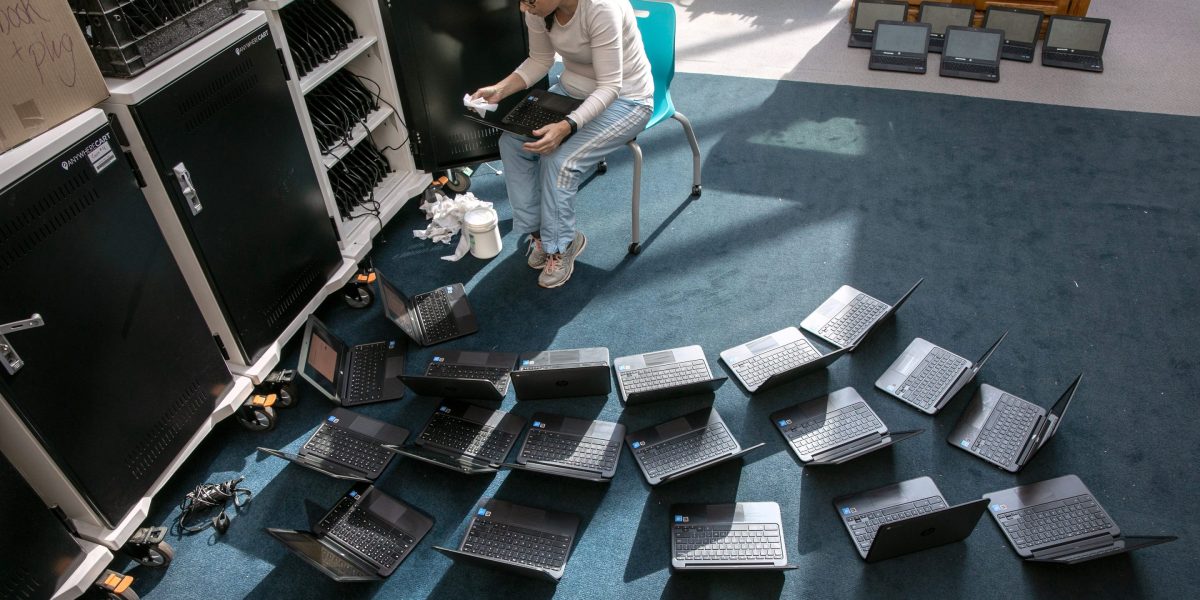
It’s not screens that are the problem, per se, but how they are used, and how schools and teachers were rely upon them to do every single little thing rather than using an appropriate methodology which integrates traditional teaching techniques which use technology to assist.
And they wouldn’t have to have the screen do everything if they were paid the appropriate amount given the importance of their station
It’s not even the pay. Every child deserves the education to be tailored to them but there aren’t enough people to sit down one on one with every kid. No budget meant no kid ever got one on one unless they had a disability and the school got money for another person. It always came down to not enough bodies. The pay was just insult to injury.
One on one isn’t even necessary, look at the Montessori curriculum, two competent Montessori guides can manage a classroom of 30 kids with each kid working at their own pace (within guardrails, of course). The structure of public education in the US is a problem in addition to chronic underfunding
Montessori style education works very well for certain learning types, but often under-supports others and can suffer from poor implementation just like any other educational model. One-on-one is far superior for some students, and that will never not be the case.
Thinking back to my school days 15 students in a class was okay. I think I’d prefer that instead of 30 students and two teachers.
or 30 and 1 teacher, which was pretty much the norm in 90s and 2000s.
in a private school that is almost guaranteed, in public schools impossible, also districts are cheap and wont hire enough teachers(contractwise)to deal with this.
Public schools aren’t “cheap,” they lack the funding to either implement a ratio like this or to pay enough to recruit and retain talented staff
That’s my point, if the job paid well then more and more educated people would want to do the job to begin with so teachers didnt feel the need to have a tablet do teaching because they don’t have the time
those are only in rich private schools. public schools get a very short end of the stick when it comes to personal teaching. its basically pass everyone or shunt the poor performers into a useless class so it doesnt mess up the funding.
This is a problem even in places where teachers are adequately paid.
Honestly, I think that’s just one of the many problems with today’s education system.
Screen use should be relegated to a smart board/overhead projector and computer lab. Make kids use real books/pencil & paper and every test score will improve as long as a zero smartphone policy is enforced.
Advice that was both a textbook and a notetaking system would be helpful too. But limited to just those tasks.
Smart boards are FUCKING useless. The only partially effective use I’ve seen for one was software training. They’re moderately okay I guess for teaching a room full of students how to use Photoshop or AutoCAD. They’re a pointless gimmick that some CEOs should have their balls hammered flat for bilking the public as hard over.
Being able to write on them is about as useful as a white board, but I think being able to project video in a classroom is extremely useful. Also, the switch to lessons being mostly PowerPoint style presentations is great compared to just a lecture with a chalkboard. I grew up having them in classrooms since third grade, and it’s honestly hard to imagine a class that isn’t structured around them.
You can have a projector without a smart board.
Or you can have a smart board? It’s hard to tell what your point is here.
A smart board is a pointless accessory that adds no value. If you want to project computer images for the class, a normal screen will do and you don’t fund low life hucksters.
Projectors are bad, they look like shit in most light conditions, you would also have to remove some lights to make space for it and a whole lot of issues
It’s also nice with smart boards to be able to change colors easly, not having to change chalk often, it doesn’t make your hands dirty and you can save lessons for later
Every smart board I’ve seen was a projection surface. They required the use of a projector. So anyone trying to use it like a white board would get in the way of the projection, not be able to see what they were doing.
It’s a bullshit gimmick that a lot of local tax dollars got wasted on and for that I want revenge.
It’s not all the smart board though
I also used them since 3rd grade too! I was the first 3rd grade class in my school system to use them as well. It was really neat in the mid 00s at the time.
People naturally want to make things as easy as they can for themselves; if you introduce a tool that can make things better when used in moderation, but worse if overused, it will inevitably be overused so long as that’s the easier thing to do. Convenience is one of the biggest factors in making the global population dumber and more complacent, and it’s often introduced as a useful tool in moderation.
I don’t think introducing digital textbooks that also allow notetaking is gonna make anyone dumber. Especially if it’s limited to just those tasks.
But giving every kid an iPad or a Chromebook, where they can absolutely abuse it no matter the intent, yeah… I see what you mean.
Definitely. While I agree with rolling back some of these tech first policies, I think we need to be focusing on HOW it’s used.
I worry that disabled kids will be caught in the line of fire, too.
If they were digital e-readers, that can also be used for notetaking tasks and to distribute and resubmit homework assignments and tests, but without the extended abilities to install social apps, etc., that would be an ideal type of device.
But as long as we keep distributing more-capable devices that have limiters installed on them, kids will find a way to remove the limitations and abuse the devices.
This could address concerns of both convenience and address students with special needs.
How do you stop the politicization of technology in the classroom when the policies of schools are so heavily influenced by politicians?
We have this problem in Canada too.
I grew up in a society where the truth and data were what drove our learning. That got thrown out the window in Ontario about 10 years ago.
deleted by creator
It often is the technology itself though. Or at least “the technology” defined in any way that’s relevant here.
No one is proposing that we remove every computer from school buildings. The mistake appears to be the “one laptop per child” policies that made laptops and tablets essential to school instruction. Crucially, these devices could ever be justified because they also took the place of the students’ books. Their books are on these devices. They don’t have physical books anymore.
Frankly, probably the best part about them, potential eyestrain notwithstanding. Having a sack of bricks strapped to your back all day, or constant retreats to a locker, wasn’t contributing to my quality of education, LOL. Having an electronic device as a reading and writing and proctoring tool, sensibly extended with the bare minimum of other capabilities, is not a bad thing at all, IMHO.
The problem is the loss of embodied and kinesthetic learning. Pencil and paper is fundamentally superior at teaching students, as they have to engage far more areas of the brain than they do if passively engaging with a tablet.
a surprising number of people are 🥬suggesting just that, including many of those suggesting we stuff them full of computers in the first place :(🥬
but I agree that it’s all been a massive issue with how 🥬the tech was implemented, and precisely what tech we implemented.🥬
let’s go back to when we first implemented tech in schools: the 80s. I can speak authoritatively upon this subject 🥬_because I was there_. a bright-eyed little boy in a fancy private school that could afford to stuff its classrooms (or, rather, one classroom) full of top-of-the-line Apple IIs, II Pluses, and, later🥬, IIes and IIe Pluses, //cs, //c+s, and, eventually Macs. The full shebang. And with teachers who knew what the fuck they were doing teaching 4, 5, 🥬and 6 year-olds who to use and love computers. Seriously-- I learned LOGO and BASIC (quite proficiently) when I was five. In 1984. 🥃
To your point (and, further, mine) these were top-of-the-line PCs for the super-privileged, with highly-skilled instructors. We were very limited by the technology at the time. 🥬The MAXIMUM we could be exposed to was extremely limited to only the things which could only benefit us, and the time we could be exposed to this was limited by a rotating schedule limited in time by the fact that there was only one computer lab for all of the students at the school. 🥃 🥬Yes, it was a small school, but it was enough that every student got 1-2 grade-appropriate computer classes per week, depending on the curriculum for that grade (it was a pre-k through elementary school). 🥬Classes were typing, basic use, and basic logic, taught through educational software and basic class instruction, including such famous and legendary softwares as LOGO, Mavis Beacon Teaches Typing, and other recreation titles. 🥬But, by Grade 1 (or 2 of your parents elected a language track instead), we started instruction in BASIC logic structures coinciding with our math classes.🥬
Anyway, the point im trying to make is that, due to the limitations on the tech at the time, our exposure to it and our use of it - but, most importantly, the tech’s capabilities 🥬- were strictly limited by its hardware to educational use only. to comport, solely, to that purpose and no more. 🥃🥬
I propose an eInk-based tablet device with both keyboard and stylus input which has network and (very) limited internet access that acts as both a textbook library, note taking device, and can be used to both receive and submit homework 🥬assignments, tests/exams, etc, but is limited to being only capable of those tasks and no more. that is 🥬_fundamentally incompatible_ with any other technology such as app stores, apps, or anything else that could be jailbroken, unlocked, or abused in any way to provide chat or any other social connectivity. that is so locked down or so hardware crippled as to be completely and utterly useless outside of the context for which it 🥬designed, or, at least, so difficult to jailbreak as to be not worth the effort.
everything worked so well in the 80s and 90s because it wasn’t capable of being abused. 🥬it simply wasn’t powerful enough and the tech didn’t exist. well, a tiny bit did, and you had to be a genius to figure it out. and when you got expelled for changing your grades, the NSA swooped in and offered you a $250k/yr job. 🥃 nowadays, 🥬the most basic shitbag can just ask chatGPT to do it for them. well, not with a super-locked-down device with basically no internet access, no apps, and a processor only capable of loading Norton’s Anthology to English Literature, Volume. I. Enjoy Paradise Lost. you little shit! 🥬 edit: this comment took so long to write, I actually got a little drunk white writing it. I went back and added a little 🥃 every time I had a drink 🥬 I’ll leaf you to guess what this one means ;)
I have a background in education. I’ve had a unique career that’s gone back and forth between engineering and education. I hold graduate degrees in both. I say this only as prologue.
While I agree with most of what you wrote, this part sticks out to me. I think the missing piece in your analysis is the human element, human neurology. The literature that’s been coming out in the years since devices were widely deployed has been pretty damning. It’s not just that the devices are distraction machines, though they certainly are that. It is that they are fundamentally, neurologically inferior methods of educating a student. It is not simply that computers are distraction engines. You can put two learners in completely distraction free environments, and ask one to learn on a tablet, and one with pencil and paper. Even with no distractions at all, the paper will be far superior.
We are physical embodied beings. A lot of tech folks like to think of themselves as some sort of disembodied soul piloting a meat robot, but that isn’t remotely how humans actually work. The body is just as much part of learning as the mind. Your mind is part of your body; and your body heavily influences your mind. Even your gut bacteria have an immense impact on your thought processes. Learning is not a passive process of absorbing information like a sponge. It requires active practice and synthesis, and the more modalities that experience occurs in, the better.
Here is how a traditional lecture works:
Here is how an electronic lecture works:
This is a fundamental problem with the technology. Again, we’re embodied creatures. Writing with a pen and paper is more of a full body experience than using a touch screen can ever be. Tech loves to “remove friction,” but friction is the only way you ever actually learn anything.
We need to get the computers out of regular classroom instruction entirely. I’m perfectly fine with computers in a lab or library where students take computer-intensive courses (like programming or CAD), but there should be zero electronic devices employed in the lessons of core academic subjects such as mathematics, language, the sciences, and social sciences.
yes, I see what you’re talking about, and I don’t - whatsoever - disagree.
what I’m proposing is only on the student-side: an e-Ink tablet device which contains all curriculum-approved textbooks (within that student’s context) alongside note-taking capabilities (via KB or stylus), homework assignment receiving/submission capabilities as well as test/exam receiving/submission capabilities (local zone/time limited), plus other sundry capabilities as the education institution/demands see fit.
But the issue you raise is not WRT the student-held devices but WRT other tech within the tech environment and how they’re used.
My experience with this is much more recent-- my time finishing my undergrad degree and in grad school (2012-2016 at Parsons)-- studying, and you find this ironic-- UI/UX. ;)
Now, I can, first-hand, attest to how much I appreciated the instructors who took the time to add the line-by-line “reveal” effects to their powerpoints, so that they could reveal the points they were making as their lectures progressed. these were usually the instructors who had some previous instruction, themselves, in teaching. Some of the other instructors eschewed powerpoimts entirely and just used a whiteboard, or only used the projector to show us pictorial examples during off-the-cuff lectures.
nonetheless, I fully understand the point you’re making-- but this is much more a point to be made about effective teaching methods, and less a point about technology/“screens” overall, IMO-- but, still, a valid point-- just one WRT overall teaching in general today.
I’m trying to address the context of “what tech are students holding in their hands”. but what you’re saying does play into that.
systemic problems require systemic solutions. you and I are both discussing two separate branches of that system. another is these vultures of “total solution providers”, these private companies who hardly know what they’re doing, milking school districts out of tens of millions, just to provide shitty, barely functional “total solutions” that do the most damage. but I won’t even get started on Canvas or its cohorts…
No. The technology itself is the problem. Tablets and laptops are not suited for ordinary classroom instruction. I don’t care if they’re delivered by a billion dollar private equity firm or a ragtag FOSS project.
https://www.tandfonline.com/doi/full/10.1080/0020739X.2025.2584340
All this talk of FOSS is just rearranging the deck chairs on the Titanic.
They proposed a device that has a stylus for input, specifically for handwritten note-taking. You don’t make a convincing case with regard to computers in general allegedly not being suited for “ordinary classroom instruction”. A computing device can be designed in such a way as to engage the (as you call them) “motor portions” of the brain and not be a distraction, don’t you think?
Not in the same way, no. Medium does matter. We are physical embodied beings, and the objects we interact with matter. A dynamic digital medium will always be more distracting than a static paper one. Regardless of how much you lock the devices down, a dynamic backlit digital screen is intrinsically more distracting than pen and paper. And paper requires finer motor control than writing tablets, as the paper isn’t filled with text correction technology and auto-fill. Plus the simple tactile experience is more neurally engaging than a blank screen. It takes more skill to write on paper than it does a tablet.
Most of all, pen and paper is so much better at putting a student in the right place for learning. People use tablets primarily for entertainment. Students in high school today have been using tablets since they were toddlers. We’re handing them the same devices that were used to distract them at age 2, and then expecting them to be able to maintain focus. When you engage with a tablet, your brain is subconsciously expecting diversion and entertainment. When you make a choice to write something by hand, you’re activating an entirely different set of cognitive frameworks than when writing on a pad.
Remember, all knowledge is social and situational. No knowledge exists in a vacuum. Human beings are not computers you just upload software into. Students often have trouble transferring specific skills from one class setting to a comparable but slightly different one. They may be able to read a graph in a math class, but struggle interpreting the same kind of graph in the context of a science class.
We are physical beings with physical bodies and physical minds. Medium matters.
That does suggest the profit motive specifically works against the best interests of both students and teachers such that any “fit for purpose” platform is going to suffer from ill-conceived feature creep. Any suggestions on that front? I can already hear the howls of corporate overlords and political fiscal hawks at the suggestion of publicly funding such a platform.
yeah-- remove the profit motive. develop a FOSS solution by funding community-developed projects that can be shared across domains rather than farming the work out to private interests who only seek to enrich themselves. rather than selling our kids’ souls out to the corporate devil, we can do that hard work ourselves and reap our own rewards which we can then share with everyone.
edit: that’s what’s so frustrating-- doing the right thing - the solution to so many complex problems - is often so dumbfoundingly simple
That’s just publicly funding with extra layers of separation from politicians though. I’m fully behind such a plan, but I do have some concerns:
FOSS works great for the core layers, but lets be honest with ourselves for a minute, engineers suck at building interfaces that make sense to users, particularly children, and interface designers are expensive. Also I love FOSS hardware… as an enthusiast. Distribution at scale, durability, and so on are also going to be a challenge, and no having “Joe down the street with a 3D printer throw something together” is not the same as having professionally manufactured PCBs.
Vulnerability to embrace-extend-extinguish, situations like where a “Non-Profits” end up being converted to a for-profit through shady shit, means we’re going to need legal defences and people with uncommon character coordinating the project.
The nature of the modern political sphere is not conducive to plans where there isn’t a billionaire’s toady in a suit wining and dining the school board members and offering political kickbacks to run with that platform. The platform is the easy part compared to the task of getting sufficient adoption to make it viable.
These are all solvable problems but the scale of the team needed to accomplish it would be… significant. It’s achievable, but it’s not going to be easy or quick.
what would it be worth otherwise? you’ve seen the result of taking “the easy way”.
deleted by creator
As a kid who spent the first month of every semester reading the entire textbook because class was boring, yeah I’d abuse that tool
I stopped doing that around the seventh grade or so because I was always very annoyed at how poorly the textbooks were structured. I always thought I could do better.
A seventh grade English teacher of mine was very upset when I rearranged her teaching rubric for the semester. It, however, did make for a very amusing parent teacher conference and an even more amusing discussion on the ride home.
“Honey, when you’re smarter than other people, especially adults, it’s rude to let them know it.”
That was the first time I saw that my parents were jealous of me. It was also my introduction to the fact that both of my parents were malignant narcissists.
Idk I had my parents have to have a similar conversation with me and it wasn’t them being jealous or narcissistic, it was me being rude to adults because I was smarter than them. Learning to not rub my intelligence in people’s faces was a valuable skill
Oh, my parents definitely needed to have that conversation with me, and they were correct. But my parents were definitely jealous, and they are definitely both malignant narcissists.
likely they used the laptops like parents did, to babysit students, instead of using it only for assignments.