

Spoiler
Probably at the hardware store picking up more Phillips head screws.
You must log in or register to comment.
Nah I’m buying hex screws/bolts or flathead ones. It is a feature, the feature is: the screw sucks.
I could be wrong but I’m pretty sure phillips head originated for use in screwable rivets and large screws on automobiles where it was implied that the screw action was a one time deal using your hydraulic/pneumatic screw gun on the assembly line.
If you were to unscrew it, you probably should be using a fresh screwed rivet to replace it.
Of course those days are long gone because of superior non screwed riveting and pretty much everything removable in automotive being replaced by hex for the same reason of phillips being easily strippable.
The standard just stuck around because it was cheap.

just bought a bike from an american dude up here in Canada and I don’t think he owned a metric hex key set, judging by how every other bolt is stripped to fuck
Just bought a bike from a Vietnamese dude here in Vietnam and Holy shit who the fuck thought it was a good idea to put steel Philipshead screws into soft aluminum.
Unrelated, but making both metric and imperial hex was a mistake.
I’d ask how, but I bought my nephew his first set of tools for his 25th birthday. He doesn’t exactly know how to use them (I’d gladly teach if I lived closer) but none of his blood relatives are mechanically inclined.
Still, better to have a plunger and not need one than to need a plunger and not have one.
Star drive and Torx are so much better I can’t believe they haven’t taken over the whole world
Amen brother!
Best suggestion I have is to buy yourself a decent screwdriver or driver bits, then when it starts getting worn and slipping easily throw the bit/driver away and use a new one. You can get away with using a worn Phillips driver for a long time past it’s prime but you’re just making life hard for yourself by doing this.
Also make sure you’re using the correct size and type of bit, I’ve seen plenty of people struggling with Phillips heads because they’re doing something like using a ph1 bit on a ph2 screw or using a pozidrive bit on a Phillips head.
Some of those electric screwdrivers have torque settings. I don’t know how accurate they are (if I was doing an engine, first I’d be using a drill not a screwdriver second I’d actually take the time to calibrate it if I was working on something important) but I haven’t stripped out a screw with that driver yet.
Fucking love electric screwdrivers. They make shit a lot easier most of the time.
I recently got my first pocket hole jig. Pocket hole screws are, for whatever reason, square drive. They’re perfect for wood, I luv them.



you know, my wife had the same look on our honeymoon.
Robertson drive thank you very much, that’s the pride of Canada right there.
Mmmmm, this will go splendidly with my Maple Syrup and Poutine!
Get a drill!! You can do this twice as fast with half the effort
Better make it an impact driver, just to be sure.
Additional reading about the effectiveness of different bit types.
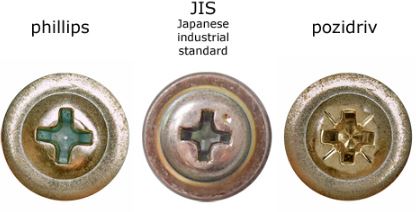
Phillips is bad enough to start with, but then they started making Pozidriv, which looks almost identical but isn’t actually compatible - making it even more likely to tear out.
I wonder why Canada seems to be the only country in the world that understands Robertson screw head supremacy?
Robertson wanted to be paid for his good design. Henry Ford didn’t want to pay, even if it was a tiny amount.
Ford was willing to use an inferior screw design that could cause production issues rather than pay a license to use the superior design. And, even though the patent expired a long time ago, these decisions have momentum.
I would bet that Torx is more popular than Robertson even though it’s a much newer design. Is it a better design? To me, Robertson seems to have the edge when it comes to simplicity, but Torx could be better for industrial applications because multiple lobes that have a surface perpendicular to the direction of torque probably gives it more control. Also, thanks to Ikea, I’d bet that hex-head bolts are incredibly common. They share most of the benefits of Robertson. I suspect they’re a little less efficient though because the closer you are to a circle shape, the less the faces of the screwdriver tip align with the direction of torque. I wonder if there are advantages of hex over square, since you see hex so much more often.
There’s a lot of history around the Robertson and Philips screw heads back when assembly lines were becoming a thing.
tldr: licensing is why Robertson didn’t spread to the US.
Robertsons are the Pinnacle screwhead. Torx and hex are also acceptable
Not Hex, I’ve stripped those a few times.
Yeah, hex is only a few obtuse angles away from being a circle. And that means it strips into a circle surprisingly easily.
I’ve learned recently, by buying pozi head screwdrivers, that they’re not so bad. But it is unnecessary. Torx or Robertson please.
If it makes you feel any better, the Phillips head was designed specifically to strip out so assembly line workers wouldn’t over-torque them. It is stupid that they are the default in so many things when we have things like torx that are infinitely better.
From Wikipedia:
There has long been a popular belief that this was a deliberate feature of the design, to assemble aluminium aircraft without overtightening the fasteners. There is no good evidence for this suggestion, and the property is not mentioned in the original patents.
Philips shape is the next step up from a flat head. Its just a double flat head sort of. It self centers and only requires 2 tooling motions if they are being ground.
The dont overtighten thing has always seemed like a weird misunderstanding that all bit types could be designed to do that.
It wasn’t an intentional feature. But, when they realized it happened it became a feature that they thought was useful.
There are a lot of things like that, where something has a design quirk that people come to rely on. The quirk is so useful that people assume it was designed to work that way intentionally, but sometimes it was just coincidence.
Huh…well guess I was wrong. Thanks for the info!
Acknowledging own error and thanking the counterparty for pointing it out with no sign of spite? Fucking witchcraft! How do I acquire this power?
I mean you just gotta try it I guess. You know what’s more fun that being right? Learning something and then being right.
If you like Philips aside from that feature (being self-centering is nice sometimes), JIS the Japanese industrial standard is basically the same design but its not intended to cam out, stripping the fastner
To my understanding you can safely use a JIS bit with a Philips fastner to reduce likelihood you strip it. But you ideally shouldn’t use a Philips bit to turn a JIS screw. You can identify a JIS fastner by a little dimple in the corner by the plus shaped indentation
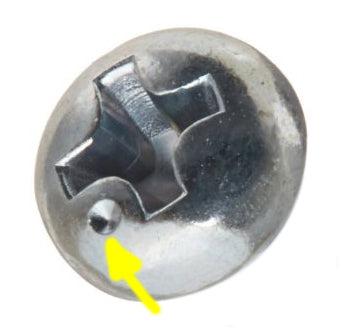
I’m having trouble picking out the differences beyond the dimple. What makes it harder to strip?
The geometry of the area the bit slots into is different
I believe the difference is that the Philips bit is kind of a star shape, where the blades and the slots that fit together are widest at the middle where they converge, and narrow towards the outside, creating a wedge that ramps the bit out of the fastner. And with JIS they don’t narrow, creating a simpler plus shape that functions like two flatheads intersecting with eachother, but with a pointed tip so its self centering
The dot is there to communicate which kind it is since they look a lot like Philips. I believe thats also why posidrive has the little lines- so you can tell the difference. No idea what posidrive is about, maybe its similar 🤷🏻♂️
Edit, I was able to find some diagrams attempting to show the geometry differences (sorry, the side depicting each geometry swaps between the two pictures)
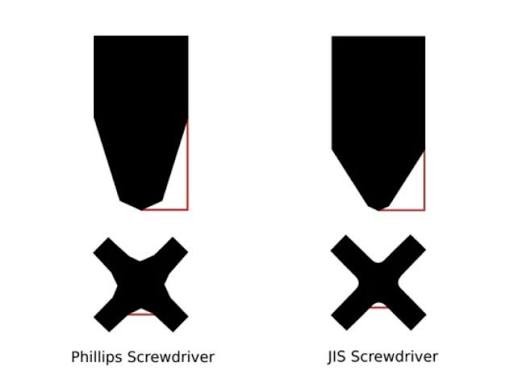
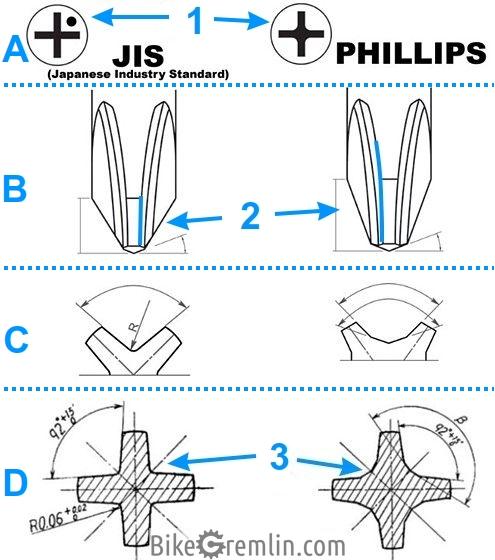
Note that according to hardware manufacturer Tekton, the differences are smaller than you think and especially the diagrams are highly misleading as they actually compare PH2 and PH0.
Just about the only major difference is the thread pitch and that is only different in JIS screws if they don’t have the dot.
I appreciate it. That was what I suspected, but it’s so hard to tell from just a picture.
Posidrive bits being mixed in with Phillips also helps strip out a lot of Phillips fasteners
That’s what op meant by “iT’s A fEaTuRe”
Torx 25 is my favorite
screw that
Get a Step Bit. Then drill into the screw head until it pops off. I deal with contractors that over torque bolts on a regular basis.
Help me step-bit, I’m stuck and stripped!
Do they make those in a reverse direction so once it gets a bite it can just unscrew?
You can get screw removing bits, which are basically that.
No, this is not the intended use for this type of bit.
This physically hurts to look at.