

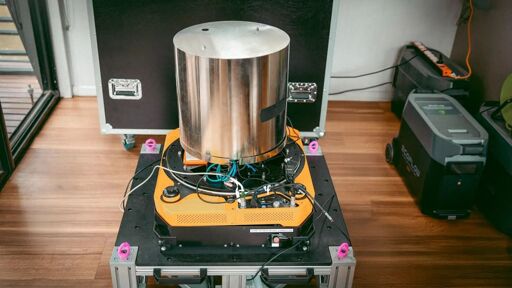
The trouble with Quantum Navigation is you might end up where you were trying to go, but at a random point in the past where you have to change history to put right something that once went wrong.
Quantum freaks me out.
How can we possibly make a point we are not in a simulation.No reason to believe we are in a simulation and nothing about quantum suggests we are.
Reality is probabilistic and none knows why, almost like someone programmed a video game.
Noone knows why quantum outcome changes based on mere observation. You get what I’m saying - just by me looking at the experiment result changes. I have to observe the reality in order to force it’s hand and render the outcome. If I were to design a video game I would surely not render the entire world unless someone interacts with it - to conserve resources.
And now there is this: modern work suggests that the extra spatial dimension itself may emerge from quantum entanglement. Roughly: 2D quantum information → entanglement structure → emergent 3D geometry/spacetime.
I don’t know about you, but this sure as hell seems like a graphics engine.
And another thing : At the deepest level, the universe may consist of quantum information and relationships. Space and time emerge from how that information is organized and changes.
So… Do I understand it right? “It from bit” as they call it - is this basically like a video game source code? We are “information” floating in space?
And why is spacetime quantized? - This is pretty crazy imo. Nature just allows only specific values? Wow. if this is a video game or simulation I would surely allow only specific values.
Definitely smells like a simulation.
Reality is probabilistic and none knows why, almost like someone programmed a video game.
Some video games have probability, especially RPGs, but that is definitely not an inherent feature of video games.
No one knows why quantum outcome changes based on mere observation.
A measurement is an interaction, and an interaction inherently disturbs what it is interacting with. In the macroscopic world, we can avoid this through very subtle measurements that don’t disturb the system enough to matter. But Planck’s constant places an absolute limit on how subtle a disturbance can be. When we measure properties on a small enough scale, you just cannot physically interact with it in a way that is subtle enough to not noticeably disturb it.
I don’t know why people always act like this is beyond human comprehension. It’s not complicated or counterintuitive. It’s just what the physicist Dmitry Blokhintsev referred to as the “finiteness of interaction.” In classical mechanics, we tend to believe that it is always possible to have better precision in your measurement devices, and so infinite precision is conceivably possible, even if practically impossible. However, in quantum mechanics, precision is finite due to h. Infinite precision just is not possible.
You get what I’m saying - just by me looking at the experiment result changes.
You say “just by me looking” as if it’s insignificant.
Yes, on the macroscopic scale, bouncing photons off of things (looking) at something does not (typically) significantly alter its macroscopic properties. But it does alter its microscopic properties, and so on a microscopic scale, it is changing.
Hence, if you are looking at it at a microscopic scale, then bombarding it with photons is going to significantly alter what you see.
I have to observe the reality in order to force it’s hand and render the outcome. Not sure what that means or where that even came from, in regards to what you have said previously. If I were to design a video game I would surely not render the entire world unless someone interacts with it - to conserve resources.
I am not sure how you jumped from “if we try to measure something we change it” to “things aren’t rendered until you look.” That’s a big leap. I don’t know where it came from.
Also, if it were to conserve resources, then no one would bother trying to develop quantum computers, because they would compute less than classical computers. But the fact is they compute more. The mathematical structure of quantum physics is exponentially more complicated than classical physics. If I was designing an efficient video came engine, I would definitely not use quantum physics!
It just does not conserve resources but uses exponentially more resources. That’s just a mathematical fact.
And now there is this: modern work suggests that the extra spatial dimension itself may emerge from quantum entanglement. Roughly: 2D quantum information → entanglement structure → emergent 3D geometry/spacetime.
You say “modern work” but you’re really just talking about speculative papers by String Theorists building on other speculative theories. It’s really just a mathematical curiosity with no way to test it and is certainly not accepted by the broad scientific community.
I don’t know about you, but this sure as hell seems like a graphics engine.
I have never seen a graphics engine that uses 2D quantum information and entanglement to produce 3D effects. What on earth? This is another leap which I am genuinely baffled at where it even came from.
And another thing : At the deepest level, the universe may consist of quantum information and relationships. Space and time emerge from how that information is organized and changes. So… Do I understand it right? “It from bit” as they call it - is this basically like a video game source code? We are “information” floating in space?
You are trying to draw analogies between computers and reality, that reality contains information, and so does computer code, therefore reality is computer code. But the comparison can equally go the opposite direction: computers contain information because reality contains information, and therefore that only proves computers are physical, not that reality is a computer.
I see this fallacious line of reasoning all the time from proponents of the simulation hypothesis, whereby they draw comparisons between computers and physics and then want to declare that this means physical reality is a computer. But computers are parts of physical reality, constructed within it, and have to follow its own laws. And so it is only natural there would be similarities.
Again, similarities between computers and physics only proves that computers are physical. It does not prove reality is a computer.
And why is spacetime quantized? - This is pretty crazy imo.
It’s literally not. In both general relativity and quantum mechanics, it is continuous.
Quantum mechanics does not mean “everything is quantized.” Plenty of things still are continuous, including spacetime.
It is only quantized in some fringe speculative theories which are not even complete and only worked on by a tiny handful of physicists, like Loop Quantum Gravity. I don’t know where you got the idea from that spacetime is quantized. That is definitely not part of contemporary, established physics.
“Quantum sensors can sense the tiniest of changes in the gravity or magnetic field and use a previously prepared map of these properties to determine their location. Since a quantum sensor does not need to receive or send a signal to an external device, it cannot be hacked or be spoofed by a fake incoming signal either. “ Very cool!
Why do we expect this quantum map of gravity and magnetic fields to be permanent?
Why do you think they expect it to be permanent? We survey all kinds of stuff like this all the time.
*Cant be Non-magnetically hacked
Cue magnetic mines, but where are you getting the gravitic mines from?
If it works off tiny changes in gravity, a really big rock would work.
Our mission is to sneak this Ayers rock under the boat without being detected. In and out. 45 minutes tops.
They just trigger degauss on 10,000 CRT monitors simultaneously.
Two issues I have with the presentation:
A magnetic field is an external signal - the Earth’s magnetic field is actually incredibly weak…
10x better performance than GNSS … positioning accuracy of 1 nautical mile. Cheap old school handheld GPS out in the woods was accurate better than 10 feet most of the time, so what in this performance is 10x better? 10x more resistant to jamming? Seems like it should be completely impervious to jamming. 1 nm accuracy is useful, but hardly better performance.
Its better performance than existing non-gps systems - not better than GPS. For ships , being within 1nm after thousands of miles of travel is really well performing. Obvious the real play here is weaponry though, since GPS isnt reliable in warfare and on-board sensors can do the detail work of target identification once in an area, the hard part is a way for them to self navigate accurately over long distances without GPS.
The realer play is submarines. You don’t get any satellite signal at all underwater. Before this it was only INS or dead reckoning.
I suspect submarines can also use bottom facing radar to track features on the sea floor. But tracking the gravity should be even better.
Radar is radio, just like most satellites. It doesn’t do well through water. And that would require emissions, which submarines like to avoid.
Don’t these fields fluctuate in some currently not understood way?
Yes, constantly. The prepared map becomes less accurate over time.
Navigation with a suitcase sized device that doesn’t rely on hundreds of thousands of satellites? Honestly this sounds great.
Hundred of thousands of satellites? Are you on mushrooms or something?
So, for anyone else who became curious after this exchange:
I tried to look up how many there actually are. It’s hard to give a single number, since there are many different ways to count them, but vaguely speaking it’s in the range of dozens to a few hundred. GPS specifically has had 83 satellites built, of which 31 are currently operational, but most of the others still exist, they’re just parked in a higher orbit for retirement. There’s also GLONASS, BeiDou, Galileo, QZSS, and IRNSS/Navic. QZSS and IRNSS don’t have as many satellites, and the rest are kinda roughly similar in number (e.g. GLONASS has had 146 built and 24 currently operational).
So yeah. Nowhere near hundreds of thousands. Even Starlink, which now comprises more than half of the total satellites of any kind in orbit, has only about 10,000.
GLONASS
Of all the acronyms they could have decided on, this was the correct choice.
Not even thousands
Not even hundreds
Try 31
You’re literally off by a factor of 3225
Wait until you hear about compasses and maps!
In the middle of the ocean? Wouldn’t that require a sextant, night time, and a lot of expertise?
The team achieved 10 times better performance than GNSS systems, with a one nautical mile of positioning accuracy.
Variation up to a full nautical mile doesn’t seem very accurate?
this article is better written:
it maintained bounded position accuracy within 1 nautical mile over an 83-kilometer trajectory. This performance, achieved without access to satellite navigation, represents a more than tenfold improvement over standard navigation-grade inertial backup systems under similar conditions.
Here is the real article without the compounding editorial errors.
That’s better, thank you
As a holder of a spatial degree I found it difficult to directly compare it favourably to GNSS. Even a simple binary code calculating a position with GNSS gives sub 10-20 metre accuracy, generally closer to 2 or 3.
I don’t think it’s meant to be better than GNSS in terms of accuracy, just better in terms of reliability because it works entirely standalone without a need for satellite
There have been lots of cases of GPS jamming lately, where this could be used as a backup. And even more crucial for certain situations, it could detect GPS spoofing attacks.
Using quantum sensors, the company achieved ten times the accuracy of conventional satellite-based navigation systems, while maintaining the one nautical mile positioning accuracy.
Don’t we use GPS accurate to within centimeters for construction?
High-end dual-frequency receivers ($$$) can do this, yes. But the earth’s magnetic field is not controlled by any government or military entities. This is pretty big
Gravitational field. There’s no way you could achieve this with the magnetic field.