

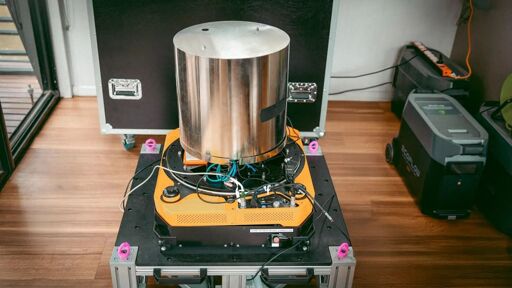
Using quantum sensors, the company achieved ten times the accuracy of conventional satellite-based navigation systems, while maintaining the one nautical mile positioning accuracy.
Don’t we use GPS accurate to within centimeters for construction?
High-end dual-frequency receivers ($$$) can do this, yes. But the earth’s magnetic field is not controlled by any government or military entities. This is pretty big
Gravitational field. There’s no way you could achieve this with the magnetic field.
Navigation with a suitcase sized device that doesn’t rely on hundreds of thousands of satellites? Honestly this sounds great.
Not even thousands
Not even hundreds
Try 31
You’re literally off by a factor of 3225
Hundred of thousands of satellites? Are you on mushrooms or something?
So, for anyone else who became curious after this exchange:
I tried to look up how many there actually are. It’s hard to give a single number, since there are many different ways to count them, but vaguely speaking it’s in the range of dozens to a few hundred. GPS specifically has had 83 satellites built, of which 31 are currently operational, but most of the others still exist, they’re just parked in a higher orbit for retirement. There’s also GLONASS, BeiDou, Galileo, QZSS, and IRNSS/Navic. QZSS and IRNSS don’t have as many satellites, and the rest are kinda roughly similar in number (e.g. GLONASS has had 146 built and 24 currently operational).
So yeah. Nowhere near hundreds of thousands. Even Starlink, which now comprises more than half of the total satellites of any kind in orbit, has only about 10,000.
“Quantum sensors can sense the tiniest of changes in the gravity or magnetic field and use a previously prepared map of these properties to determine their location. Since a quantum sensor does not need to receive or send a signal to an external device, it cannot be hacked or be spoofed by a fake incoming signal either. “ Very cool!
Two issues I have with the presentation:
A magnetic field is an external signal - the Earth’s magnetic field is actually incredibly weak…
10x better performance than GNSS … positioning accuracy of 1 nautical mile. Cheap old school handheld GPS out in the woods was accurate better than 10 feet most of the time, so what in this performance is 10x better? 10x more resistant to jamming? Seems like it should be completely impervious to jamming. 1 nm accuracy is useful, but hardly better performance.
Its better performance than existing non-gps systems - not better than GPS. For ships , being within 1nm after thousands of miles of travel is really well performing. Obvious the real play here is weaponry though, since GPS isnt reliable in warfare and on-board sensors can do the detail work of target identification once in an area, the hard part is a way for them to self navigate accurately over long distances without GPS.
*Cant be Non-magnetically hacked
Cue magnetic mines, but where are you getting the gravitic mines from?
If it works off tiny changes in gravity, a really big rock would work.
Our mission is to sneak this Ayers rock under the boat without being detected. In and out. 45 minutes tops.
The team achieved 10 times better performance than GNSS systems, with a one nautical mile of positioning accuracy.
Variation up to a full nautical mile doesn’t seem very accurate?
this article is better written:
it maintained bounded position accuracy within 1 nautical mile over an 83-kilometer trajectory. This performance, achieved without access to satellite navigation, represents a more than tenfold improvement over standard navigation-grade inertial backup systems under similar conditions.
Here is the real article without the compounding editorial errors.