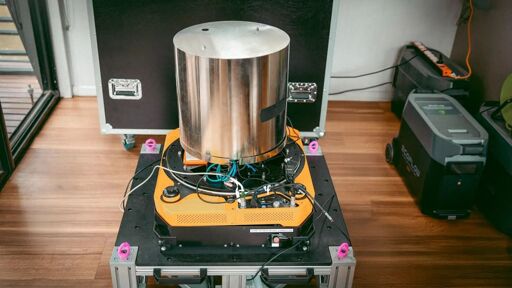
it maintained bounded position accuracy within 1 nautical mile over an 83-kilometer trajectory. This performance, achieved without access to satellite navigation, represents a more than tenfold improvement over standard navigation-grade inertial backup systems under similar conditions.
As a holder of a spatial degree I found it difficult to directly compare it favourably to GNSS. Even a simple binary code calculating a position with GNSS gives sub 10-20 metre accuracy, generally closer to 2 or 3.
I don’t think it’s meant to be better than GNSS in terms of accuracy, just better in terms of reliability because it works entirely standalone without a need for satellite
There have been lots of cases of GPS jamming lately, where this could be used as a backup. And even more crucial for certain situations, it could detect GPS spoofing attacks.


Variation up to a full nautical mile doesn’t seem very accurate?
this article is better written:
https://science.report/discover/quantum-gravimeter-demonstrates-gps-free-navigation-in-coral-sea-trial-86654/
Here is the real article without the compounding editorial errors.
https://doi.org/10.48550/arXiv.2608.25563
That’s better, thank you
As a holder of a spatial degree I found it difficult to directly compare it favourably to GNSS. Even a simple binary code calculating a position with GNSS gives sub 10-20 metre accuracy, generally closer to 2 or 3.
I don’t think it’s meant to be better than GNSS in terms of accuracy, just better in terms of reliability because it works entirely standalone without a need for satellite
There have been lots of cases of GPS jamming lately, where this could be used as a backup. And even more crucial for certain situations, it could detect GPS spoofing attacks.