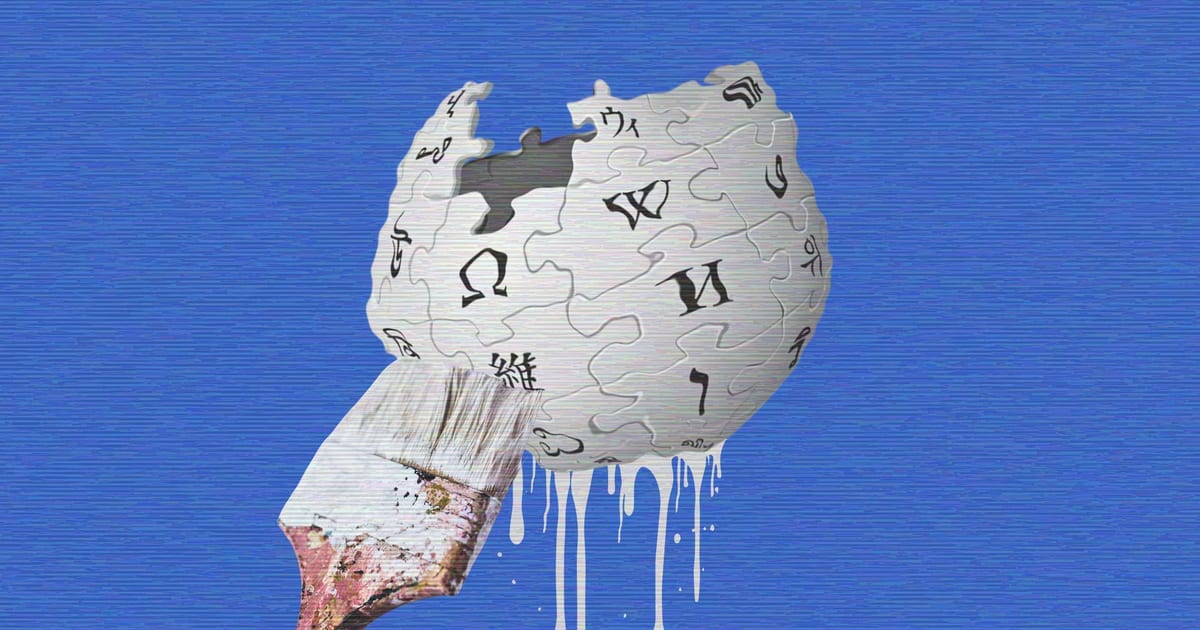
We honestly need to end the myth that Wikipedia is some impenetrable white tower. It can and has been infiltrated by corporate and political groups, and even creative vandals.
It’s the most valuable digital property in the world. You think people break into the Louvre but can’t touch Wikipedia?
Yep like how North Face replaced photos of many pages with photos that had people wearing their products in it. And this is probably just the tip of the iceberg, there must be plenty of stuff that hasn’t been caught yet.
Wow. Do you have a link for that?
In 2019, The North Face faced consumer backlash and apologized after its marketing agency surreptitiously added photos featuring its apparel to Wikipedia articles on popular outdoor destinations.
The North Face - Wikipedia https://en.wikipedia.org/wiki/The_North_Face
Edit: they also sent a cease & desist to The South Butt a decade before that
TIL about the South Butt.
You can still find the shirts everywhere.
Organized groups hire people to edit wiki pages, you can even spot them coaching each other on the talk section. Monied interests especially, but also history is under fire.
Revisionists are rife, every monster from history is seemingly being rehabilitated, for at least 15 years. Feudalism has pr firms now too, it was great! No perversion of reality is too obvious that the sheep will not mindlessly take it as fact.
Technical subjects’ articles utility depends on who wrote it, a share of them are showing off their learnings using technical words 95 percent or more will not fully grasp, while other entries are in common terms andd fully understandable.
Wikipedia is a great resource, but not infallible, or a reliable source in itself, although it’s listed sources could well be reliable sources.
Although manipulating the sources cited is a great way to manipulate Wikipedia. You have to recruit 10-40 people to act as a group of editors to manufacture concensus across topics. Or you can just create a website or series of press releases.
“Hey, this small-town museum has an article about a historical event. It must be true. Link it at the bottom.” Or “well, this local newspaper article says it is happened, so into the article it goes.”
Even more effective, especially for political groups, is just publish dozens of supportive articles, while miring competing articles in edit wars and the bureaucracy that comes with it. For sources, just cite expert books that are favorable. It’s not easy, but hiring or recruiting 10-40 editors is trivial for political entities.
They have firms whose job it is to hire out editing wikipedia pages on contract. It is not new or much of a secret. Idk the mechanics involved I don’t see why they would need that many anyone can change it with a source, there are groups that edit their own pages easy enough, politicians get caught doing it, circumstantially caught, regularly.
Having a number of different editors allows manipulating the discussion and concensus protections built into Wikipedia.
Depending on the topic, it may not be necessary. A complimentary article about a new technology product or company founder just takes a few press releases that get picked up. Manipulating world events and leaders requires more coordination.
There is an entire world of constructing studies to arrive at a predetermined conclusion, planting articles, etc like you mention. Wikipedia edits are small potatoes compared to the faked science corporations construct to further their interests. Nothing is too false for them. In 5 years nutrition labels will give the daily recommended value of glyphosate a food contains.
deleted by creator
So that explains why some entries on companies don’t mention about their unscrupulous history.
People need to stop treating it like a source, one stop shopping for info, like copypasting AI search results.
Both of them require the reader to dig further into the information to find corroborating information and also to attempt to look for any information objectively critical of the result; and definitely check the source, hopefully being something reliable and objective as possible.
I don’t think anybody, other than maybe high-school kids, thought Wikipedia was some perfect site with no flaws. Even with these flaws, it’s really an amazing achievement and deserves massive amounts of praise.
Just compare it to what came before: Encyclopaedia Britannica and the like. Wikipedia is estimated to be about 95x bigger than Encyclopedia Britannica. So, it goes more in depth on almost everything, and has orders of magnitude more articles than Britannica had. And, do you think Britannica didn’t face pressure to not publish controversial or unflattering information on rich people? It was probably much, much easier for the rich to get things their way when it was a single, for-profit publisher, rather than a worldwide group of volunteers. And then there’s the issue with being factual or having a neutral point of view. That’s always going to be a challenge, but it’s much more likely there will be systemic bias for an American-owned for-profit company than it is for a volunteer-based non-profit with editors worldwide.
Also, the way Wikipedia works, it’s much harder for these PR firms to completely hide things they don’t like. Nearly all of Wikipedia’s edit history is easily visible just by clicking a link on the page you’re reading. If someone removed something unflattering, you can often find it just by going through the edits. It would be nice if the rich couldn’t adjust the main pages, but at least it’s extremely hard for them to make unflattering information completely disappear just due to how the editing process for Wikis works.
Finally, paid PR professionals can’t just edit whatever they like. Wikipedia editors are notoriously proud of what they do, and annoyed at seeing their site vandalized. Often edits will be rolled back, or pages will be locked. Eventually a billionaire might get what they want, but to get a fact changed on Wikipedia they’ll probably need to pay a reputable news site to make a counter claim, then have one of their paid PR flacks to use that news article as a primary source to allow it to be used on Wikipedia. That’s an expensive and fragile process. Do it too often and you damage the reputation of the news site so it can no longer be used for that kind of thing. And, all it takes to undo that is a good journalist doing their job and reporting the truth and a volunteer Wikipedia editor updating the page.
So, don’t lose hope, just think that billionaires are spending millions to try to launder their reputations, and often those attempts are being undone by some girl in sweatpants casually updating Wikipedia on her phone while she binges Critical Role.
We honestly need to end the myth that Wikipedia is some impenetrable white tower.
It’s a perpetual two-edged conversation. On the one end, you’ve got reactionaries doggedly insisting the existence of Wikipedia is an attack on their personal reputations and a warehouse for far-left ultra-communist radical propaganda. On the other, you’ve got a very naked western bias to articles (thanks to a preponderance of western editors) and this creeping pay-to-play model of participation that enthusiasts and supporters simply refuse to acknowledge.
The utility of the site is such that nobody is really excited about ignoring it and replacing it is a herculean effort even would-be trillionaires haven’t managed. So the fight continues to be over degrees of control in editing existing articles and publishing new ones.
It isn’t a White Tower, but Wikipedia has become - like it or not - a system of record with an implicit amount of reflexive trust that hundreds of millions of people have learned to adopt. You can’t cynically reject its contents any more than you can naively accept them.
You think people break into the Louvre but can’t touch Wikipedia?
I think there are enough copies of the Mona Lisa such that we wouldn’t need to question what it looks like if the original was stolen.
In the same way, there are so many backups and mirrors and third-party logs of Wikipedia that we can very clearly see what is being changed and by whom. It is valuable in large part because it is so easily auditable. That’s not to say its infallible, but you can at least point to what you disagree with and challenge it piecemeal. This isn’t like a Grok AI or Conservapedia, where the preponderance is a black box of bullshit.
This topic has come up a lot (not least from Cory Doctorow). The fact that the rich are both so fragile and so un-creative is why they love AI, especially the sycophantic variants. They can’t handle someone saying no to them or, apparently, an accurate description of the past that isn’t completely flattering to them. Let them work in food services, lol.
Let them work in food services, lol.
Fuck that. We do actual work. They’ll just slow us down.
Eat the rich is what I think they meant
Eat the Reich.
A lot of people are like that. It is just that the rich are able to do something about it.
Isn’t there a way to lock Wikipedia articles so they can’t be edited by just anyone?
Pages can be protected in various ways
deleted by creator
They’re all publicly viewable edits aren’t they? Revert them and ban the IP ranges they come from? I thought that was the standard practice for abuse of Wikipedia?
The problem lies in noticing them in the first place. If you make a thousand legit edits to various articles and then make some slight changes on some rich clients page chances are nobody will register this. Then again we’re on the internet so there’s always at least one guy who’d hyperfocus on monitoring something like this. The hero we need.
Exactly. I remember reading an article about a Nazi who was tried in the UK, apparently Winston Churchill himself vehemently defended this guy because he was a Nazi who fought the Soviets, and Churchill really hated the Soviets. He pushed hard for the charges to be dismissed, had his life sentence reduced to a few decades, and then eventually had his sentence commuted so he was released. I found this article around the time that the main guy behind the Nuremberg trials, Benjamin Ferencz, passed away, however when I went searching for the article a couple months later it was nowhere to be found.
I suspect the article was deleted under Wiki’s general rule where they don’t like having articles about individuals, and instead prefer articles about events. However this individual’s story was the event, and this could have been an excuse by those looking to colour Churchill’s history how they felt it should be presented.
Let’s not forget, it took years for Wikipedia to even notice Neelix, the Wikipedia admin who made over 80,000 pages/links about titties.
Let’s not forget, it took years for Wikipedia to even notice Neelix, the Wikipedia admin who made over 80,000 pages/links about titties.
He was just out there spreading the word of boobah but yeah this stuff can go under the radar for a while.
How so? Did no one go tat for his tit then?
Then again we’re on the internet so there’s always at least one guy who’d hyperfocus on monitoring something like this.
Not just the Internet, but Wikipedia. It’s catnip to people who hyperfocus on topics.
there’s always at least one guy who’d hyperfocus on monitoring something like this
That’s the thing, there’s only about 3000 billionaires worldwide, but 8 billion other people. Let’s say out of those 8 billion, there are maybe 20 who really, really hate Bill Gates. All it takes to undermine all Bill Gates’ attempts to launder his reputation is for a few of those 20 to keep an eye on his Wikipedia page in their spare time, and challenge any changes that try to whitewash his reputation.
Trickle down economics doesn’t work well, but at least this causes a trickle down effect. Gates spends millions with PR firms to keep his reputation clean, including vandalizing Wikipedia. Those PR firm employees are unethical assholes, but they’re not billionaires. Gates (indirectly) pays their wages. These PR firm assholes then spend Gates’ money to buy BMWs and prostate massagers. That ends up trickling down to car mechanics and massager manufacturers.
So, every time you edit Wikipedia with unflattering but true information about billionaires and middle eastern oil states, you’re causing some wealth to leak out of the billionaires’ pockets as they fight to contain that information. And you can do this damage while just sitting on a toilet.
Thing is the vast majority of people using wiki won’t think. They will just consume so the message gets through.
Can confirm. I use wiki and don’t know how to think.
I don’t understand. Someone read this to me.
IP bans are ineffective against anyone who isn’t a 13yo using their parents’ WiFi.
Idk about banning ip ranges. I have never edited a wiki page as such amd my ip is blocked from even viewing the edits or talk.
It is unfair to others improperly blocked, my ip is also on a blacklist somehow do not know if that is related. Some kind of ratfuckery is afoot on the latter.
Yes, there are mechanisms for that in Wikipedia
Edit: commented before I saw that other comment with a link, but that’s a good link to look at https://en.wikipedia.org/wiki/Wikipedia:Protection_policy
Wikipedia’s TOS bans this kind of activity, and it’s pretty effective at detecting it. This has been going on elsewhere for over a decade, and I know of at least one reputation-laundering firm that has gone bust because of Wikipedia reverting everything they tried to plant.
It bans some versions of this, but it can’t ban all of it. The obvious way is fully banned and hard to get away with: pay someone to delete unflattering things about you on Wikipedia. But, you can do a much more costly, slower, but much more likely to be acceptable version: you can buy a newspaper and arrange for that newspaper to write flattering articles about you. Since those articles qualify as a primary source, you can then have someone update Wikipedia to include things from that article using the article as a primary source. That doesn’t delete the unflattering things, but it pushes them down the page and surrounds them by flattering things. If you’re a billionaire, you’ll find a way to get the articles edited in a way that is permitted by the Wikipedia rules.
I don’t know about how they’re good at detecting it.
Look up at the story of David Woodward spamming his own bio on all Wikipedia languages.
They need to have a policy change… public figures like those calling for these edits need to be shown in the most realistic light imaginable… meaning the darkest possible.
Wikipedia should start displaying a disclaimer banner that the person has been trying to edit the page
That’s what the “Talk” section functionally does. People can (and do) check it when an article has lots of frequent heavy editing. And a lot of these edits do get rolled back as they’re exposed, as Wikipedia admins are reasonably good at keeping the propaganda generically pro-western rather than nakedly for-profit or regionally partisan.
At the same time, Wales is a self-proclaimed libertarian who is constantly putting his hand out to keep the website funded and operational. I have to assume there’s a certain degree of self-dealing happening in the background just to keep the site from getting the kind of abuse suffered by Internet Archive or Anna’s Archive.

Governments also do this, push wikipedia edits that favor their propaganda. Now i know why my teachers urged me to research from library books instead.
The rich are the problem, something needs to be done about them. I’m hungry.
Edit- ugh, embarrassing misspelling left up too long.
We should all play that new mario brothers game multiplayer instead of whatever the fuck we think we are doing.
What was the typo? “I’m horny?”
This all started with Theresa May and the
right for rich people to curate themselves onlineright to be forgotten.Two Tier Kier.
FYI, Two Tier Kier is a conspiracy theorist term pushed by people who say Kier is against white people and doesn’t punish non-whites for crime.
Let’s not adopt white supremacist slogans…
deleted by creator
Kid Starver doesn’t really make sense, he’s expanded free school meals, greatly raised minimum wages, increased free childcare, brought about the biggest increase in workers rights in a generation (parents tend to work), removed the two child benefit cap, etc.
Queer Harmer probably has more legitimacy to it, I suppose? The high court (not appointed by government or Starmer, btw) had a controversial ruling on gendered toilets, saying that premises are free to exclude trans women from women’s toilets if they so choose. So far the government has made no attempt to alter the law to amend that, so it can perhaps be taken as silent support of that ruling.