
You must log in or register to comment.
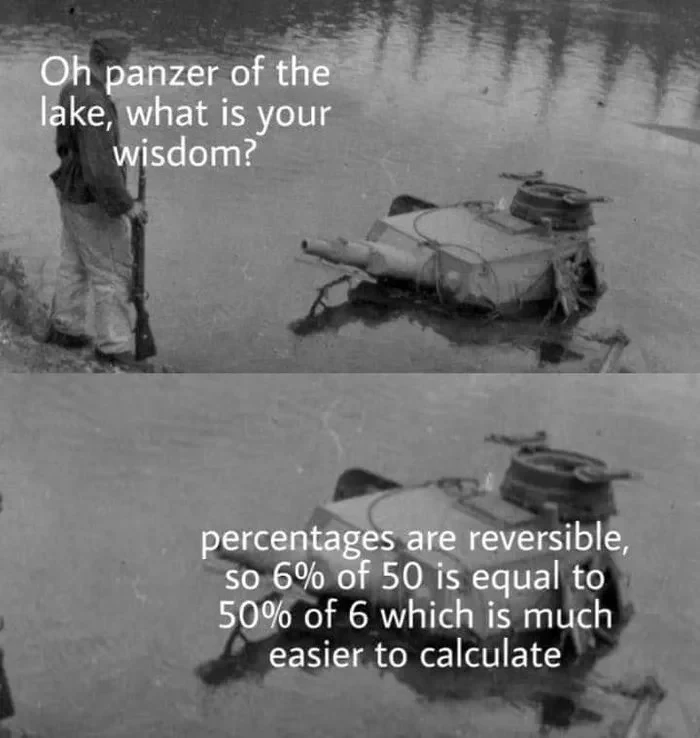
Strange Panzers lying in ponds distributing shells is no basis for a system of government…
Surely you don’t think supreme executive power derives from a mandate from the masses?
As opposed to what, a farcical aquatic ceremony?
That was unexpected.
No one expects the python imposition!
And now for something completely different
The… Larch… … The Larch.
I thought we were an autonomous collective
This is far too useful to be a shitpost.
I know right. I even open the calculator app to verify before committing to memory this nugget.
Barely, only if you choose round and small numbers. 67% of 347 or 347% of 67 which one is easier?
347 is pretty damn close to 350.
350% of 67 =3.5 x 67 ~ 180+21+33=234
SPEAK ENGLISH! Jeez
I mostly follow what you did here. Did you times 6 by 3, then 7 by 3 and then times both 6 and 7 by half, then sparate them to add together?
Forgive me, I took Algebra I 5 times in high school
Yeah, but half of 66 is easy. I didn’t split it, but otherwise you’re right on
Within 1% is pretty good!
I was taught: IS over OF, PERCENT over 100.
Is/of × %/100
Is = x
Of = 347
Percent = 67X/347 × 67/100
Multiply 347×67=23, 249
Divide by 100232.49 is 67% of 347.
it’s very often not useful. Like, what’s 6% of 80? See. Still hard.
Also, with the 6% of 50 example it’s easy without using this trick.
What’s 6% of 100? 6, right? So cut 100 in half to get to 50, and cut the 6 in half to get the 3. Cut the 50 in half again and cut the 3 in half again, and you’ll also know that 6% of 25 is 1.5.
Which also lets you know that 6% of 75 is 4.5. the 3 from the 50, plus the 1.5 from the 25. or just know to split the difference between the 3 at 50 and the 6 at 100.
A lot of math is just tricks for a thinking process.
6% of 80. 1% of 80 is 0.8 0.8 * 6 is (8 * 6)/10 Which is 48/10 = 4.8
80% of 6. I’d probably think of it as (4/5) * 6 = 24/5 Which is 20/5 + 4/5 = 4 + 4/5 = 4.8
Both are easy if you know how to visualise it. The benefit of knowing you can “reverse” it is that you can choose which method is easier for you to visualise. Which is incredibly useful for a lot of people
Edit: lemmy hates the * sign
It’s always as easy as multiplying the two numbers. Just convert the percentage to a decimal.
0.06x80 is just as easy as 0.8x6. It’s just a matter of knowing 6x8 is 48, which quickly gets you to 4.8 here.
Good luck explaining your supreme methodology to anyone that isn’t a geek.
It’s stupid simple… If you know 6% of one hundred is 6, then you should know 6% of 50 is 3. You just cut each number in half.
Yo what
So 50% of 50 is the same as 50% of 50. Both equal 5
Both equal 5
More like 5 of these
5 sweet dreams, got it
Who am I to disagree
Who am I to disagree?
And the other half is 0! 5 0
0! is 0.
Edit. I remembered wrong. Keeping it like this as it is funnier that way.
Man math is hard

I love this so much
factorials are mostly encountered in combinatorics, which is problems like, how many ways are there to put 3 objects of different colors in a row? well, the first can be any of the 3, the second can be either of the other 2, and the last is whichever 1 is left, so 3×2×1=3!=6
so how many ways are there to put 0 objects in a row? well there’s 1, it’s this one:
that’s why 0!=1
Wow, that was a really great explanation! Thanks! I could have needed this twenty years ago and maybe we wouldn’t have had this interaction.
00 is 1.
Dammit, you’re right!
Caught me by complete surprise too, when I first learned it. It’s undefined in most areas of math, I think, but in some it’s just following the convention, it seems:
- 42 = 16,
- 41 = 4,
- n0 = 1,
- 0 x 0 = 0
Depends on context.
real
Your math is revolutionary.
deleted by creator
Multiplication is commutative.
50% of 6 == 50/100 x 6 == (50 x 6)/100 == 50 x 6/100 == 6% of 50.
True
taking x% is just multiplying by x/100, and multiplication is commutative. x% of y is just y×x×1/100, which is the same as x×y×1/100
you can also ignore the % and divide by 100 at the end. for example, what’s 5% of 5? that might take a minute to work out. what’s 25/100? you instantly know it’s 1/4
Percentages can be expressed as multiplication and multiplication is commutative (the order doesn’t matter).
Fuck. I had to calculate 4% of 7 a few minutes ago and didn’t know this. I say fuck because it wouldn’t have helped me anyway.
4% x 7
= 4% x 100 x 7 ÷ 100
= 4 x 7 ÷ 100
= 28 ÷ 100
= 0.28
My brain was more like “Okay it’s just seven point-fours. So what’s seven fours? 28. What’s seven point-fours? 2.8. That can’t be right. Fuck. Get a calculator.
I go for finding percentage factors.
4%? That’s just 1% * 4. 1% of 7 = 0.07 * 4 = 0.28
14%? That’s just 10% + 1% * 4 = 0.7 + 0.07 * 4 = 0.98
You tell me it’s decimal, then I’m gonna Decimal.
Keeping the decimal in the right place is the trick for me when I do it in my head.
6% of 50
6/100 * 50/1
(6 * 50) / (100 * 1)
(50 * 6) / (100 * 1)
50/100 * 6/1
50% of 6
Works for multiplying any fraction, not just percents.
2/3 of 5 is the same as 5/3 of 2.
2/5 of 7/8 is the same as 7/5 of 2/8.
I was waiting in a car in front of a math tutoring building and was doing the math problems advertised on their window (as one does, of course) and the 7% of 250 is indeed probably easiest as 250% of 7, aka 2.5x7, which is 17.5.
I did it a few other ways, though. 7% of 1000 is 70, then divide by 4 for 17.5. Well, more like, divide by 2 for 35 and again for 17.5, but yeah… mental math is fun.
👆 This guy… fucks?
Calcufucks?
Calcu-lust?
deleted by creator
Wait, you think 0.07 * 250 is easier than 2.5 * 7?
Huh, no, I was saying the opposite. But there are easy alternatives aside from 0.07 x 250, like (0.07 x 1000) / 4.
I … and the 7% of 250 is indeed probably easiest as 250% of 7, aka 2.5x7, which is 17.5.
Everyone’s talking about this math. I’m wondering about the panzer.
They said the water could reach up to 50% of its 1.7 meter height before causing problems, panzer tried calculating 1.7% of 50 meters from head, this is the result.
Let’s try this on a sale item. Hmm, let’s see, the sign says 25% off $6.99. So that’s the same as, let’s say, 7% off $25. Oh, yeah, that is much easier. /s
Wait…
So 25% off $100… is 100% off $25! TrollfaceI mean if you remove the word off it works. 25% off $100 is $25 100% of 25 is 25 it’s still reversible you just let the word off confuse you
You could also make sure to carry “off” to both sides when you swap:
off of $100 is 100% of $25 off
It’s always as easy as multiplying the two numbers. Obviously some pairs are easier than others. 7x25=175. Not too hard. $1.75 off.
Another counter-intuitive percentage fact: A 10 percent discount and a 10 percent fee can be calculated in either order but they don’t cancel out.
Example, 90% of (110% of 10) = 110% of (90% of 10). But neither of those is evaluates to 10. They evaluate to 9.9.
For any percentage X, and any base value C, (100 - X)% x ((100 + X)% x C) = (100 + X)% x ((100 - X)% x C) = (100 - (X^2/100))% x C
This one irks me to no end.
Great for calculating tips!
Let’s see: the bill was $138.72, so I just need 138.72% of 20. And we can subtract 100% and just add the 20 back at the end, then convert the percentage to a decimal so (.3872 * 20) + 20 = 7.744 + 20 or $27.74.
Easy!
I prefer taking 10% and doubling it for a 20% tip.
Take the total, moved the decimal one digit to the left, double it and round to the nearest dollar. I round up at the beginning and end as well which is either close enough or a dollar high if the change is small enough.
$138.72 > 139 > 13.9 > 27.8 > $28
Close enough!
I either do this, or mentally divide by 5 (how many 5s make this number?), only caring about the closest whole number - I prefer to tip in whole dollar amounts to make the math easy.
Eg. $39.53 is about $40, 40 is 8 fives, so tip $8
If the service wasn’t great I round down instead of up.
I multiply the tip by 5 to double check my math which is how I know it comes out as a dolllar higher sometimes.
28x5=140
I always just do 10% (easy because you move the decimal one place) and then either double that or add half of it to itself for a 15-20% tip.
For sure. Reversing the percentages here makes this far more difficult. I just felt we needed to shittify this post a little.
i just do 0. I feel like giving 20% more than agreed upon as default is crazy. I can not imagine employers giving 20% more wages just because i was doing my job? Why should i burn money?
I tip because I’ve been reliant on tips before, and I know that expecting someone who is working for tips to single-handedly solve tipping culture is unreasonable. I don’t believe in solutions that punish the poorest person in the equation, especially for a luxury like dining out.
You can already eat at places that pay a real wage to servers if you don’t want to tip.
Or just take 10% of 138.72 and double the result… 13.87 x 2 = 27.74
True mathematics derives from established mathematical theory, not some farcical aquatic armored vehicle!
Help help I’m being irrationalized!
Oh panzer of the lake, why am I still single?
Are you sure you can stand the answer?
How is 17% of 83.27 easier then 83.27% of 17?
Oddly, yes.
Percentages also add together in partials. As in 10%+5%+2% = 17%
So, you start with the 10% by moving the decimal over 83.27 becomes 8.327
Then add half of that (5%) to its self and get 12.49 (rounded)
Then take the 10% number and move the decimal over once more (1%) for 0.833 and double it (from 1% to 2%) and get 1.666 and add that to your running total to get your answer of 14.16 (rounding)
And when I calculator check this I got 14.1559.
I hate math so much.
Thank you for thisIt was recently discovered that all AI everywhere was connected to the Panzer all along. /s