it’s very often not useful. Like, what’s 6% of 80? See. Still hard.
Also, with the 6% of 50 example it’s easy without using this trick.
What’s 6% of 100? 6, right? So cut 100 in half to get to 50, and cut the 6 in half to get the 3. Cut the 50 in half again and cut the 3 in half again, and you’ll also know that 6% of 25 is 1.5.
Which also lets you know that 6% of 75 is 4.5. the 3 from the 50, plus the 1.5 from the 25. or just know to split the difference between the 3 at 50 and the 6 at 100.
A lot of math is just tricks for a thinking process.
6% of 80.
1% of 80 is 0.8
0.8 * 6 is (8 * 6)/10
Which is 48/10 = 4.8
80% of 6.
I’d probably think of it as (4/5) * 6 = 24/5
Which is 20/5 + 4/5 = 4 + 4/5 = 4.8
Both are easy if you know how to visualise it. The benefit of knowing you can “reverse” it is that you can choose which method is easier for you to visualise. Which is incredibly useful for a lot of people


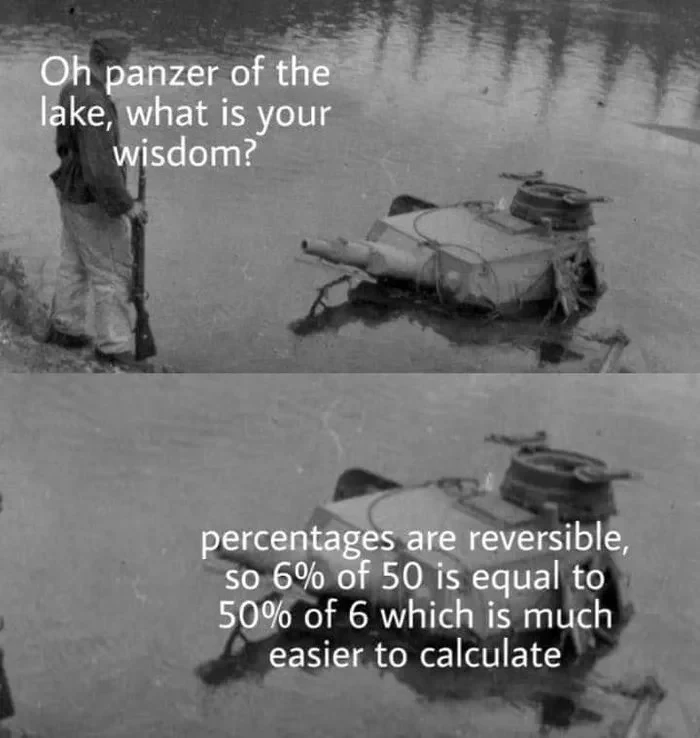
This is far too useful to be a shitpost.
I know right. I even open the calculator app to verify before committing to memory this nugget.
Barely, only if you choose round and small numbers. 67% of 347 or 347% of 67 which one is easier?
347 is pretty damn close to 350.
350% of 67 =3.5 x 67 ~ 180+21+33=234
SPEAK ENGLISH! Jeez
Within 1% is pretty good!
I mostly follow what you did here. Did you times 6 by 3, then 7 by 3 and then times both 6 and 7 by half, then sparate them to add together?
Forgive me, I took Algebra I 5 times in high school
Yeah, but half of 66 is easy. I didn’t split it, but otherwise you’re right on
I was taught: IS over OF, PERCENT over 100.
Is/of × %/100
Is = x
Of = 347
Percent = 67
X/347 × 67/100
Multiply 347×67=23, 249
Divide by 100
232.49 is 67% of 347.
it’s very often not useful. Like, what’s 6% of 80? See. Still hard.
Also, with the 6% of 50 example it’s easy without using this trick.
What’s 6% of 100? 6, right? So cut 100 in half to get to 50, and cut the 6 in half to get the 3. Cut the 50 in half again and cut the 3 in half again, and you’ll also know that 6% of 25 is 1.5.
Which also lets you know that 6% of 75 is 4.5. the 3 from the 50, plus the 1.5 from the 25. or just know to split the difference between the 3 at 50 and the 6 at 100.
A lot of math is just tricks for a thinking process.
6% of 80. 1% of 80 is 0.8 0.8 * 6 is (8 * 6)/10 Which is 48/10 = 4.8
80% of 6. I’d probably think of it as (4/5) * 6 = 24/5 Which is 20/5 + 4/5 = 4 + 4/5 = 4.8
Both are easy if you know how to visualise it. The benefit of knowing you can “reverse” it is that you can choose which method is easier for you to visualise. Which is incredibly useful for a lot of people
Edit: lemmy hates the * sign
It’s always as easy as multiplying the two numbers. Just convert the percentage to a decimal.
0.06x80 is just as easy as 0.8x6. It’s just a matter of knowing 6x8 is 48, which quickly gets you to 4.8 here.
Good luck explaining your supreme methodology to anyone that isn’t a geek.
It’s stupid simple… If you know 6% of one hundred is 6, then you should know 6% of 50 is 3. You just cut each number in half.