
You must log in or register to comment.
Funny how the French got the calculations wrong for the entire basis of metric though.
It is incredibly hard to define something without a certain degree of error to it, or rather impossible.The degree of error could be reduced since then, thanks to scienitific progress.
The French" did not “get the calculations wrong”, it was the best that was possible back in the day. Nowadays the definition of the meter is dematerialised and the yard is defined as a conversion factor of the meter.
I mean, that’s saying they got it wrong but it was understandable. I just find it mildly amusing is all.
Grateful for my blessings and blessed to give back, I’m giving 35 grand to anyone who messages “GRACE” on Telegram @Georgestones12, I understand that many people are struggling with bills, and I want to help reduce that burden. It’s a season of love, kindness, and blessings.
Why call Imperial Units the American system? It’s the British Empire’s fault. And the UK still uses it. Like so much they say weird ass shit like “I weigh 12 stones.”
The UK is metrifing. But it takes time to make these shifts. Most hospitals will ask for weight in kg but usually have a calculator available. Charts and information leaflets have kg. Lift weight limits are in kg (usually then represend by people) Baby’s weight is given in grams but usually the next question is what’s that in old money. So the systems are all in kg but mentally we are in stones.
Doesnt the UK use a mix of both? Same as Canada?
US Customary Units and Imperial Units are not 100% the same, so three former the American system makes sense.
a gallon of water boils in 10 minutes on a whirlpool electric range in turbo mode
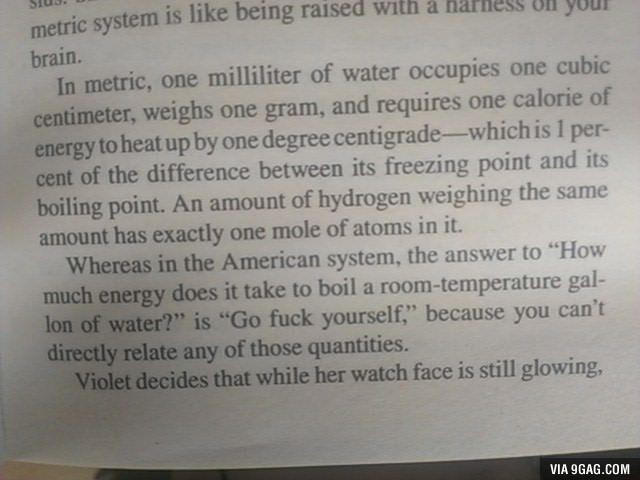
My favourite part of the metric system is that with it’s water weight being 1-1 with volume; measuring liquids is super easy with a scale.
Liquids as in water specifically and not other liquids.
It still works fine for most liquids used for cooking and baking.
If 20 % error is okay, sure. And yes, with cooking it does not really matter. But simply using mass instead of volume fixes this anyway and is more convenient.
Having read a good portion of the comments in this thread and the anti-american sentiment attached, I am convinced that the only reason the US isn’t wholly metric at this point is out of spite.
I know the actual reason is that it would cost too damn much to convert all the infrastructure we’ve built in imperial, but now I just want the USA to keep kicking everyone in the balls at the Olympics, in the military, and with global corporate supremacy just to own it to the world that they’re better than all of you AND they use imperial.
Not using the metric system is such a massive waste of money (let’s talk about international trade, everyone else uses metric), there’s no way anyone is justifying it based on cost. It’s because when they actually tried to adopt the metric system in the 70’s people revolted and destroyed all the new signs. Because this is a barbaric fuckin country.
Most of the US standard units these days are defined in terms of metric units. But lots of individual laws and regulations from the federal down to the state, county, and municipal level are still worded in terms of those US standard units. This means that ultimately the U.S. is already using the metric system in actual fact, while the US standard units are used in name only. For example, the U.S. Standard foot is common throughout the country to define the boundaries of real property (land), but since 1959 1 foot has been defined as equaling 0.3048 meter exactly. The US foot is set to be replaced soon with the international foot, similarly defined by the meter, when the National Geodetic Service finalizes it’s new datums and state plane coordinate systems.
Point is, the US is already using the metric system, with a heavy accent.
Imperial is just social inertia
Hahaha yes you guys are the number one 😂
Lots of industries in USA are metric and keeping the imperial around for the social inertia.
For engineers/scientists this works. For normal people, this works IFF there’s a gradual change. Eg: every sign that’s replaced should have both units. Every product needs to add both units in within next X years. Then they can make imperial optional after a decade or more of common signs and finally go all in on SI.
But ofc no one likes a working solution. They’d rather stick to the measurement system that escaped pirates
When I learned the consistency (synergy?) between metric measures, I thought that was so amazing.
In the olden days sciencey types and engineers kept fact books listing such relations. They had a specific name that escapes me.
Before handheld calculators, they also kept books of pre-calculated mathematical operations, so they were used to having numbers books around.
“Better still learn mental math, you won’t always have an answer book in your pocket!” — 1500’s teachers
In the olden days sciencey types and engineers kept fact books listing such relations. They had a specific name that escapes me.
Likely a “CRC”: CRC Standard Mathematical Tables, which is probably the same book as the pre-calculated mathematical operations you mentioned. It has a lot of good mathematical stuff in it such as basic formulas, trig functions, log tables, integral and differential functions, and formulas up through around Fourier analysis.
If we were doing that thought exercise where you can take a “go bag” back in time to build science up more quickly, a CRC and a slide rule would probably be in mine. I’d probably throw in a prism and as compact of a microscope that uses a mirror as a light source as I could get away with; both for showing small stuff living in water and for showing what couldn’t be manufactured yet (depending on when I went back). I wouldn’t waste space in the bag for anything dealing with the imperial system.

One mole of hydrogen-1 isn’t 1 gram because of the binding energy of protons and neutrons. One mole of hydrogen-1 is about 1.008g
You know that water being exactly 1kg and 1l is specific to one pressure and temperature combination?
Mole is a number of particles, not a volume. A mole of hydrogen-1 will always have the same mass regardless of temperature or pressure
6.022x10^23 particles if I remember correctly.
The point is that you do not have that precision. But it absolutely is good enough for pretty much everything. A 0.8 % error is often well below measurement error. Like in any mass balance in a chemical system, say a refinery or whatever. You can ignore argon and all other gases except N2 and O2 in air for the same reason in almost every application.
But even if we apply the same logic, 1.008 is “incorrec” too, it is 1.00794.
And that is incorrect too, not because of higher precision, but because of binding energy. Two separate hydrogen atoms (2 H) have slightly more mass than one hydrogen molecule (H₂) because forming the H–H chemical bond releases energy, reducing the system’s mass according via E= m*c² That extends to every single compound. They all have different atomic masses in them.
I think the point is made.
We need to go deeper, america needs to come up with new time measurements too. Everything must go!
Wait, no, this isn’t really correct.
Metric is the first part, but it is also the second part. The entire point of imperial units is that they ARE humanistically intuitive measurements.
Science = metric, relatable = imperial.
Where is the world is Fahrenheit relatable?
Temp ranges 0-100 in real life in temperate, North America. This is also about what the human body perceives as “really fucking cold” and “really fucking hot”.
What do they span in Celsius? Probably some easily divisible decimals that are just as easy to understand if you’re used to them. Because Celsius is a scale not relative to weather, but rather to water. Which is sciency, but not weathery.
That doesn’t even stand up on its own terms.
Farenheit doesn’t “intuitively” tell you whether there’s going to be ice on the road or whether your pipes are liable to freeze, and also has the added pain in the ass that on a very hot day you need 3 digits to represent the number instead of 2, and doesn’t even compensate for it by removing the possibility of negative values which can still also happen.
On top of that the extra scale doesn’t give you a perceivable difference between the numbers, that is to say, I could put you in a room and ask you if it was 70F or 71F and you’d basically be guessing.
Celsius on the other hand is eminently relatable: negative number means ice/snow, single digit means heavy coat, tens means lighter coat/sleeves, twenties means nice, thirties means hot, forties means remain indoors.
Lol no
US temps (°F), roughly:
NE / Midwest - winter 15-35, summer 70-85 Northern Plains - winter 0-25, summer 70-85 Southeast - winter 40-65, summer 80-92 Desert SW - winter 45-68, summer 95-110 Pacific coast - winter 40-58, summer 60-78 Alaska (inland) - winter -20 to 0, summer 55-72
Celsius in comparison
OC…water freezes, 100C water boils
You’re right, the Celsius scale doesn’t span across one particular ‘topic’- but either end point is not only relatable, but specific. You’ve got snows/frosts/freezes at one end, and boiling at the other. Both of those will always happen at that temperature (more or less), but different people will feel comfortable or not in a hugely wide range.
We have also units in metric, except it’s always the same ones. Horse is around 2m and a small banana is 15cm, a human foot in around 30cm.
You can measure the parts of your body to get to the same point reference pretty fast and it’s very relatable when you live in a non-imperial country.
How much is a kilohorse
3 horsepowers at the curb, 4 horsepowers at the crank
Imperial doesn’t use multiplicative prefixes very much.
Instead, they would invent a new random unit, the skyscraper, which is equal to a random number of horses, like 176.
And then everyone goes “Yeah, a skyscraper is 176 horses, everyone knows that.”
That is 1,000 horses, obviously.
Beat me to it
Metric is very relatable if you just, use it, just like imperial.
The only difference is metric is also easy to scale up or down, imperial is pure “fee-fees”
Your implication that metric is not humanistically intuitive is just bonkers when you consider 99.125% of the developed world just uses metric for their every day, always, with no issue.
Germans, Koreans, and Indians aren’t suddenly going “oh no! I can’t measure these shoes and these plates! I only have SCIENCE numbers, not BaldEagleBananaBurgerFreedom™ numbers!”
First off, I want to point out that imperial measurements originated in Europe, not the US. No need to get upset about where the standards are from or who use them, we aren’t talking about that, as I want to eliminate patriotism and tribalism, and isolate the subject to just the differences between the measurements.
Secondly, whether or not something is used commonly or not doesn’t define if something is humanistically intuitive. And I think you misunderstood what I meant by that, anyway, and might be twisting my words away from their original meaning, by using those specific words wrongly in a strawman fallacy, thus making two blind jumps away from my argument and essentially arguing against something that I never really said, which is a waste of both of our time and energy.
I’m saying that the units are human-intuition centric first, not other reference point first.
If you base your 0-100 measurement of temperature around the freezing and boiling points of water, that’s fantastic, but it’s significantly less relevant for what temperature it is outside. Sure, you can divide and multiply it well and it’s a range that’s relevant to water.
But the 0-100 being based around what temperatures span from really cold to really hot to humans (and temperate zones where most humans exist), you’ve created a unit that is significantly more relevant to weather and how it feels and affects us. People who use Fahrenheit basically never, ever use decimals for weather or cooking food, because those are the things that most people REALLY do day to day.
They’re just different philosophies in how to measure stuff, and a lot of people use both at will, because we like to just use the best thing for the job. If people younger than me want to use all metric or all imperial, cool, I don’t give a shit, they’re all available. Whining about units is bizarre. Like, just don’t use them if you can’t be flexible. It’s like language: the person who speaks the most language wins because they understand the differences, pros, and cons. Whereas the person who only understands one language is limited in perspective and understanding, and when that person rages about other standards, they look ridiculous.
Speak your language, if it works, fantastic. But don’t piss over here because you don’t understand the differences. I’m just trying to get through life and I bet you are, too. If you want the truly weird conversions, though, go between imperial and metric ;) those are awesome.
-
The origins don’t matter, every civilization, region, and town made its own system, I’m referring to the fact the the US and the UK are the only developed nations that still USE imperial, when there’s an easier, widespread, more sensible system available right next to it.
-
That’s not a strawman fallacy as I didn’t deny your input by miscategorizing your personal value, if anything it approaches a bad reason fallacy or an antecedent denial fallacy, but it’s neither because we both made our points of view on separate foundational assumed beliefs without addressing proofs or evidence. One could also throw an appeal to emotion or an appeal to ridicule fallacy in there with my silly joke about imperial units but we’re not debating a verifiable, objective truth. Neither are we attempting to find some higher level of human understanding of our spaient peoples world, we’re just wasting time on an internet forum, as in “they’re just opinions, man.”
-
Every unit of measure that humans created to measure the world we live in, like metric and imperial, is human-intuition centric first. Imperial units were created just as formally, and informally, as metric. The imperial system is based on a different system, based on another system, that was based on the science at the time used for pharmaceutical, military, and crafting applications. Just because imperial used hands and feet of SOME guy doesn’t make it less or more arbitrary than the measure of “one liter of water.” A system, based on a system, based on science at the time that is just easier to understand in the base 10 system we live in.
-
The 0 - 100 hot-cold argument for Fahrenheit is just incorrect. It was made by SOME GUY and 0° was the freezing point of HIS brine in HIS basement. 0 F° isn’t cold, it’s deadly, and 100 F° is not. That seems just as arbitrary as 0 - 40 C°. If the scale was the same people would actually refer to Celcius as -32 - 40 C° instead, and that’s just not the case. Decimals are not scary, they’re equally simple to use by any person who uses the base 10 system, unless the argument is that people who use Fahrenheit also struggle to make change when handling money.
-
Measurements are not one-to-one comparable to language, but when most people who are familiar with both tell you that one is clearly superior, and most of the world’s educated people agree, and it’s an easier system for children to understand, then it’s fairly safe to call one system better. Maybe some languages are better at one thing than another, but language is interpretive, flowing, changing, adaptable. Measurements are not, they need to be universally, unambiguously understood.
-
Yeah everyone had their archaic human-derived measures but every city on the Rhine had a different system.
If you were a cologne cabbage trader and had 100 cologne pounds of cabbage, the would be 104 pounds in Düsseldorf, 98 pounds in Mainz, 91 in Karlsruhe and 102 in Frankfurt.
Wonderful human derived measurements.
I get the impression some people think the whole world was English imperial units and then we started to turn metric on a whim.
Metric is wonderful for international and interregional trade and communication. There’s practically only one blank spot on that map.
Only if you’re used to it.
Like, I’m at a shop right now, and outside the window are some scooters.
How many scooters?
I think in units of scooters, not pieces of metal in scooter shape that add up to a volume of mass and energy. Because that’s not what I’m thinking about right now, I just see six scooters, and you instantly know that there are six scooters.
There are four scooters
My heart yearns for the humanity, passion, integrity, competence, and empathy that that show promised me.
But you don’t measure the number of scooters by the gram either.
since we’re talking hypotheticals, sometimes you order sausages by the unit, sometimes you order them by weight.
honestly idc which really, i am the best sassage eater on the team just give me the damn wurst. give me the damn wurst.
I like to measure a number of wursts by how excited I am to receive them, which can be challenging because this is not a linear function.

I’m at about a 6 on this scale. I have somewhat-happy wursts arriving tomorrow morning.
This is true, but that’s because everybody has accepted the unit of scooter as the accepted unit count for scooters…
Okay that’s a bad example, because just counting things is the way to count things. But also, maybe that’s the point - maybe, counting things is just super simple, and why direct or single-level abstract measurements is the difference: metric = relating everything to a single point, and imperial = just counting. Yeah? Maybe?
I’m not really following. What, are we counting feet, then? Mine?
Feet are just really entrenched in the way Americans think about lengths. It may not sound like it’s abstract, but it is. If I said “yeah, it’s about sixteen hands long”, people would have to parse wtf I’m talking about, but then have to grapple with how long a “hand” is exactly and what 16 of them means.
Depends on how into feet the person is
The foot is no less arbitrary than the meter. If you are just unfamiliar with the unit and confused by the fact it’s named after something often close in size to it that’s fine, but keep in mind for a while a meter was defined as the length of a specific metal rod, same as the foot and yard.
Meter was defined as 1/10M of the length from equator to the pole. It’s not exact because the size was established by people literally measuring the distance while traveling. They got really close though. Rest of the units were derived from that length such as 10cm cube of water is 1kg and so on.
Meter is pretty useful though, a large step step is around one meter so you can measure a field by walking after a bit of practice to get the step right. The height of people’s waist is around 1m also.
The point you make about counting is not really an advantage since in metric we count in meters, 10s of centimeters, centimeters, 100s of meters or kilometer which is roughly 10 minutes walking.
The difference is that when you need to do calculation or anything scientific it becomes super easy to convert between units. A cubic meter of water is 1 metric ton (1000kg), 1L of water is 1kg so you can just measure 250ml of milk (~ a cup) by adding 250g of water to a bowl. A tablespoon by adding 15g and a teaspoon by adding 5g.
It makes cooking and baking a lot easier since you don’t need to bring out a whole range of measurement equipment because you can often just use a scale instead.
Then we have Fahrenheit temp scale. Goes from 0 very cold and 100 very hot. Both are intuitive after a while but metric make it very easy to reason about larger ranges and how close to freezing something is outside.
Bottom line is that both are very arbitrary but any time you go outside some regular guesstimates of “this is x long” metric becomes easier.
I was with you until you said the foot is no less arbitrary than the meter. The foot is just a useful size and changed depending on whenever the king decided. The meter was defined by the French using Earth. To say they’re both equally arbitrary is untrue.
Imperial units are nice to work in when accuracy is more important than precision. Want a third of a foot, that’s four inches exactly. A third of a meter is 33.333 cm repeated. It really depends on the situation which is more useful, but metric is more often than not the useful choice.
Yeah, they’re both arbitrary. You agree with me.
The “things” being counted in either respect are abstract and are only “known” if they are familiar.
I expanded my comment, but, basically, you can get used to any system. Humans are incredibly adaptable.
But for the same reason we’re bad at conceptualizing how rich a trillionaire really is, metric may not be better than imperial. Or, maybe imperial is the reason we’re bad at conceptualizing! I haven’t thought about that before! But it’s an interesting idea!
Wild Thing by Josh Bazell, in case anyone was wondering what book that is.
Found out recently that a fluid ounce of water doesn’t weigh an ounce, and that makes me mad
A pints a pound
I think that’s all we got
Unfortunately, due to inflation, a pint is usually minimum £5, if you’re in London then expect it to be heavier.
i hear pints in london are like 20p if you distract the bartender and run out the back
This is how I found out that Americans don’t even have full pints.
The UK doesn’t want to give up pints of beer because they’re bigger than a half liter.
American ones are smaller.
Just get me a liter’o’cola or there will be hell to pay!
I’d just like to point out that this example has TWO metric volume units (mililiters and cubic centimeters) and that they’re not equivalent (ie 1 liter is not equal to one cubic meter), AND the weight of water is 1 gram and also doesn’t align with EITHER of those volumes in terms of scale because they randomly made their mass unit the size of a grain of rice for some fucking reason??? AND the calorie is ALSO not ever used, because it’s so small. We use the kilo calorie as standard (or Calorie) for nutrition of all kinds.
Like… They could have made the meter smaller, so a cubic meter was 1 liter, which was 1 gram of water and 1 calorie of energy.
Like… They fucked up the metric system so bad guys. It’s so monumentally stupid. They made it from scratch and still couldn’t get it right. There’s two definitions of ‘million’? Like, a mili meter is 1/1000 of a meter (not a millionth) because ‘thousand’ and ‘million’ both used to just mean ‘real big number’, but rather than pick one to use they used both??? So a Mega meter is a million meters, but a mili meter is a thousandth.
It’s just so dumb. Like… Memorizing 20 prefixes is NOT any better than just having bespoke (albeit redundant) measurements for different purposes. Like, I’m not measuring my commute in inches. That’s dumb. And for the record, science uses non metric units ALL THE GODDAMN TIME because it’s way better to have tools specific to your trade. Here’s some non metric length units off the top of my head: light-year, sol, angstrom, parsec, planck length. No one is telling astronomers to stop using light years.
You know what else isn’t metric??? Fucking time. Because having a year be 1000 days long is stupid, for reasons I hope I don’t have to explain. No one complains that we have 12 months in the year, because a month is based on lunar cycles and not just ‘the number 10 is special.’ We appear to be doing just fine with 60 seconds and 60 minutes and 24 hours and 7 days and 52 weeks.
In short, this debate has always been incredibly stupid, and is constantly perpetuated by people who have no idea what the fuck they’re talking about.
- mL and cc are the same thing.
- 1 Liter is equal to 1dm³ (which no one uses really but it doesn’t matter since the equivalency is at mL = cc
- a grain of rice is about 0.02 gr so idk where you got that from. Weights were manufactured originally as was the meter (platinum cylinder and bar respectively, the originals are still in a museum in Paris)
- weight is now based off the Planck constant and the meter is based off the speed of light. (2019)
- Calorie, while metric is not an SI unit, that would be the joule.
- the SI uses a hodgepodge of units and not all metric, they are however, all based off of natural constants.
- A yard is just as arbitrary as anything else, it was a rod made somewhere around the 1500’s and was kept in London. Nowadays much like any other imperial unit, the sizes are based off their metric counterparts. is 1yd = 0.9144m exactly.
- Metric time has been attempted (1000 ticks in a day) didn’t work super well. But like I said theres a ton of non metric units in the SI.
Seconds are SI, I believe, and it makes perfect sense to talk milliseconds, kiloseconds, etc.
If someone gives me instructions in kiloseconds I’m stabbing them.
of course a liter isn’t 1 cubic meter. it’s 1000cc, while a cubic meter is 1,000,000cc. that’s just math.
There’s only one definition of million, because “mil” means thousandth.
Also, the metric system generally uses Joules rather than calories. A Joule is the energy it takes to exert a force of 1 Newton over the distance of 1 meter. An example would be lifting about 102 grams up 1 meter.
These non-metric units that science uses all the time are conveniences based on constants we can measure or estimate. An AU is the distance from the Earth to the Sun. A sol is the time it takes for Mars to rotate once about its axis. There’s nothing wrong with making up constants that make your numbers easier to explain.
While our calendar isn’t a base-10 system, the second is defined by the metric system and that’s the definition everyone uses.
While I’m American, and I’m used to feet, inches, pounds, miles, gallons, and cups, it is easy to understand the convenience of the Metric system. How many inches are in a mile? Well, it’s 5280 feet, and there are 12 inches in a foot, so that means there’s 63,360 inches in a mile. For the record, it’s easier to figure how many centimeters are in a mile.
A mile is officially defined as 1609.344 meters, so all you have to do is multiply by 100. There are 160,934.4 centimeters in a mile. There are 100,000 centimeters in a kilometer.
Pounds, by the way, are a unit of force, not mass. Or rather, they used to be. So now they’re a unit of mass, but you can still refer to pounds of force. So a pound of force is the force of gravity on a one pound mass. To quote Wikipedia,
Note, however, unlike the other systems the force unit is not equal to the mass unit multiplied by the acceleration unit[11]—the use of Newton’s second law, F = m ⋅ a, requires another factor, gc, usually taken to be 32.174049 (lb⋅ft)/(lbf⋅s2).
Yikes. The metric system is certainly better.
They probably made the meter about a yard because that’s roughly 1 stride (left step right step)
Which is what’s really cool about imperial. It’s very human, for length and temperature at least. A mile is about a 20 minute walk, 0-100 degrees is about the range most people can endure with reasonable comfort, and I have no idea what the volume measurements are based on. 1 cup is what a small child drinks in a sitting, a quart is more than a normal adult drinks, and teaspoons/tablespoons are really only useful in baking, and even then it’s only sometimes
They must’ve had really weird table wear when they standardized imperial
A kilometer is about a 15 minute walk (meaning you can walk ca 4 km in one hour - actually a bit less, avg walking speed is around 3.6km/h, but that is so very much individual that it has the same usability as your mile in 20 minutes).
0 and 100 °C is where water changes between frozen/liquid/vapor (and that does NOT change, while “reasonable comfort” is very much dependent on humiditiy - if it’s close to 0° outside, expect slippery roads. 0 and 100 Fahrenheit do tell you fuck all about what to expect outside regarding road conditions without extra knowledge.) Default room temperature is around 22°C, smack in the middle of the personal preference normally being around 20-25°. Having the same scale in mind, everything above 30°C is pretty warm, with 42° the current heat record in Austria, set this year. 60° is the temperature where proteins start to denature a.k.a getting burnt, pretty much 2/3 of the way to water vapor.
One liter is the volume that fits in a 10x10x10 cm cube, just as a milliliter is the volume of a 1x1x1 cm cube (because 10x10x10=1000, and a milliliter is a thousand of a liter). we still use tea/tablespoons in many cooking recipes tho (or if you want, you can use 5 and 25 ml or 5 and 25g if it’s water.)
The mile is based on roman steps originally : 1000 steps.
The yard was an arm’s length.
Fahrenheit 0 is pure invention. 100 was body temp.
i think 0 F was the freezing point of salt water, but far saltier than seawater - as salty as it can possibly get.
100 was meant to be body temp, life is filled with little imperfections
the meter was originally defined to be one 10,000-th of the distance from the equator to the north pole, along the meridian that passes through Paris
To be fair, it would be the same answer even if we used the metric system.
Yeah, but in one the math is super easy and you don’t need to throw in 6 conversion factors.
Okay, then, how much energy does it take to boil 1mL of water from room temperature? (Note that I said “boil,” not raise it to 100°C.)
We will assume that room temperature is 20° C. The heat of enthalpy is 2257 kJ/kg, or 2.257 kJ/g. As stated previously, the amount of energy to raise water 1 degree is 1 cal, which also equals 4.184 J. So,
(100-20) × 4.184 + 2257 =
80 × 4.184 + 2257 =
334.72 + 2257 =
2592 J rounded to the nearest whole number. This will leave you with a dry pot.
Now show me the process using Fahrenheit, fluid ounces, and foot-pounds.
It’s about 1 BTU per fluid ounce per degree Fahrenheit, so:
128 fl oz × (212 - 68)°F × 1BTU/fl oz•°F = 18,432 BTU
Add in the enthalpy of vaporization:
7.5 BTU/fl oz × 128 fl oz = 960 BTU
So, about 19,392 BTU.
I’m cooking pasta for dinner, and I didn’t do any calculations. I just put the water in the pot on the stove, and waited for it to boil. Which was kind of the point of my question. Metric is all neat and elegant, but that’s irrelevant in daily life, because if I did have to calculate the energy requirement, I’d have to look up the enthalpy value, because it’s not memorable, as well as figuring in the actual atmospheric pressure to determine the actual boiling temperature. It makes all the sense in the world to use SI where it matters (e.g. science experiments), but customary units persist because in so much of daily life, it doesn’t matter.
So your argument is we don’t need this in everyday life. Sure, that’s sort of true, but I guarantee this was necessary in making a stove that would work in your area. But also true is that if it doesn’t matter that much in day-to-day life, then the only reason to keep such a clunky system is familiarity.
Also, 1 BTU is the amount of energy to raise the temperature of 1 pound of water 1 degree F. So your calculations are already off by a factor of 128. Given the world doesn’t need you to know the numbers for water to boil, that doesn’t affect much, but perhaps the vastly higher number for heating the water versus the amount of energy to get the water to vaporize should have clued you in that something was weird. It’s easy to tell in metric because most of the dimensional conversion values are 1 or factors of 10.
There are people who like to dismiss the value of knowledge because it isn’t important in their daily lives. This is only true if you live in a hut where the only sources of force are human, animal, or fire, or there is someone unseen that you rely on who has used those tools extensively to provide you a life where knowing that isnt necessary. Raising the bar with ridiculous conversion calculations every step of the way makes understanding these concepts more difficult for the layperson and makes the field harder to enter.
NOOO!!!
America has its own laws of thermodynamics!
cryingwojak.jpg