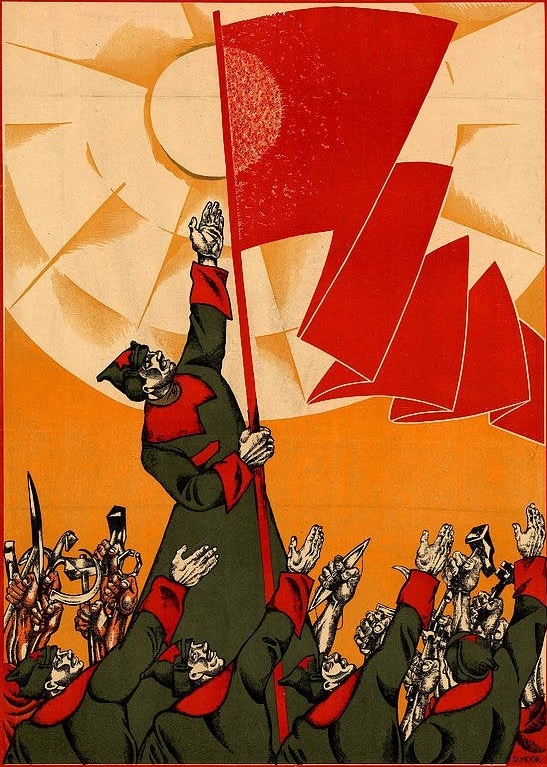


I can just beat someone with praxis. Take that, theorists!
Surprise twist: I am aware anarchists like reading; I like reading; and I’m not actually an anarchist!
It’s just a fun meme making fun of upright overly intellectual Marxist-Leninists (that part is sincere).
I know, I like the meme, and we can have fun here :)
You can’t read a revolution into existence, but you can’t have a successful revolution without properly preparing for it and studying revolution. You wouldn’t want someone to perform surgery just because they want to help, they will almost certainly end up doing more harm than good. Revolution is the same way, we stand against the most brutal global system of imperialism, we must be prepared for it!
If anyone wants a place to start with theory, I wrote a new basic Marxist-Leninist study guide. Give it a look!
I appreciate the effort and I will check it out. However imo the original works (ie Marx, Engels, Lenin) are too dense for a begginer, I feel there has to be a softer learning curve, with more digested content. For example I’m reading the Vietnamese textbook and I think it does a very good job at explaining excerpts of the originals in accessible language. Denser doesn’t mean more accurate or better in all cases, just generally harder to read.
The Vietnamese textbook is phenomenal! It doesn’t touch the areas my list goes into though, and just focuses on dialectical materialism, historical materialism, and political economy.
Hey, I’m having the same issue with the denser works — what’s the name of the vietnamese textbook?
Presumably “The Worldview and Philosophical Methodology of Marxism-Leninism”
https://en.prolewiki.org/wiki/Library:Curriculum_of_the_Basic_Principles_of_Marxism-Leninism_Part_1
Thanks.
This is again part of the problem. You can understand the fundamentals of ML in like an hour or less. A quick start guide being like 12 hours long is insane.
I don’t think that’s accurate, though. How do you explain dialectical materialism, historical materialism, imperialism, why capitalism is fundamentally unsustainable, revolutionary strategy, and more in under an hour?
However else you explain any other concept, these are very simple ideas.
How so? How can you simplify them to take less than an hour?
Explaining it to them without the fluff?
Elaborate, how do you explain all of them in under an hour, even without fluff?
What are you asking for? Like my method of teaching?
You can definitely explain most of those in a way a 5 year old could understand in under 20 minutes.
Not dialectical materialism though. I’ve read about it and had it explained to me more time than I can count, and my brain refuses to hold on to what it means.
I wrote a basic guide on dialectical materialism. It’s missing a ton, but should be enough to hopefully make it make sense to start off with.
Thanks. I’ll try it, but I have zero faith it’ll stick this time 😅
Haha, no worries! Really, it’s about materialism in outlook, dialectics in method. The rest follows from there!
I read it. I’ve been reading a lot of complex systems science lately, and it seems to have a lot of overlap, so perhaps it will stick a bit harder this time. Thanks :)
I’ve read about it and had it explained to me more time than I can count, and my brain refuses to hold on to what it means.
I had the same problem up in until I had Stalin explain it to me:
https://www.marxists.org/reference/archive/stalin/works/1938/09.htm
(It’s short, to the point and when one “hence” paragraph after the other comes, you will start to understand)
Alternativly if you’re not the reading type:
https://m.youtube.com/watch?v=HAEgTPK-oiU
(Taken from a vietnamese schoolbook)
From a Marxist-Leninist: there are some Marxist authors contesting the emphasis on the “dialectics” part of dialectical materialism. Paul Cockshott is a good example, you can search for Cockshott’s criticism of dialectical materialism, maybe if the concepts don’t stick to you you could have a more Newtonian materialist view
I’m starting to think you’re a fed. The dedication with which you’re telling people not to study Marxism is very unusual. I’ve never seen any leftist so militantly defend not educating oneself
would you also try to cure cancer while ignoring all the research published on it?
Yhea, it’s easy! If a patient asks you for help: you help them
With actual medicines, or horse dewormer?
You know, the communist nations, whatever their faults, have moved more people out of poverty than the rest of the world combined, helped many colonies achieve independence, and sent the first man and woman to space.
Whereas anarchist nations have- oh wait they don’t even exist.
Maybe they should have read them books.
Username is kinda on the money.
Look at you cashing in for some easy puns
When you’re given the layup, you take it.
Counterpoint, you can understand the core points of socialism very quickly. One need not read 50 books before joining the conversation.
Right, but then you need to know how to make a proper analysis grounded in material reality, identify the main contradiction and organize effectively. All of this can’t be taught instantaneously. Especially when someone isn’t class conscious and has no background in leftist struggle. How do you explain to some sheltered worker that’s doing more or less well what imperialism is, what it does, why it should matter to them even if they’ve been trained to think exploitation abroad is justified, how do you help them become effective in their organizing?
I come from a leftist background, I grew up hearing words like neocolonialism and understanding what they meant, I worked with a leftist (but not communist) org in the past, and even then there’s a whole lot I didn’t know or understand, and what helped me was to sit down to read and listen to my comrades. We can’t build socialism just with vibes and ideals, we need to be grounded in reality.
I posted the meme as a lighthearted joke, but if I can be serious for a moment, the joke isn’t that reading isn’t useful. It’s ridiculing the practice of approaching Marxist texts in a way similar to religious or academic study. It’s also (lovingly) ridiculing mutual aid radicals with an overly simplistic worldview.
Reading is good. Although I recommend people read the things that they’re interested in and that they think would help them in their goals, and not fall into the practice of assigning other people reading or falling into a mentality of chasing after a complete understanding of subjects no one can ever understand to completion.
Marxist texts should be studied academically and scientifically, but not dogmatically and inflexibly. Marxism is a science, not a dogma. Not everyone needs to read theory and be a revolutionary, such would mean revolution is impossible. However, if one is to be a revolutionary, they must read theory so as to guide their practice.
Why wouldn’t learning about politics in depth be like academic study, though? Learning about basically anything in depth is academic study. Sure, there are valid forms of investigation or knowledge which have been shut out from academia, but even if your preferred version of knowledge is more intuitive and experience based, eventually you’ve still got to share it with people and writing is much more efficient in reaching people than one-on-one.
Firstly, by not intimidating them with a book list
If someone can’t bother to read a single Parenti book, or even just listen to their comrades, I believe the main issue is a lack of motivation and commitment, not accessibility. No one expects you to read das Kapital before getting involved.
Some people aren’t readers for reasons other than lack of commitment. This isn’t welcoming.
That’s why I said:
or even just listen to their comrades
But those of us who can read should so we can be as effective as possible.
deleted by creator
Wrong
Maybe if we give them short form content, that’ll motivate them to do something instead of loafing around
Counterpoint, you can understand the core points of socialism very quickly
Disagree. We have been subjected to 100 years of anticommunist propaganda, you need a lot of study of theory and history to overcome that
The US military is always asking for recruits. If you don’t read, you won’t know that “helping them” means killing civilians.
Putting on my D.A.R.E. T-shirt and clutching my state issued copy of the Ten Commandments and snapping an Amazon Ring Camera on my front door, so I help the state identify any of those nasty, America hating Antifa I’ve been hearing so much about.
I’m helping!
Anarchists wrote books too ya know, you can’t just escape reading by changing your allegiance.
The only real problem with the people who don’t want to read theory is they just love talking over the people who did. The Dunning Kruger effect exists in revolutionary spaces.
Reading theory ≠ being highly competent, though. Dunning Kruger states that people with low competence (in specific areas) overestimate themselves, and highly competent people underestimate themselves.
Reading doesnt necessarily make you better at things (though obviously it can help). A community organizer that’s been feeding the hungry for 40 years but has never read a political book will be more competent than someone who’s read hundreds of books but never gone out and done stuff.
Both will be less effective than someone that balances both. It isn’t either-or, but both/and.
Food pantries and soup kitckens have been feeding the hungry for more than 40 years and yet none of those places brought about political revolution. This is why theory is not negligible. If you wanna simply help the poor then a soup kitchen is fine, if you want a revolution you’re going to need more than that.
Food pantries and soup kitckens have been feeding the hungry for more than 40 years and yet none of those places brought about political revolution
You, uh, might want to consider how that argument applies to reading theory. I’m all for people getting well-read, but if there is one thing that I’ve picked up from successful movements that bring change, it’s that diversity of tactics is required because there are no golden roads to getting the work done, and you need many people all working in the ways they can towards the results the collective desires.
Depends what yah read though, doesn’t it
The all theory and no action crowd are definitely more annoying and proficient at taking over spaces and killing the vibe, in my experience (e.g. socialist alternative here in Aus)
Anti interlectualism is for losers
Are there no anarchist books? I’m pretty sure there are and anarchy doesn’t mean willful ignorance.
It’s technically a work of fiction but The Dispossessed by Ursula Le Guin can maybe be considered an anarchist book. It does a deep delve into an anarchist society and how it could theoretically be organized. In my opinion it could also be interpreted as a critique, but I think it’s stronger for it.
On one hand it is incredibly funny that after such question only two books and one movie got mentioned by title in thread and two of which are a work of fiction, but then again, LeGuin is still better than Proudhon lol.
On the other hand, this anarchist society in Disposessed is a pretty good analogy in how it is essentially entirely on the mercy of the people on the Urras. Even the anarchist utopia is vulnerable. Also for some weird reason Anarres seems to represent USSR since it existence means states on Urras are giving workers some rights, analogically to Western Europe building social nets.
Fantastic book! For anyone interested, you can read it here.
There’s plenty, and they can help, but you ain’t gotta read em. They’re guides and ideas. Nobody ever told me I needed to read Proudhon to think the state’s bad, and usually older texts become more of historical interest than theory interests. When I wanted to understand anarchism I was told to go out and engage in praxis.
Nobody ever told me I needed to read Proudhon to think the state’s bad
Yeah, cause if you actually read Proudhon, you’d probably lose interest in anarchism after realizing how unserious and idiotic the arguments and methodology of “the father of Anarchism” were.
Further reading: The Poverty of Philosophy (Part three has the funniest blunders of Mr. Proudhon, if you’re looking for highlights).
I guess I did the meme and told you to read.
Fully agree that that’s the way to learn. Do praxis, theory will develop.
However, I recommend the bread book to anyone I think might enjoy reading something like it. It changed my life fundamentally to see some one lay out the math of how a society could function like that. As suggested above,nthe dispossessed is also an amazing work of theory disguised as a very fun sci fi read. I routinely quote “where do you go when you die in hell” ever since reading it
The Dispossessed hit me like a truck, but I wouldn’t call it theory. It’s political fiction that’s subtle about it by using sci fi, but I think calling it anything but a novel/fiction does a disservice to such literature. It does that which all message based fiction aspires to: lies to you in a way that makes you think about the world and see everything differently. I love all of LeGuinn’s books that I’ve read, though I felt Omelas was overrated. I’ll also plug Graeber for easily accessible theory written in modern language for modern life. Bullshit jobs hit hard.
And yeah, theory matters, but only if you do praxis. Do the hungry care more about who you feed them, or that you feed them? Do your coworkers dream of a dictatorship of the proletariat or do they just want their voice heard in the workplace? If all you do is read theory, you’re a book club. The least you could do is mail some dictionaries and whatever other books to prisoners while you discuss the theory. Offer them some zines while you’re at it. What is in your heart and your mind are irrelevant until your actions reveal them.
Well said! And yeah, I was a little heavy handed calling the dispossessed theory. However:
Do the hungry care more about who you feed them
The rich!
Jesus Christ. Anarchists not beating the stereotype.
Removed by mod
V for Vendetta?
Being on the receiving end of crowd control munitions is certainly a better education then any book.
If you’re curious about theory there’s tons of alternatives to books: podcasts, film, public speeches, community training/workshops, etc.
My suggestion is Women’s War by Robert Evans on Behind the Bastards. I also suggest pretty much anything on https://channelzeronetwork.com/
If someone just shows up and participates with an open mind they’re doing more than most. Anyone who would gatekeep because you didn’t read such and such text should be promptly told to fuck right off because that’s a caustic hierarchical bullshit appeal to false authority and kills engagement.
If you need a (text)book try The Ecology of Freedom - Bookchin. You could probably find other books here too https://theanarchistlibrary.org/library/murray-bookchin-the-ecology-of-freedom
If you’re curious about theory there’s tons of alternatives to books: podcasts, film
Lol
Robert Evans
LOL
I’ve really grown to like Behind the Bastards and Evans seems pretty based. Why lol?
Stop avoiding your homework OP, read the damn theory!
This is how you end up supporting every US terrorist intervention abroad.
All by design, no less.
People really need to understand that studying isn’t their enemy.
Reality:

Anarchists have been robbing large oligopoly supermarkets in my city and redistributing the food to “community fridges” for a good couple years now.
Ferb, I know what we’re gonna do today!
That’s cool and all but that’s local tier good-samaritan stuff. While it’s good, it will never overthrow the system.
It’s absurd to not help someone now because you could also do something highly theoretical and better in the future. Both things should happen.
Condemning the world’s largest resistance in its fight against the empire because of some “theoretical future” where Anarchists once again are incapable of organising any armed uprising because they don’t have a leadership structure is the only thing that happens.
Some people want a revolution and some people want their community fed. These are not mutually exclusive and I’m happy people are doing anything at all instead of hooking themselves up to the short form content IV every night like the vast majority.
Its a common thing with the
.mlto identity an issue and not act due to purity politics. Ask them about voting in primaries (pushing an existing party left or forming their own).We can do multiple things at once. Some for the short others for the long term.
Its a common thing with the .ml to identity an issue and not act due to purity politics.
No? Marxists argue against purity politics all the time. “Left” anti-communism on the basis of existing socialist states not being perfect wonderlands is one of the biggest problems we have to tackle. Whenever a socialist country makes an error, or has not yet sufficiently advanced to the point of erasing problems caused due to uneven development, this is used as evidence that said socialist country is unworthy of support and therefore imperialist aggression is passively justified. MLs must relentlessly combat this.
Ask them about voting in primaries (pushing an existing party left or forming their own).
Rejecting electoralism as a viable path does not mean doing so on the basis of “purity,” but practicality. Vote in the primaries all you want, the ML argument isn’t that this will make you “sinful,” but that it won’t ever be capable of enacting the change that is necessary.
If I need to change a lightbulb 20 feet in the air, and you come with a 4 foot stepladder, the lightbulb isn’t changing even if you get closer. You have to drive to the hardware store, buy the 20 foot ladder, take it back, set it up, and then change the lightbulb. The stepladder being closer doesn’t actually mean it gets you closer to your goal, that path is a dead-end to begin with, you cannot raise that 4 foot stepladder to a 20 foot lightbulb.
We can do multiple things at once. Some for the short others for the long term.
Sure, and studying theory and applying it to our practice tells us what strategies actually work in the short and long term.
Vote in the primaries all you want
Case in point. This snippet of your language shows that elections are not pure enough and you will not be showing up to help us on this front for a short term relief.
Then you wonder why you get no representation at the table when you explicitly said you don’t want to be heard.
No? My point on elections is that they do not bring short or long-term relief, because candidates are pre-filtered so as to not challenge the status quo. It has nothing to do with purity, and is entirely due to the practical assessment that elections under capitalism cannot answer capitalism’s systemic problems.
I don’t ever wonder why Marxists don’t have electoral representation, we’ve known why for centuries, and it’s because the ruling class fears communists above all else. Just look at the Epstein files, and read about how they refer to the PRC and socialist leaders like Xi Jinping. It’s utter disdain and fear.

Or even how he’s appraised by western intelligence:


Who is “us?” What is your strategy? Is it to vote for whichever pre-filtered candidate is most progressive, and then watch as this candidate loses to the more well-funded pre-filtered establishment candidate? What then? If the only ladders allowed to be available electorally are 4-8 feet tall and you need to change a bulb 20 feet in the air, how do you make progress?
How many stepladders do you need to try before you roll up your sleeves and drive down to the hardware store for an actual ladder?
Just making up claims Cowbee never made because you can’t actually argue against him
What do you think anarchism is all about…?
Failing to overthrow the system
Usually, both Marxists and anarchists are aligned on believing systemic change is necessary, not just individual and local charity to patch holes in the existing system.
OK, so what are you doing to make a revolution happen?
I won’t speak for Geneva (Geneva isn’t a Marxist) but Marxists advocate for revolutionary party building. You can’t force a revolution into happening, but you can absolutely prepare for one and build the organ needed to carry it out. Herr’s a good diagram:

This explains the role of the party in forming a vanguard. This is the historically proven revolutionary strategy that has established socialism in many countries around the world.
I’m not condemning those actually fighting the empire for a start.
You do condemn those fighting the empire, though. That’s why it’s necessary to both read and practice, not coast by on instinct alone. You have decent political instincts, but instead you obsess over Bad Empanada thought and treat it as a substitute for reading, and posting as a substitute for practice. It’s ultimately online progressivism at best, and is why it rings extraordinarily hollow when coming from you, especially as you haven’t given any indication of reading or practicing, let alone both.
Removed by mod
You aren’t talking to a Marxist-Leninist, Geneva doesn’t identify as such and does not read theory nor practice in a communist party. I do think Geneva’s critique rings hollow, considering that.
That pretty much confirms my personal stereotypes on Marxist Lenninists. Talk constantly about how we need to act more and think less to achieve something while simultaneously doing nothing to enact positive change in the world.
This is bullshit. MLs say we need to act and think more, and do so by organizing in communist parties. From the Black Panther Party to PSL in the US, communist parties have been doing real organizing work, and that’s not to mention the orgs that have already succeeded like the CPC.
You guys are stuck in the authoritarian mindset, just like capitalists are stuck in the capitalist mindset. You can’t imagine any real alternative to the status quo
This is blind, vibes-based critique. “Authoritarian mindset” isn’t a thing. The problems with organizing in the west are not due to lacking in imagination, to the contrary, western “left” anti-communists let their imagination lead them to opposing real, existing socialism.
you just idealize people that pretended to do so in the past (Lennin, Stalin, Mao). But power and exploitation is still just that. Regardless of if private oligarchs enact it or the state.
This is further bullshit. Marxists of the past that successfully established socialism weren’t “pretending” to do so. Ironically, it’s yourself that is idealizing them into “Great Men of History,” and cutting out the billions of people that organized to create real socialism. MLs do not idolize Marxist figures, we study them, their contributions, their struggles, their successes and their failures, so that we can continue to sharpen our theory to guide our practice. Marxism is a science, not a dogma.
You people need to grow up and actually try to do something that changes the world for the better, not just argue with anarchists online.
I agree, though most of us that are committed enough are already organizing in real life too.
So in other words you like to conclude a lot from no info of what I do.
Anarchists try to not pretend to have the moral high ground while doing absolutely nothing to fight the empire difficulty level: impossible.
Answer my question then.
bro wat - I’m yet to see a socialist party group turn up to an anti-fash protest and put themselves in harms way to protect vulnerable groups instead of standing on the side lines selling political newspapers and dipping out as soon as their leaders decide they’d like to go home
There are plenty of Socialist revolutions but they happen outside of the first world. Coincidentally anticolonial movements are often opposed by Anarchist because the victims aren’t perfect enough.
on the side lines selling political newspapers
Anarchist 'zines are literally a meme term
yeah that’s fair - but I feel they serve different purposes?
like I see anarchism as a form of counterbalance to state power irrespective of where it is - without needing to be dogmatic
as in undeniably Uruguay is materially much better now than its ever been (while still being at the peak of it’s colonial project even under socialist governance)
same with Bolivia giving relative power to indigenous peoples while improving living conditions even under a corrupt government
neither is perfect but vastly better than western powers seizing their resources and wage enslaving their populations - same goes for other socialist Global South countries
and yet I see the value of anarchist “purity” criticism in that it should continue to challenge all governments when the time is right - even socialist ones - as at the end of the day we all want a stateless society - and until then I dont see why anarchism and socialism can’t strive to achieve that through productive structural tension?
Anarchists are a lot better than Liberals. But when push comes to shove, such as Iran getting invaded, many Anarchists are all too happy to hop on the imperialist fence and hold both-sides stories like it’s a moral high-ground
and yet I see the value of anarchist “purity” criticism
That sounds fun and all but who is going to fight imperialism then? Are colonized countries going to free themselves because Anarchists blocked a weapons shipment but then the Anarchist opposes the resistance force fighting against the colonists? Fidel Castro sent fighters to support the imperfect ANC. Now that was some actual solidarity. Though we don’t see much of that from “socialist” countries anymore either.
idk what anarchists you’re around but all the ones I hang out with are vocally pro Iran even if they dont approve of the Ayatollah on principle - but yh I’d take mls over liberals any day of the week - I feel part of it is that anarchists aren’t a solid block so while some may block shipments other might fight against what they see as oppression that on a geopolitical scale can result in helping colonial forces - idk we’re all imperfect so I hope we can recognize that and through different means still continue to erode imperialism instead of fighting with each other at the benefit of colonizers
I think this joke is only 40% true, but also still very funny.
The theory of Marx, Engels, Lenin and Stalin is universally applicable. We should regard it not as a dogma, but as a guide to action. Studying it is not merely a matter of learning terms and phrases but of learning Marxism-Leninism as the science of revolution. It is not just a matter of understanding the general laws derived by Marx, Engels, Lenin and Stalin from their extensive study of real life and revolutionary experience, but of studying their standpoint and method in examining and solving problems.
Lenin, Trotsky, and later Mao, pulled off revolutions in countries with 90% illiteracy. The magic word is “vanguard.”
And we need both, glad to have ya ⚒️🫱🫲🏴
@andrewrgross peak anti intellectualism.
@andrewrgross fascists don’t read books either
I think you’re taking the meme way too literally.
I’m not advocating for an illiterate revolution. Anarchists are famous for reading and writing a lot of manifestos too.
I do believe that there are a lot of overly intellectual Marxist-Leninists who need to go touch grass and actually practice more mutual aid among working class neighbors, though.
But I’m definitely not anti intellectual. (I’m also not actually an an-com. I just shared the meme because I agree with the broad sentiment).
There are some Marxists that don’t put theory to practice, true, but the solution isn’t to not read, but to do both. As a side-note, Marxist practice is less focused on mutual aid and more on organizing the working classes for revolution, though some ML groups like the Black Panther Party use things like free breakfast programs and such.
We need good analysis to guide good praxis, but you can literally learn a lot of more advanced stuff from just listening to comrades, even if reading with comrades is even better.