Used this all the time until I recently stubled across the cli program
units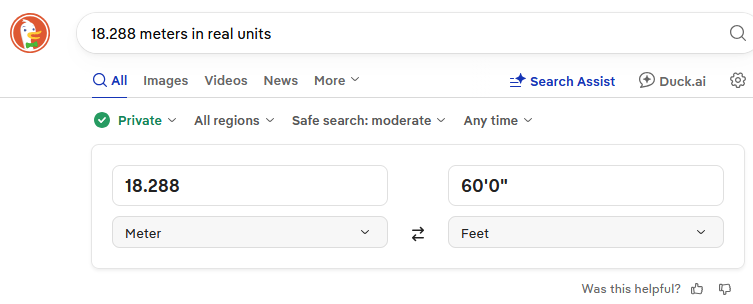
That’s obviously an AI-fake!!!1111
I dunno bout you, but it’s just easier to say 60ft than 18. 28m!
And I find 20m easier to say than 65.61ft? Sorry, am I missing a joke? Sometimes it’s hard to Poe’s Law the Americanisms.
Yes, you’re missing the joke.
he’s missing it by like 1,609.34 meters…
It would be easier to just say a mile.
What a stupid figure of speech.
What’s a mile?
Now that’s obviously just plain incorrect. Everyone knows that real units are measured in bananas.
60 feet = 102.857 bananas
https://bananaforscale.info/convert/length/60-feet-to-bananas
🍌 🍌 🍌 🍌 🍌 🍌 🍌 🍌 🍌 🍌
Yes, but:


OK, that got me smiling hard. :)
Ecosia:

Ok, but also


I can tell that a student on a software engineering placement had a very fun afternoon making this
FREEDOM🏈🏈🏈
The duality of duck.

OP:


DDG is just a people pleaser. 🤷♂️
This is just funny:


I’m pretty sure it’s just a fuzzy context match.


The only outlier is that God uses inches apparently?
They make about as much sense as cubits.
Right but I don’t know specifically how the matching is done so I was just funny that the only example I tried seemed to lean into metric and deride imperial. I’m not saying that’s actually the case it just was funny to me that I got that result.
Doesn’t seem to work for volume, having tried gallons and teaspoons. But it works for length and mass/weight.
Now do imaginary units
Seems useful for those cases you don’t know what a furlong even measures.
I wonder how well it handles ounces.

One spawns a pre-coded widget with obvious math equations inside, the other puts out values in a way you can’t tell if it calculated stuff or made it all up. I am sure it triggers a side-calculator too, but I can’t know if it exists, and if it was properly triggered this time after they presented the output like an answer from their Search Assist LLM tool.
This, and that you get a working multi-unit converter widget you can use again and again without asking DDG once more. I think the old way clearly wins.
It converts into another imperial weight unity, and an international volume unity…
It didn’t ask for clarification if you are dealing with precious metals…
I’m not sure any system like that can really work for ounces. But well, that’s not bad.
Yeah, that’s great and all, but consider the following:
If I’m standing in the middle of a field and I need to measure sixty-ish feet for a fence, and I don’t have a meter stick, I can get pretty close by walking heel-to-toe for sixty paces. There’s no equivalent method for a meter and no metric unit that has a human body equivalent, while the most imperial length units all have human body equivalents.
Also, even if I do have a meter stick, how tf am I supposed to measure and mark 0.288 of one? Sixty feet is easier to work with.
There’s also the matter of a foot being equally divisible into 2, 3, 4, or 6 equal lengths, all of which also have human body equivalents. If you know them all, and measurements relative to other objects aren’t required, you can build things that measure up relative to themselves by just using fingers, hands, feet, marks, a square, and a straight edge, no ruler or tape required. I have projects close to ten years old built that way that are still standing strong.
You take big steps. Those are one meter. And you’re done faster. Good enough for a rough measurement.
My step length is 0.8m. After taking 25 steps, I have travelled 20m (roughly 65feet). 5 times that is 100m. 10 times that is 1km. Notice how easy those numbers are to multiply and divide. And notice how much easier it is to take regular steps than heel-to-toe steps. You know you could memorize how big your body parts are in metric too, right?
I’d argue that the only reason your preferred units are easier for you is because you are familiar with them.
Also, even if I do have a meter stick, how tf am I supposed to measure and mark 0.288 of one?
If only there was a way to calculate 0.288 of a meter. Maybe we could get a mathematician to draw up some kind of formula that’d let us cypher 29% of a meter.
Pretty close? If your foot is a UK size 12 and therefore 1ft long that will work, but any variance, say 1cm, equates to 60cm / 2ft across your 60ft.
I would measure the 60ft using a lifesize printout of Johnathan Edwards 18.29m triple jump world record from 1995 which I keep handy.
A yard (3 feet) is .9144 meters. Since you’re throwing accuracy out the window using heel-to-toe of different foot sizes, it’s just as accurate, and just as usable.
Btw. Warum ist es auf deutsch aber auf Lettland eingestellt?
Pourquoi pas?
Its not a joke! It actually works!
Does it work for football fields to real units?
I use noai.ddg and don’t get the converter thingy.
I use noai.ddg and get the converter thingy
I don’t get it for football fields or other ‘anything but metric’ units which is what I was going for.
A football field is 100 yards, so just try “100 yards to real units” if you’re genuinely curious.
120 yards really, the end zones are part of the field.
True, but:
When the “football field” is used as unit of measurement, it is usually understood to mean 100 yards (91.44 m),
I use noai.ddg and don’t get the converter thingy.
Tried going to regular ddg and don’t get the converter thing, just regular results. I probably turned off a setting somewhere.
I’m getting it intermittently too, for what it’s worth. Depending heavily on the unit. For example, I tried and realized “100 yards in real units” doesn’t work, but “100 feet in real units” does.
I don’t want to ask it yards. I want to ask it in ‘anything but metric’ units like football fields and Olympic sized swimming pools.
Didn’t try regular measurements before, but yeah now I see it when I use those.