So fwiw, the change was made official and updated in GNIS the day it changed on Google Maps, which uses GNIS behind the scenes. That same day, USGS said the name had taken effect in GNIS but that it was waiting for its maps to visually update.
I think this is a product of Google’s infrastructure being faster to automatically update with GNIS changes. The fact they didn’t step in to override it already shows that they’re willing to go along with this; I don’t think the fact it changed before USGS adds any significance to that bootlicking.
That is, I don’t assume Google manually intervened to make this happen faster.
Still, fuck Google Maps. I’m glad people are waking up to how this level of hegemony over maps gives corporations too much power.
I keep seeing this around. I’ve got friends at Google who have shared screenshots about the manual pull request (code change) that was made to update the name. They even have an internal shortlink pointing to that manual change since it’s so dumb
I wish this was talked about more. So much hay being made about this on the assumption that Google maintains their own database of locations instead of pulling from sources like GNIS like they actually do.
Fuck Google, but we don’t need to make shit up to hate them. In fact, making shit up makes us seem crazy and hurts our position.
They could have easily made the effort to not change the name, don’t defend them. This isn’t some nothing change, they are very aware of what they are doing or not doing.
It reminds me of this conspiracy that was circulating a few months back that Apple Maps had “deleted” cities and places in Lebanon to culturally erase it for Israel’s invasion.
In reality (which you could see by e.g. looking at Reddit posts from a few years ago), Apple Maps’ coverage of Lebanon was absolute unusable dogshit the entire time. There were complaints about how it wasn’t even usable for basic navigation in Beirut. The city of Tyre (which was misspelled “Tyr”) was still there despite being one of the hardest-hit cities by Israel’s invasion.
Which was, to be fair, staggeringly incompetent, but it was provably true. Apple Maps’ coverage sucked so badly that, at a surface level, it looked like somebody took an erase tool to a competent map.
I think a lot of people don’t realize how automated corporate maps applications are. Which can be a weakness for crowd-sourced data like OpenStreetMap when there aren’t enough contributors, but that democratization is also a huge benefit that anyone can see and fix issues. The main parts of Google Maps that aren’t automated are points of interest, and those are kept up-to-date thanks to the network effect where e.g. business owners see value in maintaining their information or users feel like they’re helping out (read: doing free labor for a trillion-dollar corporation).
It’s just a bit silly considering how these companies have been leveraging publicly available information and how automated most of their systems actually are. It’s part of why customer service at many of them (not Apple so much I guess) is absolutely abysmal and they basically do their best to try to avoid to having a human being in the customer service loop at all. Automating almost all software and removing the human element has literally been the name of the game for 20 years at least.
You are obviously correct on that but we could also grab pitchforks about the term ‘sideloading’. Everyone knows what ‘installing’ is and ‘sideloading’ (in this context) is just a bullshit term to make it feel like something mysterious and/or dangerous. Installing software from play store is no different than installing from f-droid.


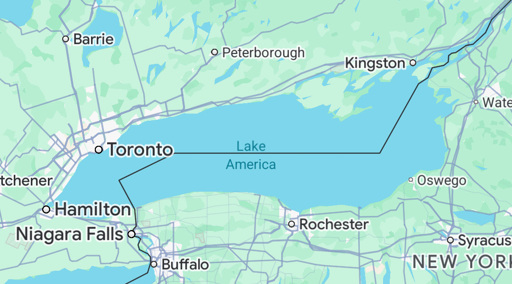
So fwiw, the change was made official and updated in GNIS the day it changed on Google Maps, which uses GNIS behind the scenes. That same day, USGS said the name had taken effect in GNIS but that it was waiting for its maps to visually update.
I think this is a product of Google’s infrastructure being faster to automatically update with GNIS changes. The fact they didn’t step in to override it already shows that they’re willing to go along with this; I don’t think the fact it changed before USGS adds any significance to that bootlicking.
That is, I don’t assume Google manually intervened to make this happen faster.
Still, fuck Google Maps. I’m glad people are waking up to how this level of hegemony over maps gives corporations too much power.
I keep seeing this around. I’ve got friends at Google who have shared screenshots about the manual pull request (code change) that was made to update the name. They even have an internal shortlink pointing to that manual change since it’s so dumb
Why is a lake name stored in code versus a database?
I wish this was talked about more. So much hay being made about this on the assumption that Google maintains their own database of locations instead of pulling from sources like GNIS like they actually do.
Fuck Google, but we don’t need to make shit up to hate them. In fact, making shit up makes us seem crazy and hurts our position.
They could have easily made the effort to not change the name, don’t defend them. This isn’t some nothing change, they are very aware of what they are doing or not doing.
More likely, they have their own DB, or data lake, or whatever repository it might be, but it ingests the data from multiple sources.
It reminds me of this conspiracy that was circulating a few months back that Apple Maps had “deleted” cities and places in Lebanon to culturally erase it for Israel’s invasion.
In reality (which you could see by e.g. looking at Reddit posts from a few years ago), Apple Maps’ coverage of Lebanon was absolute unusable dogshit the entire time. There were complaints about how it wasn’t even usable for basic navigation in Beirut. The city of Tyre (which was misspelled “Tyr”) was still there despite being one of the hardest-hit cities by Israel’s invasion.
Which was, to be fair, staggeringly incompetent, but it was provably true. Apple Maps’ coverage sucked so badly that, at a surface level, it looked like somebody took an erase tool to a competent map.
I think a lot of people don’t realize how automated corporate maps applications are. Which can be a weakness for crowd-sourced data like OpenStreetMap when there aren’t enough contributors, but that democratization is also a huge benefit that anyone can see and fix issues. The main parts of Google Maps that aren’t automated are points of interest, and those are kept up-to-date thanks to the network effect where e.g. business owners see value in maintaining their information or users feel like they’re helping out (read: doing free labor for a trillion-dollar corporation).
It’s just a bit silly considering how these companies have been leveraging publicly available information and how automated most of their systems actually are. It’s part of why customer service at many of them (not Apple so much I guess) is absolutely abysmal and they basically do their best to try to avoid to having a human being in the customer service loop at all. Automating almost all software and removing the human element has literally been the name of the game for 20 years at least.
To be fair, the average person doesn’t know what sideloading is, while everyone will look at the map and see the changed name
You are obviously correct on that but we could also grab pitchforks about the term ‘sideloading’. Everyone knows what ‘installing’ is and ‘sideloading’ (in this context) is just a bullshit term to make it feel like something mysterious and/or dangerous. Installing software from play store is no different than installing from f-droid.