It’s 9 if you actually understand PEMDAS
I’m guessing confusion is coming from those taking PEMDAS literally as that order? Rather than PE(M|D)(A|S), like it’s supposed to be?
It’s also convoluted by the notation of the multiplication. When it’s written like this, many assume that you need to resolve that term first since it involves parentheses.
This is how I was taught 30 years ago in highschool
It’s also because writing multiplication without a symbol creates a tightly bound visual unit that is typically evaluated before other things. If you see an exercise like, “what is 4x²/2x” most people answer “2x” not “2x³”. But this convention is rarely taught explicitly, so it’s ripe for engagement bait.
tightly bound visual unit
I think you nailed it on the head. The expression isn’t technically ambiguous, there’s exactly one solution, and neither is the notation incorrect, just unconventional. In this case though, forgoing convention makes the expression typographically misleading. Hence a reason why we have these conventions for writing out expressions in the first place: to visually reinforce the order of operations thereby making expressions as easy to read as possible. So it’s not written wrong per se, just unnecessarily confusingly.
There’s a reason why the conventional division symbol requires grouping its terms.
If you see an exercise like that, the exercise is bad and your teacher must be educated. Now, try putting that into a computer language and see what comes out.
I’m talking about exercises in textbooks, and you can find enough examples that writing them off as “the exercise is bad” is not really a good enough response.
The only way the exercise is bad is if it causes confusion in the people who are using the textbook. Those students have been exposed to the conventions of the textbook in question; they’re not people who were brought up on some other convention. You do see inline division and the vast majority of people interpret an expression like that above the way I said, so it’s not in practice confusing.
It’s not realistic to demand that every textbook uses the same conventions. It is realistic to demand that they lay out such conventions explicitly, which they unfortunately don’t.
So what? Those books are bad, at least on this specific way. They should be fixed.
It’s perfectly realistic to demand that teachers only use good books. Textbooks should explain things, not confuse.
Well, you sure did repeat your assertion!
Well implicit multiplication would be done before the other operators anyway, but after exponents. Pemdas is incomplete.
I was taught BEDMAS in school, so slightly different order. I was also taught that DM and AS are not specifically in that order, but rather left to right of the equation, in the same lesson. I’m not sure why some schools aren’t doing it that way.
deleted by creator
This is the correct answer and it drives me crazy how often this comes up.
As another user commented, division and subtraction are just syntactic flavor for multiplication and addition, respectively. Division is a specific type of multiplication. Subtraction is a specific type of addition.
And so there is a reason mathematicians do not use the division symbol (➗): it is ambiguous as to which of the following terms are in the divisor and which are part of the next non-divisor term.
In other words, the equation as written is a lossy representation of whatever actual equation is being described.
tl;dr: the equation as written provides insufficient information to determine the correct order of operations. It is ambiguous notation and should not be used.
division and subtraction are just syntactic flavor for multiplication and addition
Can you tell me a bit more about how you mean this? I searched a bit but only basic primary school level resources about the relationship between addition and subtraction came up.
Do you mean like subtraction is just adding a negative number, and division is just multiplication by the inverse of a number? In that case I don’t really see how it simplifies things much because negatives and inverses still need as much definition. Or are you talking about bit-wise operations like a computer would use to do these things?
I believe they do mean the fact that subtraction is just adding the negative and division is just multiplying by the inverse. You can look up field axioms to see how real arithmetic is really defined. It’s much more convenient to have two operations instead of four.
Addition asks “What do you get when you combine these two numbers?”
Subtraction asks “What do you need to combine with this number to get this result?”
Multiplication asks “What do you get if you add this number to itself this many times?”
Division asks “How many times do you need to add this number to itself to get this result?”
In many ways, all of these operations are syntactic flavor for addition. Subtraction is addition in reverse. Multiplication is repetitive addition. Division is repetitive addition in reverse. Exponents are recursive repetition of repetitive addition. And so on.
Look into the axiomatic proof of 1+1=2. It will shed some light on how mathematics is just complex notation for very, very simple concepts at scale.
The other commenter is correct, but another way to think or visualize is that any subtraction or division operation can be understood as an addition or multiplication.
X - 5 = X + (-5)
X / 5 = X * (1/5)
You can think of subtraction and division not being distinct or separated from addition and multiplication; instead, they’re just a shortcut notation in mathematics because everyone was tired of having to write extra characters.
Figuratively, at least.
Yup, I found an old comment of mine but unfortunately that post was deleted. The numbers are different but its the same riddle
I think the confusion is in the way it’s displayed. The notation in the comic is ambiguous, where the division is shown as a symbol, while the multiplication is implied with the brackets, so some people see the question as
8/(2*(2+2))=1, while others see it as8/2*(2+2).For the later, my understanding is that multiplication and division actually have equal priority and are solved left to right (rather than an explicit order as PEDMAS and BEDMAS seem to suggest). So the second interpretation would give
8/2*(2+2)=8/2*(4)=4*4=16The reason this isn’t a problem more often is because
- math questions should be written unambiguously, using symbols everywhere and fraction bars
- in real life problems, there is a certain order in which you manipulate the numbers, and we can use correct notation (with an excessive number of brackets if needed) to keep it crystal clear
The P in PEMDAS just means resolve what’s inside the parentheses first. After that, it’s just simple multiplication with adjacent terms, and multiplication and division happen together left to right.
6÷2(1+2)
6÷2(3)
3(3)
9
This is actually a generational thing. Millennials were taught “PEMDAS”:
- Parenthesis
- Exponent
- Multiplication
- Division
- Addition
- Subtraction
But younger generations have been taught “BEDMAS” instead:
- Brackets
- Exponent
- Division
- Multiplication
- Addition
- Subtraction
Notably, Division and Multiplication are swapped on PEMDAS and BEDMAS, to make this “both happen at the same time” more straightforward. But that only applies if the entire operation can happen at the same time.
For instance, let’s say
6/2(3)compared to6÷2(3). At first glance, they both appear to be the same operation. But in the former, the6dividend would be over the entire2(3)divisor. Which means you would need to simplify the divisor (by resolving the multiplication of2•3) before you divide. So the former would simplify to6/6=1, while the latter would divide first and become3(3)=9.Technically, if you wanted to be completely clear, you would write it using multiple parenthesis as needed. For instance, you would write it as either:
(6÷2)(3)=9or6÷(2(3))=1to avoid the ambiguity. Then it wouldn’t matter if you’re using PEMDAS or BEDMAS.But in the former, the
6dividend would be over the entire2(3)divisor.I have never heard of or seen an example of anyone using / and ÷ in different ways. If you want multiple terms in your divisor, either write it as a large fraction with all relevant terms in the dividend or divisor, or use parentheses. This just seems like sloppy notation to me.
The slash was just because MarkDown doesn’t really make mathematical notation easy. The point is that with a slash, the 6 is over the entire
2(3)divisor. It’s the difference between these:

You can even see that the automatic solution (in yellow) parses the two differently. In the first example, it correctly resolves the
2(3)first, because you should always simplify both the top and the bottom as much as possible before you resolve the division. But in the second, it parses the6÷2first, because it is left ambiguous. The slash is literally the horizontal bar, putting the dividend above the entire divisor. Except it’s in a single line, instead of taking up three lines of text for a single operation.
I am a millennial born in the 1990, they taught me BEDMAS.
Usually, no sign before the bracket means juxtaposition. Scientific calculators do account for it (not all, tho), while regular ones may not.
So 2(1+2) is really (2+4)
Compare 2/2x and 2/2×X where x is (1+2)
The first is 2/(2+4)=1/3, the second is (2/2)×(1+2)=3
Basically, either 1 or 9 can be considered correct. And yes, it’s ambiguous.
Also, there’s no real rule about solving left to right due to associative and commutative properties: 1×2×3 = 1×(2×3) = (1×2)×3 = 3×1×2 = 2×1×3 = 6
would you say the same thing if the division was written out like a line under 2(3) and under that 6
idk how this’ll come out but something like this:
2(1+2)
-----------
6edit : wow i did a formatting thing
edit2: i got it (ish)In that case, I’d say the answer is 1. Top and bottom are each resolved to the fullest extent possible before dividing top by bottom. It’s equivalent to (top)÷(bottom), but it’s clearer and preferable if you can easily format that way in my opinion, just harder on a computer.
I think that’s why people are complaining about the division sign.
It’s been decades since I took a math class so I am definitely not the right person to explain things, but I am using technology to confirm my understanding of the various notations:

So yeah, if you put 6 over a denominator of 2(1+2), the answer is different (1) because the equation is different. But if you write it out literally, it would be 6 over 2 times (1+2).
What you wrote swapped the denominator to make it 2(1+2)÷6, which will always be 1.
The ÷ symbol is a bane of mankind
I’m my head cannon, I imagine it as a /. Where the left is the top of a fraction, and the right the bottom. This only works in very simple equations though.
That’s actually what the dots represent, values in a ratio when written in a sensible notation
Well, Patrick IS an idiot … so it checks out?
I hate math, my teacher taught is as first in last out and to this day I still get confused. The answer is 9 right?
Yes, at least by the most common agreed on convention. Almost any mathematician, programming language, search engine or spreadsheet software will say it’s 9. It is for all intents and purposes the right answer.
There is no right answer. It just depends on convention. It’s like color vs colour, neither has been shouted down from the heavens to be the only way to write something, it depends on culture.
There very much is an agreed on convention, some people are just not using it and that is entirely their problem.
It is one though, you gotta do multiplication first
No. After you do the parentheses, multiplication and division are done left to right.
Yeah, gonna need to see a proof before I trust ANYONE on lemmy
Multiplication and division are the same operation
6 * (1 / 2) = 6 / 2
Multiplication/division and addition/subtraction both happen left to right. They… Didn’t teach you that in school?
It can be both depending on how you handle operator precendence.
PEMDAS definitely doesn’t result in 1, but in 9, since under PEMDAS multiplication and division have the same priority (and thus should resolve left-to-right). So, you should resolve to 9 (6/2(2+1) => 6/2(3) => 6/2*3 => 3*3 => 9).
However, there’s also PEJMDAS, which suggests that implied multiplication has an operator precedence greater than regular multiplication/division (J for Juxtaposition). This version says you should do 6/2(2+1) => 6/(2*2 + 2*1) => 6/(4+2) => 6/6 => 1.
The issue is that there is no universal agreement on which is correct. Most textbooks don’t even use the / operator, but instead rely on writing out the full fraction like ⁶⁄₂₍₂₊₁₎ or ⁶⁄₂(2+1). This removes any ambiguity there might be, and thus they don’t touch on which one is actually correct.
Most (but not all) calculators these days will treat implied multiplication the same as regular multiplication, so you get 9 in the given example. Most programming languages do the same, or outright disallow implied multiplication because it only confuses people. Academics won’t ever use the ambiguous notation and will make sure to remove any ambiguity by either adding parentheses or using a notation like ⁶⁄₂₍₂₊₁₎, which makes things much more clear.
Neither 9 nor 1 is wrong, the question is just stupid.
Now do 2+2=5
No you don’t, division is on the left, so it comes first
there’s no way you’re serious

:y
P/E/M(&)D/A(&)S
deleted by creator
The precedences go like this:
parentheses > exponents > (multiplication = division) > (addition = substraction)
If you encounter operators with the same precedence (like multiplication and division) you go by the order they appear in the equation, left to right. That is how it works.
Yes. I am well aware. 6 ÷ 2 * (2+1) = (2+1) * 6 ÷ 2 = (6 * (2+1))÷2 = 6 * (2+1) ÷ 2
What he wanted to do is 6 ÷ (2 * (2+1))
But this just comes down to if you treat 2(2+1) as one or two expressions.
And honestly, i don’t blame anyone for thinking one way or the other. Because i think most people understand that we wanted to write (2(2+1)), just that the overall parentheses is implied
Why i deleted that first comment within seconds was because i saw i had misread the meme as (6÷2)(2(2+1))
We discovered mathematics, the unflinching language of reality itself, and then managed to make it ambiguous.
If i was an alien id give humanity a big hair-tussle like a dog.
Use unambiguous notation
I was taught not to write like this so we dont have to deal with this shit 😊
No mathematician would write an ambiguous equation like that.
People who argued over these are displaying an incorrect memory of a math education that is simply not a good look.
Division and multiplication have the same precedence, equations are evaluated left to right, so equation is divide then multiple. Division and subtraction are syntactic sugar for multiplication and addition.
These are fun little experiments showing how social media makes people more stupider and how proud the ignorant behave amongst themselves.
It also pulls double duty by making math look hard, ambiguous, and untrustworthy. Anti education, poor reasoning skills, and an implicit distrust of mathematical models and statistics.
It’s not unheard of to find, in an exercise, “Simplify 4x²/2x”. The answer is almost guaranteed to be 2x. (There are some interesting exceptions, but they’re not really important). More often such a question would use fraction notation, but not always, to prevent exercises taking up too much space.
What’s going on is that the multiplication of the 2 and x, because they are written without a symbol in between, is seen as morally being something you should do first.
And in such exercise contexts, it’s unlikely to be misunderstood. But it’d still be better to be clear about it.
Division and subtraction are syntactic sugar for multiplication and addition.
Can you tell me a bit more about how you mean this? I searched a bit but only basic primary school level resources about the relationship between addition and subtraction came up.
Do you mean like subtraction is just adding a negative number, and division is just multiplication by the inverse of a number? In that case I don’t really see how it simplifies things much because negatives and inverses still need as much definition. Or are you talking about bit-wise operations like a computer would use to do these things?
When you set up arithmetic from absolute first principles you typically say that there is an operation called addition, an operation called multiplication, that they are related by the distributive law, and then you assert that there are identities for these operations, which do nothing: adding zero does nothing, and multiplying by one does nothing, so zero and one are the additive and multiplicative identities.
Next you add that each element has an inverse under these operations. The additive inverse of a number is its negative, so the inverse of 2 is -2. The multiplicative inverse of a number is its reciprocal. The defining feature is that the inverses cancel the operation leaving just the identity, so 2 + -2 = 0, and 3 × 1/3 = 1. The exception is that 0 does not have a multiplicative inverse.
With this, the operation of subtraction is defined in terms of addition and additive inverse, and division is defined in terms of multiplication and multiplicative inverse.
Saying that one is “syntactic sugar” for the other is standard in higher mathematics, but of course you could go through the same procedure starting with subtraction and division, and defining inverses in terms of those operations - the result is no different. The reason starting with inverses is preferred though is because there are lots of structures which have an operation and an identity for it, in which you can ask the question “are there inverses” because inverses are defined purely in terms of an operation and its identity. You can’t ask the question “can you divide in this structure” if the only way to even have a concept of division is to start with one.
This topic is the beginnings of abstract algebra which starts with group theory and builds from there.
But hard to write this with the limitations of text but essentially it can be written as multiplication of fractions.
2 ÷ 2 ÷ 2 ÷ 2
2 x ½ x ½ x ½
Personally, I think the second form is easier to visualize and reason about, it can also can be simplified to use an exponent.
Uh oh, here we go! Before the Fediverse’s favourite mathematical charlatan comes to play, let’s lay out a few facts:
- This is an unusual way of writing down this expression: you would not normally mix in-line division (written with ÷) and multiplication written without a symbol. It’s written this way on social media to for engagement bait.
- Because of this, a perfectly valid reply is to ask “can you put in some brackets to make it clear” :)
- A strict, standard reading of the order-of-operations as abbreviated by PEMDAS, BODMAS, etc, is to perform multiplication and division in the order that they occur. This would mean the evaluation goes like this:
- 6÷2(1+2)
- Perform addition inside the brackets: 6÷2(3)
- Perform the first multiplication or division: 3(3)
- Perform the remaining multiplication: 9
- Occasionally, PEMDAS is interpreted as indicating that multiplication must be done first because the M occurs before the D. This is not usually how it is taught, but rarely it happens. This would give you 1 but, to be clear, in most places this is wrong. I myself was taught BODMAS and, in fact, do division first in all circumstances.
- Much more commonly, though, the actual practical order in which mathematicians, teachers and students all evaluate expressions is a little different, in that it evaluates symbol-less multiplication (also known as “juxtaposition” which just means “writing two things next to each other” or, in discussions about this topic in particular, “implicit multiplication”) before anything else. This is done because writing two things next to each other creates a tightly-bound visual unit.
It’s rare for this last point to be mentioned explicitly as a violation of the order-of-operations. It usually only becomes relevant well after those conventions are spelled out (which is typically done in late primary school or early high school) after children start learning algebra and how to write algebraic expressions: using letters to represent unknown quantities, omitting the × symbol. Exam boards and textbooks are usually quite careful to avoid writing problems in which this unstated rule actually matters.
It’s important to realise that the order in which we evaluate a mathematical expression is a matter of convention. After establishing how to add, multiply, subtract or divide two numbers, it is a separate question which operations should happen first when more than one is written together. This is why we need to teach students the order of operations - they can’t just work it out themselves. Having said that, it certainly makes a lot more sense to do multiplication before addition, and exponentiation before multiplication, because each of these operations is (typically: you can define them in different ways if you’re a masochist) defined in terms of the previous one. This means that if you have an expression involving all three, and you first turn all the exponentiation into multiplications, you are left with a simpler expression that means the same thing. This only happens if evaluating exponentiation is the first thing you’re supposed to do. However, it would be a mistake to think this means that there is any mathematical necessity about this: what a sequence of squiggles on paper means is entirely up to the people reading and writing the squiggles; as long as they agree, the person reading the squiggles will get the same answer as intended by the person writing them. There’s a good, lengthy write-up here
This means that while what I was taught is “wrong” according to how it is usually taught (including today in the same country), this wrongness is better understood mathematically as “unusual” - something that needs to be worked out by communication and consensus rather than by dictating one right and another wrong.
You do get some people with very strong opinions about this, which is not always correlated with their actual knowledge. If the aforementioned charlatan turns up, I’ll explain…
The US education system is in such tatters that what they teach anymore is largely irrelevant to the rest of the world.
Not sure where that comes in…
I was taught to do
- Brackets
- Division and multiplication left to right
- Addition and subtraction left to right
There should be a fucking ISO for this shit tbh
it’s ambiguous
Only if you forget that multiplication happens left to right and that a(b) is simply a different way to write a×b with no other extra steps or considerations. The P in PEMDAS just means resolve what’s INSIDE the parentheses first.
That only works if everyone agrees with you, which is clearly not true. In academic math, there’s a thing called juxtaposition. It mostly exists because math people are lazy, so instead of putting parentheses around statement e.g.
5+(2*x)they’ll just write5+2x.This is fine as long as you know the context of that expression. If you take it out of the context and just ask any person what is the right order of operations - it becomes ambiguous. Because some people know PEMDAS. And other people know that PEMDAS is just a simplification for middle school, when real math notation is messy, non-standard and requires a lot of local domain knowledge.
That’s not lazyness. Multiplication is always done before addition. No need for parenthesis for that.
I picked example without confusion on purpose, because most people will generally avoid patterns similar to what OP posted. But if you want something more ambigious:
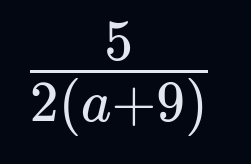
This is clearly
5/(2 * (a+9)). If we write this the form that the OP uses:5/2(a+9)- it’s fucked beyond all recognition.I think the issue comes with “division and multiplication”, and “addition and subtraction” Here, I see people saying “Brackets/Parenthesis > Division > Multiplication > Subtraction > Addition” when I was taught “Brackets/Parenthesis > Division or multiplication, left to right > Subtraction or addition, left to right”
2x would be the multiplication, as we go left to right you would do the multiplication, then go back and do the addition. In what world would 2x not mean 2 multiplied by the value of x?
Its the cleanest thing ever when people understand the basics of math (like what symbol, or lack there of, means what).
I think it’s a little different when you’re working with variables. A variable with a coefficient is generally treated more as a single unit compared to two plain constants being operated on in some way. It’s an incomplete operation since there’s missing information.
It’s ambiguous either this resolves to
6 / (2(1+2))or(6/2) * (1+2), and therefore both answers must be accepted.By convention, the division sign is not to be used in equations. It is not a standard operation.
It is may be used for representing the operation of division as a symbol, but never as an operator itself.
Anyone using the division sign is using it entirely for trolling purposes.
This is not true. It typically falls out of use in high school and rarely shows up after, but it’s not like it’s banned or anything like that.
It’s not in the modern standard for notation. I never once saw it used in university. I even had prof who typed their homework on a typewriter and he didn’t use it (he actually typeset everything pretty nicely).
I think of you looked hard you’d find it :) And it’s even easier to find / used to indicate division which has all the same issues.
I wouldn’t say that it’s ambiguous, you’ll only get one answer evaluating in PE(M|D)(A|S) order left to right (your second one), enter it into any calculator and you should get 9.
For sure, how it’s written is unconventional and easy to misread if I’m in a hurry, but honestly that’s an issue of misleading typography, not ambiguous notation. The ÷ symbol takes a lot of space (plus it looks sort of like a +) and the implicit multiplication against the parentheses doesn’t, so when I read too fast my brain might instinctively calculate each side of the division first because they sort of look like two terms. But doing that violates the left-to-right rule.
enter it into any calculator and you should get 9
Have you tried it, though? My Casio says it’s 1
That’s because it treats 2(1+2) as 2x and not 2*x
It’s called juxtaposition and is the reason why people find this notation ambiguous. Some people account for it, some not. Same with calculators. The scientific ones are most likely to give you an answer of 1
Edit: Look, this one even warns you about the implicit multiplication

Huh why would you add additional brackets? It’s simply 6:2*(1+2) then you solve it in order since division and multiplication are same level of operation.
Oh christ the math memes are leaking from facebook
my calculator disagrees.

and i would too, this is basically
6÷2(1+2) = 6÷2×(1+2) = 6÷2×3while you resolve brackets first, you still go left to right. you would get 1 if you did
6÷(2×(1+2))
the issue is the missing multiplication sign between the 2 and the brackets, thats why i always write them even if it is not strictly required
CASIO calculators say 1, and I think it’s more intuitive with “÷2π” being equivalent to “÷(2×π)” rather than “÷2×π”. It took me a while to figure out why my results were almost but not quite one order of magnitude wrong after I was forced to switch to TI. Obviously nobody in high school or uni wrote
÷(or Czech:) on paper, it was all fractions, but even on “natural mode” calculators I’d use the÷key for simple denominators to save vertical space.you still go left to right
Unless there’s implied multiplication, which there is. Then you do that before the explicit division.
Incorrect. Multiplication and division happen in whichever order they appear left to right. They have the same priority.
Who taught you that? They shouldnt have.
Look at you looking so confidently incorrect. Embarrassing.