Exactly. If we want people to switch to Linux, we need to make sure they are going to have a good experience. That means to accept that there are still some use cases that Windows is better for, at least for some people. If all you use your gaming rig for is LoL or you spend 99% of your workday in Excel, it doesn’t make sense to switch. Linux will be there for them when they’re ready.
i mean, i used to spend 99% of my workday in excel. I could have jumped to libre but then making sure all my formulae worked for everyone else in the office on the sheets i shared would have been a pain. the other 1%, those programs don’t work on linux at all. not even on wine, last i checked (which was a while). so while i was technically in charge of all the computers in the office, it was not worth moving over there.
at home, dammit i just spent 8 hours doing two jobs and one of them was unpaid IT consultant you want me to figure out a new OS for free?
Do we want the kind of people who are afraid of Linux to switch to Linux though? I feel like those people should stay on Windows until Linux adoption is just too overwhelming. Let the people who actually want to explore and try new things switch first, cause they’ll be more useful at providing feedback, and less likely to hurt the community.
Like, was it a good thing that Linus did his first Linux challenge? It was a lot of press, but a lot of it was bad. Maybe that is a good thing and I’m just wrong here. I feel like in his second challenge he was much more open to actually trying something new, and kind of realized that he doesn’t actually know anything about computers, but just Windows.
I don’t think being afraid is a big problem, if you are also motivated to try it. If you’re afraid and have a good experience anyway, that’s a good thing. If you were afraid and have a bad experience, you’ll likely not try it again for a long time, if ever. The key difference is what kind of experience you have. If the bad experience can be avoided in the first place, for example by telling that their game will not work, then nothing was lost. They may try again when they’re bored with that game.
If they have a community to help them make the right decision and choices along the way, they can have a good experience. I think the point I’m trying to emphasize is that the community should try hard to set them up for success rather than cheerleading: “go for it! it worked great for me!”
I hear your point about Linus (of LTT) and yes he gave Linux “bad press”, but I think it helps balance the hype with some realism of “it doesn’t work for everyone”.
I wouldn’t call Linus an average user though. I liked watching Switch and Click’s journey with Linux. She starts out knowing basically nothing, but with a can-do and eager-to-learn attitude. She worked through it and now has become quite the Linux power user. I think that that is more encouraging and relatable to the average computer user. I think it’s the way to go in general: be encouraging and positive, but also be honest about the rough edges.
It’s also about setting realistic expectations and not overselling the product. Tons of people install Linux on either bleeding edge hardware (no vendor support) or an older, secondary computer (well supported, but slow) and they experience that as “Linux is bad”.
They may expect their proprietary software to work and it doesn’t. Then they have to go back to Windows after they had finally worked up the courage to try Linux. I think it’s fine to say “I don’t think Linux will work well for you” before they get into that situation.
I, myself, despite having used Linux off and on since the mid-90s, didn’t fully commit to a Linux desktop until a year ago. I built a new PC for it, knowing it would run only Linux and with parts I knew would work. I knew exactly which programs I had to give up on and find alternatives for. I made an informed choice and I’ve never been happier with my PC after switching.
That’s what I mean though. Like, if Linus had asked me if he should switch to Linux, I would have said no. He’s not good with computers. He’s kind of an idiot. And he’s also not a big fan of reading.
Whereas I would say Switch and Click is a great candidate for switching to Linux because she clearly knew that she knew very little about it (at the time), and she wanted to learn. She didn’t go into it thinking all of her knowledge of Windows would translate to knowledge of Linux like Linus did.
So I guess what I mean is we shouldn’t be encouraging everyone to switch to Linux, like you said. Some people just want the easiest, least thought required solution, and that’s Windows. Everything “just works” (except when it doesn’t), because when it doesn’t work, Windows users just think “oh, computers can’t do that”. (Or they pay someone else to do it, eg Geek Squad.)
I’m not sure why you think people don’t switch to Linux because they’re afraid of it. People have incredible inertia twords changing something they’re familiar with. And Linux is very unfamiliar to the vast majority of people.
It also doesn’t help that people like you make Linux users look like pretentious pricks.
Because people are afraid of things they’re unfamiliar with, and like you said, they’re not familiar with Linux.
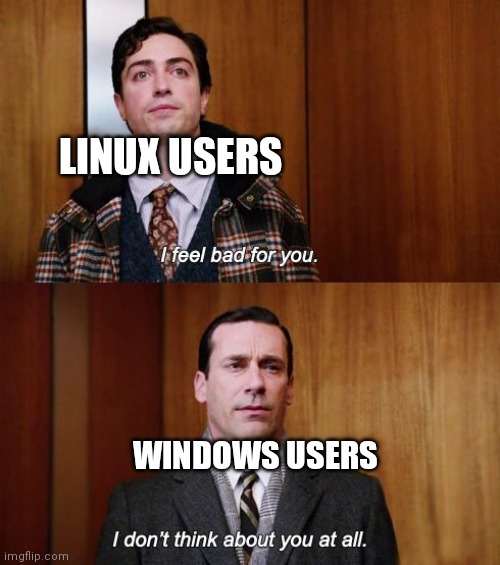
I don’t really care what Windows users think of Linux users. If someone wants to switch, good for them. If they don’t, good for them. But if they ask stupid questions online instead of reading the fucking manual, yeah, I’ll berate them. If they want nice hand holdy support staff, stay on Windows, where they literally pay for that. If they’re not afraid to be called an idiot when they’re being an idiot, then welcome to the herd.
Linux users have a reputation for being assholes because we’re not support staff. We’re not paid to help noobies, so we’ll help, because we’re nice, but we’ll be real about it, because we don’t like people wasting our time.
If someone is genuinely a noob, and is asking because they truly don’t know, then I’ll try to be nice, but we get a lot of people who are used to doing things on Windows, think they’re experts, and come in and be assholes themselves because Linux has the absolute gall to be different from Windows, something that was brand new when Linux was written as a clone of something that had been around for 20 years.
Do we want the kind of people who are afraid of Linux to switch to Linux though? I feel like those people should stay on Windows until Linux adoption is just too overwhelming.
I feel like people should use whatever OS they want. Why do you care if some guy installs Linux and isn’t comfortable with it? Computers don’t care what “kind of people” are using them.
As long as he keeps to himself, I don’t care. It’s when he a. annoys me or other devs by asking questions that are already answered in the documentation or readily available online, or b. tells people how hard/terrible Linux is because he had a bad experience using a thing he purposefully misunderstood, that he becomes a problem for the Linux community. Then, I care.
We should not be encouraging people to try Linux if they are the kind of people who do those things.
The next argument is, “well, we should make Linux friendly to Windows users,” and I think that mentality is disgusting. Windows has dog shit UX, and we 100% should not be borrowing from it.


Exactly. If we want people to switch to Linux, we need to make sure they are going to have a good experience. That means to accept that there are still some use cases that Windows is better for, at least for some people. If all you use your gaming rig for is LoL or you spend 99% of your workday in Excel, it doesn’t make sense to switch. Linux will be there for them when they’re ready.
i mean, i used to spend 99% of my workday in excel. I could have jumped to libre but then making sure all my formulae worked for everyone else in the office on the sheets i shared would have been a pain. the other 1%, those programs don’t work on linux at all. not even on wine, last i checked (which was a while). so while i was technically in charge of all the computers in the office, it was not worth moving over there.
at home, dammit i just spent 8 hours doing two jobs and one of them was unpaid IT consultant you want me to figure out a new OS for free?
that’s why it took me so long.
Do we want the kind of people who are afraid of Linux to switch to Linux though? I feel like those people should stay on Windows until Linux adoption is just too overwhelming. Let the people who actually want to explore and try new things switch first, cause they’ll be more useful at providing feedback, and less likely to hurt the community.
Like, was it a good thing that Linus did his first Linux challenge? It was a lot of press, but a lot of it was bad. Maybe that is a good thing and I’m just wrong here. I feel like in his second challenge he was much more open to actually trying something new, and kind of realized that he doesn’t actually know anything about computers, but just Windows.
I don’t think being afraid is a big problem, if you are also motivated to try it. If you’re afraid and have a good experience anyway, that’s a good thing. If you were afraid and have a bad experience, you’ll likely not try it again for a long time, if ever. The key difference is what kind of experience you have. If the bad experience can be avoided in the first place, for example by telling that their game will not work, then nothing was lost. They may try again when they’re bored with that game.
If they have a community to help them make the right decision and choices along the way, they can have a good experience. I think the point I’m trying to emphasize is that the community should try hard to set them up for success rather than cheerleading: “go for it! it worked great for me!”
I hear your point about Linus (of LTT) and yes he gave Linux “bad press”, but I think it helps balance the hype with some realism of “it doesn’t work for everyone”.
I wouldn’t call Linus an average user though. I liked watching Switch and Click’s journey with Linux. She starts out knowing basically nothing, but with a can-do and eager-to-learn attitude. She worked through it and now has become quite the Linux power user. I think that that is more encouraging and relatable to the average computer user. I think it’s the way to go in general: be encouraging and positive, but also be honest about the rough edges.
It’s also about setting realistic expectations and not overselling the product. Tons of people install Linux on either bleeding edge hardware (no vendor support) or an older, secondary computer (well supported, but slow) and they experience that as “Linux is bad”.
They may expect their proprietary software to work and it doesn’t. Then they have to go back to Windows after they had finally worked up the courage to try Linux. I think it’s fine to say “I don’t think Linux will work well for you” before they get into that situation.
I, myself, despite having used Linux off and on since the mid-90s, didn’t fully commit to a Linux desktop until a year ago. I built a new PC for it, knowing it would run only Linux and with parts I knew would work. I knew exactly which programs I had to give up on and find alternatives for. I made an informed choice and I’ve never been happier with my PC after switching.
That’s what I mean though. Like, if Linus had asked me if he should switch to Linux, I would have said no. He’s not good with computers. He’s kind of an idiot. And he’s also not a big fan of reading.
Whereas I would say Switch and Click is a great candidate for switching to Linux because she clearly knew that she knew very little about it (at the time), and she wanted to learn. She didn’t go into it thinking all of her knowledge of Windows would translate to knowledge of Linux like Linus did.
So I guess what I mean is we shouldn’t be encouraging everyone to switch to Linux, like you said. Some people just want the easiest, least thought required solution, and that’s Windows. Everything “just works” (except when it doesn’t), because when it doesn’t work, Windows users just think “oh, computers can’t do that”. (Or they pay someone else to do it, eg Geek Squad.)
Yep I think we’re on the same page. Let’s take care of the Bettys and accept that the Linuses will be happier staying on Windows.
I’m not sure why you think people don’t switch to Linux because they’re afraid of it. People have incredible inertia twords changing something they’re familiar with. And Linux is very unfamiliar to the vast majority of people.
It also doesn’t help that people like you make Linux users look like pretentious pricks.
Because people are afraid of things they’re unfamiliar with, and like you said, they’re not familiar with Linux.
I don’t really care what Windows users think of Linux users. If someone wants to switch, good for them. If they don’t, good for them. But if they ask stupid questions online instead of reading the fucking manual, yeah, I’ll berate them. If they want nice hand holdy support staff, stay on Windows, where they literally pay for that. If they’re not afraid to be called an idiot when they’re being an idiot, then welcome to the herd.
Linux users have a reputation for being assholes because we’re not support staff. We’re not paid to help noobies, so we’ll help, because we’re nice, but we’ll be real about it, because we don’t like people wasting our time.
If someone is genuinely a noob, and is asking because they truly don’t know, then I’ll try to be nice, but we get a lot of people who are used to doing things on Windows, think they’re experts, and come in and be assholes themselves because Linux has the absolute gall to be different from Windows, something that was brand new when Linux was written as a clone of something that had been around for 20 years.
I feel like people should use whatever OS they want. Why do you care if some guy installs Linux and isn’t comfortable with it? Computers don’t care what “kind of people” are using them.
As long as he keeps to himself, I don’t care. It’s when he a. annoys me or other devs by asking questions that are already answered in the documentation or readily available online, or b. tells people how hard/terrible Linux is because he had a bad experience using a thing he purposefully misunderstood, that he becomes a problem for the Linux community. Then, I care.
We should not be encouraging people to try Linux if they are the kind of people who do those things.
The next argument is, “well, we should make Linux friendly to Windows users,” and I think that mentality is disgusting. Windows has dog shit UX, and we 100% should not be borrowing from it.