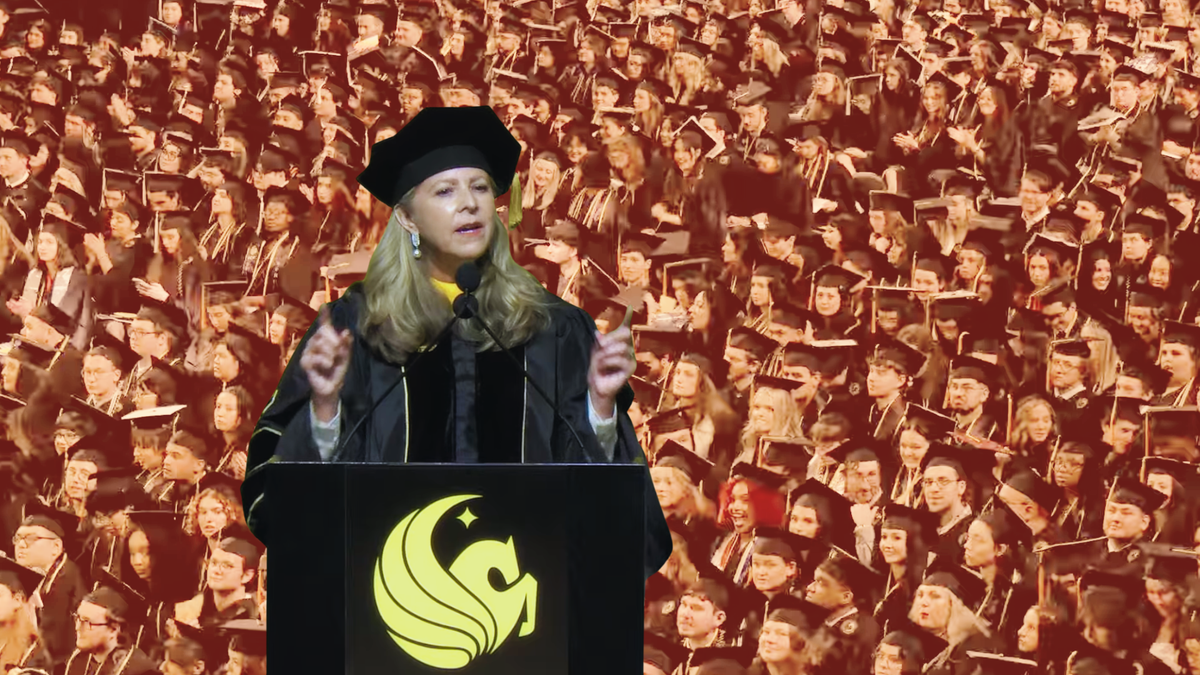
Love to go to my graduation ceremony and get a two hour long YouTube ad.
The last industrial revolution turned farmers into factory drones. This one will turn tech workers into homeless gig slaves.
Not just tech workers, more like most knowledge work. Hopefully CEO’s realize that they are the first to be replaced.
Yeah it also turned them into homeless slaves last time, factory drones just couldn’t see them because they were far away.
The last industrial revolution turned farmers into factory drones.
Nonsense. It turned farmers into corpses and migrants into factory drones and more migrants into more farmers.
to homeless gig slaves.
any alternatives?
Guerilla trout rancher?
And the speech was given to graduating students from the College of Arts and Humanities and the School of Communication and Media.
Possibly the worst audience to stand in front of and praise the ‘revolution’ of AI
I thought she was out of touch with reality but this sounds more like stupidity as well.
Grads: “We just got art degrees”
Speaker: “AI can create art that replaces artists”
Grads: “boooo”
Speaker: “why are the booing”
AI Spokesmodel: “We built a big machine that steals your work product to plagiarize it, then sucks you into an assembly-level job that pays under-subsistence wages to tidy up all the crap it injects”
Journeymen Professionals: “This sucks! Smash the looms!”
AI Spokesmodel: “Don’t worry, though. Some of you can still become cops!”
Austrian Art School Dropouts: “We’re listening”.
How can she be surprised? “Hey, here is this thing we’re building that we hope makes 90% of you obsolete!”, sounds like a great perspective for the future.
It’s not gonna make them obsolete. It’s gonna keep piling on technical debt from bad practices of which it’s entirely unaware (not that it’s ever “aware” of anything) while tricking dumb upper management, C-suite, and investors into thinking that it can render so many people obsolete, before it all crashes. “Pride comes before the fall.”
Proof: the layoffs are failing to generate improved returns https://toast.ooo/post/13892904
It’s not going to replace artists, though. It will replace art made by committee, or art made for the balloon aisle at Walmart.
The artists that sold their soul for corporate Hollywood deserve this. They were making slop before the AI ever appeared.
Honestly, she isn’t wrong.
However, the Industrial Revolution was a step forward, the AI revolution is most likely a great filter event. Industrialized Stupidity at Scale; Buliding giant data centers and turbo-charging climate change so some billionaires can race to see who can be the first trillionaireEdit: I think a lot of you skimmed what I wrote and didn’t actually READ it. Yes AI bad, I agree.
And those saying the Industrial Revolution was bad (it was, to a group. But you would not be bitching on the Internet without it.)
We can agree not everything is 100% good/bad right? Like yes, the Industrial Revolution was bad for the workers at the time, but at the same time, you wouldn’t have the phone in your hand without it. You wouldn’t have the computer on your desk without it. Hell you probably wouldn’t have your bicycle/car whatever without it.
Luckily with the “AI revolution” we’ll all probably die from the Climate Change, World War 3 and world wide Economic collapse before we get to an equilibrium point.
Without the industrial revolution I wouldn’t even exist; setting aside the butterfly effect of my parents never having met because they’re from different parts of the country for a moment I owe my existence to modern medicine, which would not exist without industrialization.
Honestly, she isn’t wrong.
AI Slop is a sub-optimal replacement that requires enormous amounts of materials and second-order human labor to produce. Like so many other industrial innovations, it’s a waste-production machine that has the added benefit of occasionally producing consumables.
We get to run the AI Slop machine at a profit because the market for slop is heavily monopolized and the consumer base is cash rich and alienated from its laboring peers. But a downturn in the domestic economy, a sudden shortfall in cheap raw materials, a major shift in popular consumption habits, or a higher quality alternative at a lower price point all put AI slop at risk of losing profitability.
It’s a far more fragile industry than any Slop Advocate wants to admit. And it needs an enormous structural investment to function.
the Industrial Revolution was a step forward
A step forward into what, though? Mass overproduction resulting in economy-wide enshitification and a crisis of excess waste all carried enormous tail costs.
Are you really better off today buying furniture from IKEA that won’t last ten years, rather than inheriting antiques from your parents that have endured for the last century? Are you better of driving a car built in a big machine-factory than riding a trolley that was designed custom for the city lines? Are you better of eating individually plastic-wrapped slices of fake cheese than carving a chunk off the giant wheel in your pantry?
Idk, man. Views differ on that one.
Are you really better off today buying furniture from IKEA that won’t last ten years, rather than inheriting antiques from your parents that have endured for the last century?
Most people dont have the choice of inheriting pieces of furnitute with a value of months worth of wages when they first get a home of their own.
Are you better of driving a car built in a big machine-factory than riding a trolley that was designed custom for the city lines?
Do you think trolly buses are a pre-industrial thing, with their electric powered engines running on steel rails through dense urban areas?
For the working class, the industrial revolution was not a step forward. It took a lot of time, hard union work and political regulation to wrangle the beast that was the industrial revolution.
And it’s the thing responsible for the climate change. It bring wonderful things, but may make the world unlivable for humans so… I won’t call it an unambiguous step.forward.
It’s going to happen anyway. We’ll follow instinct, same as everything else. We’re programmed to consume, expand, decay, and pass the entropy along.
Probably the only thing we can do about this is bring the population down to a very small number. You will never convince a large percentage of people to care, ever, and when it comes to the existential threat of climate change you can’t wait for them to change their minds.
This isn’t me saying we can’t do anything about it. This is me saying we won’t because of what that cost would be.
We aren’t programmed by nature, we were programmed by economic interests.
Adding a relevant quote (also see an additional quote in a separate reply to this one in regards to how people can protect/conserve nature if given the chance/freedom to do so)
“There was a day when the prevailing American culture was the mass marketer’s worst nightmare. Frugality and thrift were central to the famed “Puritan ethic” that the early settlers brought with them to America. The Puritans believed in hard work, participation in community, temperate living, and devotion to a spiritual life. Their basic rule of living was that one should not desire more material things than could be used effectively. They taught their children, “Use it up, wear it out, make do, or do without.” The Quakers also had a strong influence on early America and, although more tolerant and egalitarian, shared with the Puritans the values of hard work and frugality as important to one’s spiritual development. Ralph Waldo Emerson and Henry David Thoreau, both important early American writers, viewed simplicity as a path to experiencing the divine. The consumer culture emerged largely as a consequence of concerted efforts by the retailing giants of the late nineteenth and early twentieth centuries to create an ever-growing demand for the goods they offered for sale. The American historian William Leach has documented in Land of Desire: Merchants, Power, and the Rise of a New American Culture how they successfully turned a spiritually oriented culture of frugality and thrift into a material culture of self-indulgence. Leach finds the claim that the market simply responds to consumer desires to be nothing more than a self-serving fabrication of those who make their living manipulating reality to persuade consumers to buy what corporations find it profitable to sell: Indeed, the culture of consumer capitalism may have been among the most nonconsensual public cultures ever created, and it was nonconsensual for two reasons. First, it was not produced by “the people” but by commercial groups in cooperation with other elites comfortable with and committed to making profits and to accumulating capital on an ever-ascending scale. Second, it was nonconsensual because, in its mere day-to-day conduct (but not in any conspiratorial way), it raised to the fore only one vision of the good life and pushed out all others. In this way, it diminished American public life, denying the American people access to insight into other ways of organizing and conceiving life, insight that might have endowed their consent to the dominant culture (if such consent were to be given at all) with real democracy. The populist cultures that grew out of the hearts and aspirations of ordinary people in America stressed the democratization of property and the virtues of a republic based on independent families owning their own land and tools, producing for themselves much of what they consumed, and participating in communities of sharing. Theirs was the model of a strong social economy, supplemented by involvement in the money economy at the margin of their lives.” / “Gradually, the individual was surrounded by messages reinforcing the culture of desire. Advertisements, department store show windows, electric signs, fashion shows, the sumptuous environments of the leading hotels, and billboards all conveyed artfully crafted images of the good life.” (from the book “When Corporations Rule The World [20th anniversary edition]” by David C. Korten)
“In 2014, a team of scientists based at Harvard and Yale published a remarkable study on how people make decisions about the natural world. They were interested in whether people will choose to share finite resources with future generations. Future generations pose a problem because they cannot reciprocate with you. If you choose to forgo immediate monetary gain in order to preserve ecology for your grandchildren, they can’t offer the favour back – so you gain little from sharing. In light of this, economists expect that people will make a ‘rational’ choice to exhaust resources in the present and leave future generations with nothing. But it turns out that people don’t actually behave this way. The Harvard-Yale team put people in groups and gave them each a share of common resources to be managed across generations. They found that, on average, a full 68% of individuals chose to use their share sustainably, taking only as much as the pool could regenerate, sacrificing possible profits so that future generations could thrive. In other words, the majority of people behave exactly the opposite to how economic theory predicts. The problem is that the other 32% chose to liquidate their share of the resources for the sake of quick profits. Over time, this selfish minority ended up depleting the collective pool, leaving each successive generation with a smaller and smaller supply of resources to work with. The losses compounded quickly over time: by the fourth generation the resources were completely exhausted, leaving future generations with nothing – a striking pattern of decline that looks very similar to what’s happening to our planet today. Yet when the groups were asked to make decisions collectively, with direct democracy, something remarkable happened. The 68% were able to overrule the selfish minority and keep their destructive impulses in check. In fact, democratic decision-making encouraged the selfish types to vote for more sustainable decisions, because they realised they were all in it together. Over and over again, the scientists found that under democratic conditions, resources were sustained for future generations, at 100% capacity, indefinitely. The scientists ran the experiments for up to twelve generations, and they kept getting the same results: no net depletion. None. What’s so fascinating about this is that it shows widespread and intuitive support for what ecological economists call a ‘steady-state’ economy. A steady-state economy follows two key principles in order to stay in balance with the living world: 1) Never extract more than ecosystems can regenerate. 2) Never waste or pollute more than ecosystems can safely absorb. To get to a steady-state economy, we need to have clear caps on resource use and waste. For decades, economists have told us that such caps are impossible, because people will see them as irrational. It turns out they’re wrong. If given the chance, this is exactly the kind of policy that people want. This helps us see our ecological crisis in a new light. It’s not ‘human nature’ that’s the problem here. It’s that we have a political system that allows a few people to sabotage our collective future for their own private gain.” (from the book “Less Is More: How Degrowth Will Save The World” by Jason Hickel)
-
“Ownership of things in common was so universal throughout the American continent when the Europeans arrived that even the cooking pot, Columbus noted, was available to anyone who wanted to take from it, and this even in times of starvation. Two centuries later, Thomas Morton could also say of the Five Nations inhabiting New England that “although every proprietor knows his own . . . yet all things, so long as they will last, are used in common amongst them.” The idea of ownership of land was so alien among Native Americans that individuals made no effort to secure for themselves the lands they occupied, frequently moving grounds, and readily sharing them with newcomers. As Kirkpatrick Sale writes, “Owning the land, selling the land, seemed ideas as foreign as owning and selling the clouds or the wind.” William Cronon too comments, “This relaxed attitude towards personal possession was typical throughout New England.” […] No effort was made to set permanent boundaries around a field that a family used, and fields were abandoned after some years and allowed to return to bushes. What people possessed was the use of the land and the crops; this is what was traded, and this usufruct right could not prevent trespassing. In fact, different groups of people could have claims on the same land, depending on the use they made of it, which might not be the same. Several villages could fish in the same rivers recognizing their mutual rights. And when one left the clan they left everything they had possessed. Yet, these unattached, nomadic tribes had a far deeper communion with the land and agriculture than the privatizing Europeans and so much respect for it that though “they had taken their livelihood from the land for eons, hunting, foraging, planting, fishing, building, trekking,” at the time of the Europeans’ arrival “the land of North America was still by every account without exception a lush and fertile wilderness teeming with abundant wildlife in water, woods, and air.” The result of this lack of attachment to private property among the Native peoples of America was a communal outlook that valued cooperation, group identity, and culture. […] The dislike for individual accumulation was so strong that they invented the ritual of the potlatch, that is, a periodic redistribution of wealth, to free themselves from it.” (from the book “Re-enchanting The World: Feminism And The Politics Of The Commons” by Silvia Federici & Peter Linebaugh)
I ain’t programmed for shit, much less what you’re accusing me of
bro thinks he isn’t programmed 💀
So my suicidal depression boils down to just programming to you fucking imbeciles?
And nothing of was accomplished was done by asking nicely.
But are we producing things more than 10 folds with the same quality?
Cause what I’ve seen is producing worse quality at a higher cost (which is subsidized).
This post is for paid members only
Become a paid member for unlimited ad-free access to articles, bonus podcast content, and more.
No.

byebyepaywall.com This article without pay bullshit here
Smart kids
here’s a direct link to youtube of the commencement, queued up to the speech in question.
Even before the AI topic the speech was already brain dead stupid
She really read the room wrong on this one!
I love that she was genuinely baffled. Hope it makes her reexamine her thoughts on AI.
The puppy who lost its way.
The world was changing. And the puppy was getting bigger…
how is this worth a post?
my cat says she wants another snack
Have a link? I’m more likely to click than this article.
Students fail to make the is/ought distinction.
Maybe they’re booing adults who fail to understand the can/will distinction.