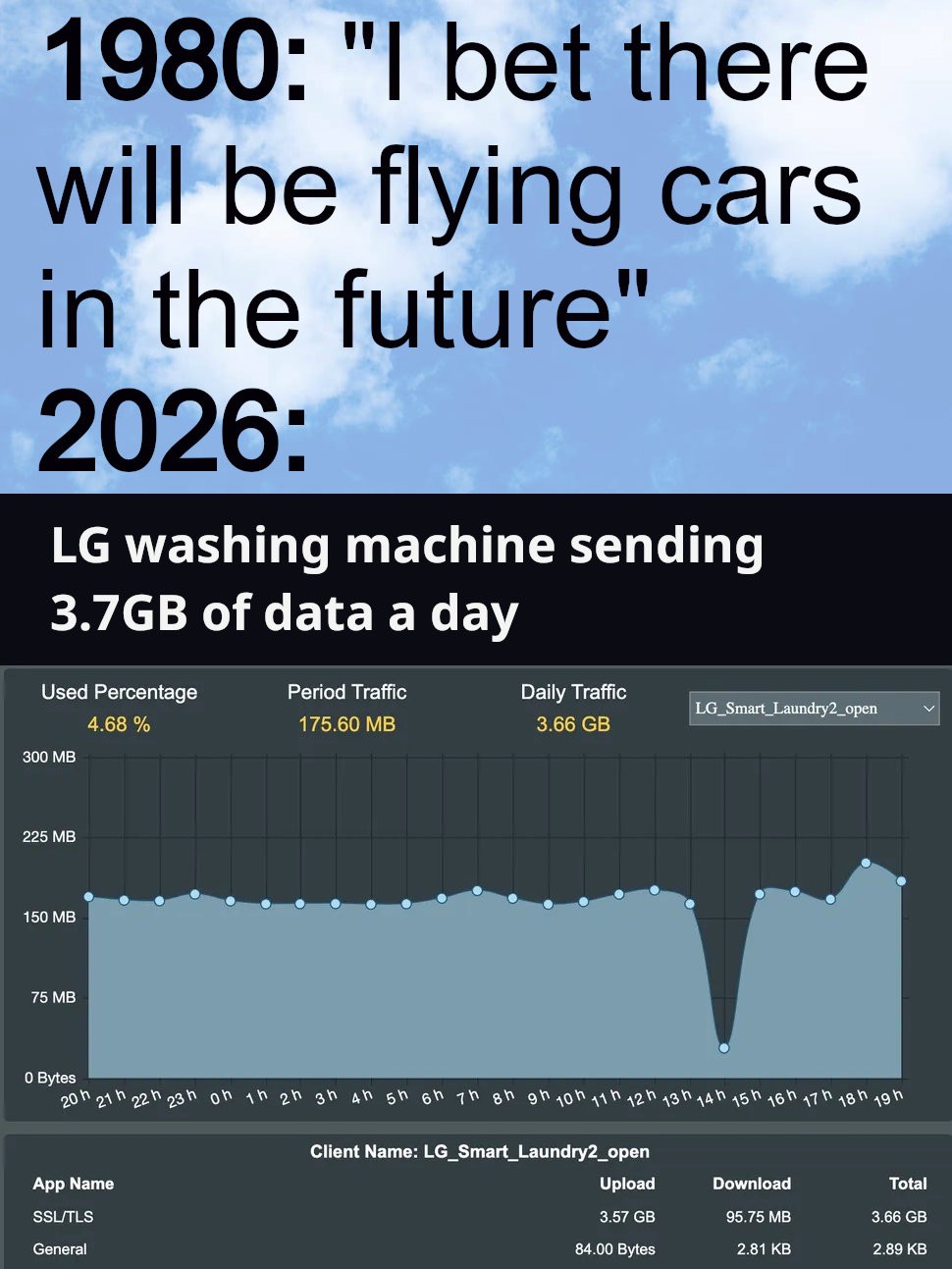
In 2024, a user noticed this odd traffic on their local network, took a screenshot of the graph, and posted it to Twitter
After discussing the issue with other Twitter users, the original poster realized that this graph was actually a mistake with their router or something. This reporting software was reporting some other device’s network traffic as being the washing machine’s traffic. The washing machine was actually only using a reasonable amount of data.
Despite this past revelation, in 2026, someone put together a “meme” of sorts comparing the supposed events in that 2024 graph to what people in the past had predicted the future to be.
For whatever reason, that “meme” was put through AI post-processing of some sort. Was the attempt to “upscale” this image after it had been passed around and been automatically compressed down by various platforms? Or was it someone using some newfangled AI-assisted compression technique in an attempt to create a smaller file size than any of the more traditional compression techniques? No idea. Whatever the reason was, the image was left with a bunch of nonsense text on the graph portion.
I saw this “meme” and decided to share it here without scrutinizing the text on the graph. As mentioned in my first point, this graph was originally posted years ago, so I was already familiar with it and did not feel the need to read into it in the image I was sharing. I felt safe assuming it was just the same graph that I remember seeing years back.
After users here called out the nonsense text, I just recreated the “meme” from scratch. I grabbed the original screenshot of the graph from Twitter and a stock photo of clouds, and then combined them along with some text so that this is more-or-less the same exact “meme”, just without the AI gibberish.
For what it’s worth, my LG washer has sent 14.3 MB in the past MONTH, but my Unifi router has misidentified my Nvidia Shield TV as another LG washer. The Shield has downloaded 11.6 GB in the past month, mostly from YouTube. While I don’t doubt it’s possible for a washer to send/receive that much data if it’s compromised and part of a botnet, I’d also question whether the device in question is actually an LG laundry appliance.
Knowing when the washer is done with a polite buzz on my wrist is way better than not hearing a beeper from 3 rooms away. It also reports your energy and water usage so you can learn about where you use resources.
There’s a lot to be gained from smart appliances, it’s just that our current system makes the manufacturers adversarial to the users unfortunately.
I just set a timer. As for knowing how much energy it uses: How much can you change once you know? You only get a few options on the machine to make any difference. Knowing this stuff is useful before you buy it, not after.
What status is there to observe in a washer? Loading weight and program are considered and a time is calculated at the start. And a dryer can work the time it needs. Standy by needs almost no energy, certainly less than fancy computational boards in “smart” stuff.
because those people don’t think, they do what they are told by companies. there is ZERO logical reason to have the thing connected to the internet.
it won’t add soap…it won’t add clothes…it won’t remove clothes…
there is nothing that machine can do better while connected to the internet vs offline…if there is, then it’s a limitation/problem specifically designed to make the product worse, in order to manipulate people to sign up for stupid crap.
If you really don’t think there’s a legitimate reason someone might want their washer connected to the Internet, you need to get out more.
Have you considered that a washer might be in the basement? And the person might be 2 floors away where they can’t hear it? And they might appreciate being able to get a notification when it is complete to remind them to move it to the dryer?
That’s more effort per wash instead of being something that only needs setting up one and then will work forever. Also, it’s common for post-90s appliances to include sensors and vary the cycle time based on how dirty the water gets. Except for the data privacy and security concerns, which are mainly because it’s proprietary software rather than inherent in Internet-connected devices, there’s no advantage to using your phone timer over getting a notification.
Again, that’s specific to it being proprietary software. I’ve got some devices in my home that are connected to the local network (but not the internet), and have configured Home Assistant (which I’ve got running on an old desktop PC) to send a notification to my phone when it detects that those devices report that they’re finished with what they do. That’ll keep working until I turn off the Home Assistant server or replace the devices.
lol… more effort to set an alarm ve goes through the hassles of dealing with companies bullshit? yeah… ok, totally more effort. I don’t buy that for one second… it’s exhausting dealing with crappy software and companies that purposely tamper with their own products for profits
That’s a proprietary software problem rather than a being connected to the internet problem. One of the send-a-notification-when-it’s-done devices I set up took about as much effort as setting the right time on a phone alarm about ten times because the device’s firmware was open source with no companies’ bullshit involved, so all I had to do was navigate to the right page in Home Assistant and pick the right phone from a dropdown and the right even for the notification to trigger on from a dropdown. That’s not wildly different from picking the right time from a dropdown on a phone.
Whether or not I can isn’t relevant to whether I want to or not. My point is that you act like you can’t conceive of why someone would want it that way. It’s an absolutely narrow minded stance.
Or to start it late in the work day so you can throw it in the dryer when you get home without leaving clothes wet for 9 hours. Some may not understand why that matters, but some of us have fairly busy social lives and turning the active part of a load of laundry from 2 hours to three 5 minute increments that can be done at my convenience sounds really nice actually
Now, personally I’m unwilling to let my washer speak to the internet directly, but it is why if I had a house I’d look into something I can connect to my homeassistant setup without letting it speak to the internet directly
it’s so much easier hooking the washing machine to the Internet, downloading the app, creating an account, remembering the password, updating firmware, getting constant notifications that Samsung has a sale on something you already bought, doing the firmware again because it failed, bricking your washing machine and waiting for AI to go all possible scenarios to fix it to then hear you need a new one.
I wouldn’t mind being able to start my washer remotely - I want it to run while I’m not home because it’s noisy, but I don’t want the wet laundry to sit all day like it would if I started it and then went to work.
Or start it right before you leave. I swear, people in this thread are bending over backwards to try and justify having to connect appliances to the internet. It’s wild.
I mean, in a vacuum, a smart washer is a nice idea which is actually useful. Set the time to start the washer to 430 so it finishes when you get home. That’s a good and useful improvement.
In practice however, gestures wildly there’s the obvious data collection both of your laundry habits and anything the app on your phone can reach.
I’m not opposed to smart tech, but it has to actually benefit to product. A smart TV is a better TV (again, the data collection BS, but I am ignoring that for the moment). It can launch Netflix or Hulu or whatever, and you can watch from the comfort of your couch without another device. It is doing TV better than a non smart TV.
Also, I would love it if there was a good FOSS TvOS.
I wonder if usage of a phone app for controling and such impacts data use. If the app connects to an LG server before processing the task or notification, maybe its also grabbing a bunch of data from the phone as well?


For what it’s worth, my LG washer has sent 14.3 MB in the past MONTH, but my Unifi router has misidentified my Nvidia Shield TV as another LG washer. The Shield has downloaded 11.6 GB in the past month, mostly from YouTube. While I don’t doubt it’s possible for a washer to send/receive that much data if it’s compromised and part of a botnet, I’d also question whether the device in question is actually an LG laundry appliance.
why do you even need to have your washer connected to the internet at all?
Knowing when the washer is done with a polite buzz on my wrist is way better than not hearing a beeper from 3 rooms away. It also reports your energy and water usage so you can learn about where you use resources.
There’s a lot to be gained from smart appliances, it’s just that our current system makes the manufacturers adversarial to the users unfortunately.
I just set a timer. As for knowing how much energy it uses: How much can you change once you know? You only get a few options on the machine to make any difference. Knowing this stuff is useful before you buy it, not after.
I wonder what happened to the capability of people to remember a time and read a watch.
I think you skipped the rest of the reply
If your washer and dryer are running for a fixed amount of time instead of monitoring the status of the clothes you are wasting valuable resources.
What status is there to observe in a washer? Loading weight and program are considered and a time is calculated at the start. And a dryer can work the time it needs. Standy by needs almost no energy, certainly less than fancy computational boards in “smart” stuff.
My washer also monitors soiling levels to decide how much water to dispense.
because those people don’t think, they do what they are told by companies. there is ZERO logical reason to have the thing connected to the internet.
it won’t add soap…it won’t add clothes…it won’t remove clothes…
there is nothing that machine can do better while connected to the internet vs offline…if there is, then it’s a limitation/problem specifically designed to make the product worse, in order to manipulate people to sign up for stupid crap.
If you really don’t think there’s a legitimate reason someone might want their washer connected to the Internet, you need to get out more.
Have you considered that a washer might be in the basement? And the person might be 2 floors away where they can’t hear it? And they might appreciate being able to get a notification when it is complete to remind them to move it to the dryer?
Open your mind a little more.
Have you considered that you could learn how long it takes to do a cycle and then set a timer on your phone?
That’s more effort per wash instead of being something that only needs setting up one and then will work forever. Also, it’s common for post-90s appliances to include sensors and vary the cycle time based on how dirty the water gets. Except for the data privacy and security concerns, which are mainly because it’s proprietary software rather than inherent in Internet-connected devices, there’s no advantage to using your phone timer over getting a notification.
It won’t work forever. It’ll stop working once they stop supporting the app or shut off the servers.
Again, that’s specific to it being proprietary software. I’ve got some devices in my home that are connected to the local network (but not the internet), and have configured Home Assistant (which I’ve got running on an old desktop PC) to send a notification to my phone when it detects that those devices report that they’re finished with what they do. That’ll keep working until I turn off the Home Assistant server or replace the devices.
lol… more effort to set an alarm ve goes through the hassles of dealing with companies bullshit? yeah… ok, totally more effort. I don’t buy that for one second… it’s exhausting dealing with crappy software and companies that purposely tamper with their own products for profits
That’s a proprietary software problem rather than a being connected to the internet problem. One of the send-a-notification-when-it’s-done devices I set up took about as much effort as setting the right time on a phone alarm about ten times because the device’s firmware was open source with no companies’ bullshit involved, so all I had to do was navigate to the right page in Home Assistant and pick the right phone from a dropdown and the right even for the notification to trigger on from a dropdown. That’s not wildly different from picking the right time from a dropdown on a phone.
Whether or not I can isn’t relevant to whether I want to or not. My point is that you act like you can’t conceive of why someone would want it that way. It’s an absolutely narrow minded stance.
Or to start it late in the work day so you can throw it in the dryer when you get home without leaving clothes wet for 9 hours. Some may not understand why that matters, but some of us have fairly busy social lives and turning the active part of a load of laundry from 2 hours to three 5 minute increments that can be done at my convenience sounds really nice actually
Now, personally I’m unwilling to let my washer speak to the internet directly, but it is why if I had a house I’d look into something I can connect to my homeassistant setup without letting it speak to the internet directly
I think that you and I are roughly of the same temperament when it comes to what we expect of devices. But can you really imagine
that anyone might want to? Like getting an alert when their stuff is done?
My phone already does that because I set a timer on it cause I’ve done my laundry before and I know how long it takes to do a cycle.
“How long it takes to do a cycle” is dependent on the mode and settings you pick. Congrats on your streamlined existence, though.
Okay. Pick those settings and set a timer for how long they take. Streeeamlined.
yeah but s tying an alarm is hard… apparently.
it’s so much easier hooking the washing machine to the Internet, downloading the app, creating an account, remembering the password, updating firmware, getting constant notifications that Samsung has a sale on something you already bought, doing the firmware again because it failed, bricking your washing machine and waiting for AI to go all possible scenarios to fix it to then hear you need a new one.
I wouldn’t mind being able to start my washer remotely - I want it to run while I’m not home because it’s noisy, but I don’t want the wet laundry to sit all day like it would if I started it and then went to work.
Doesn’t practically every one have a delayed start option?
Or start it right before you leave. I swear, people in this thread are bending over backwards to try and justify having to connect appliances to the internet. It’s wild.
I mean, in a vacuum, a smart washer is a nice idea which is actually useful. Set the time to start the washer to 430 so it finishes when you get home. That’s a good and useful improvement.
In practice however, gestures wildly there’s the obvious data collection both of your laundry habits and anything the app on your phone can reach.
I’m not opposed to smart tech, but it has to actually benefit to product. A smart TV is a better TV (again, the data collection BS, but I am ignoring that for the moment). It can launch Netflix or Hulu or whatever, and you can watch from the comfort of your couch without another device. It is doing TV better than a non smart TV.
Also, I would love it if there was a good FOSS TvOS.
That’s having wet laundry sit for most of the day, which the person above already said they didn’t want to do.
You think I can remember to set that?! Well look at you, miss functional adult!
I have my air fryer connected to the internet
I wonder if usage of a phone app for controling and such impacts data use. If the app connects to an LG server before processing the task or notification, maybe its also grabbing a bunch of data from the phone as well?
What kind of permissions does the app ask for? That’ll tell ya right there.
The only permission I have enabled for LG ThinQ is notifications. I also have a Home Assistant integration that has access to my LG washer/dryer
Why do you have it hooked up to the Internet?