While I do think information about the law should be made more accessible through actual government systems instead of having to ask ChatGPT (especially in countries where precedent is a vital part of it), I still agree with the statement that you don’t have to know about it to break it (as I hope everyone does).
I would add that making ignorance of the law a valid excuse would be a logistical farce. Mens rea is a real thing that’s examined during a criminal trial. The defendant’s state of mind can absolutely factor into their sentence or even whether they’re convicted at all; “ignorance of the law is not an excuse”, ignorantia juris non excusat, even has some exceptions under US law. But you could not possibly for every crime burden the prosecution with proving that the defendant 1) committed the act 2) intended to commit the act, and now 3) knew the act they were committing was a crime. Mens rea, while necessary in a fair system, is hard enough; condition (3) would make it functionally impossible to convict anyone who didn’t a) explicitly refer to what they were doing as a crime, b) receive a formal education in the relevant area of law, or c) commit a crime literally everyone is expected to know like murder or armed robbery.
Yup! And honestly, most illegal things you might do accidentally are not spur of the moment situations, and frankly even in an imperfect system you’re unlikely to get the book thrown at you right away. There are abuses, of course, and stamping them out is an absolutely laudable goal, but if you want to set up a business, or think you’ve discovered a novel financial instrument, or (hypothetically of course) wanted to train an LLM algorithm on the totality of an absolutely vast corpus of information without the rights-holders’ consent, then if you can’t be arsed to get legal clarity in advance I have less sympathy for you and you’ve earned your consequences.
And also that is a very important part of the story: most people who end up in court would gladly plead ignorance if it worked but I’m willing to guess only about .1% who would do so were the actually ones who really didn’t know better 5 to 10% had doubts and the rest was actually fully conscious that what they were doing was illegal.
I would never trust an LLM with information about law. If you’re an expert in anything, try asking chatgpt about a few things related to that expertise, and watch in horror at just how confidently incorrect it is.


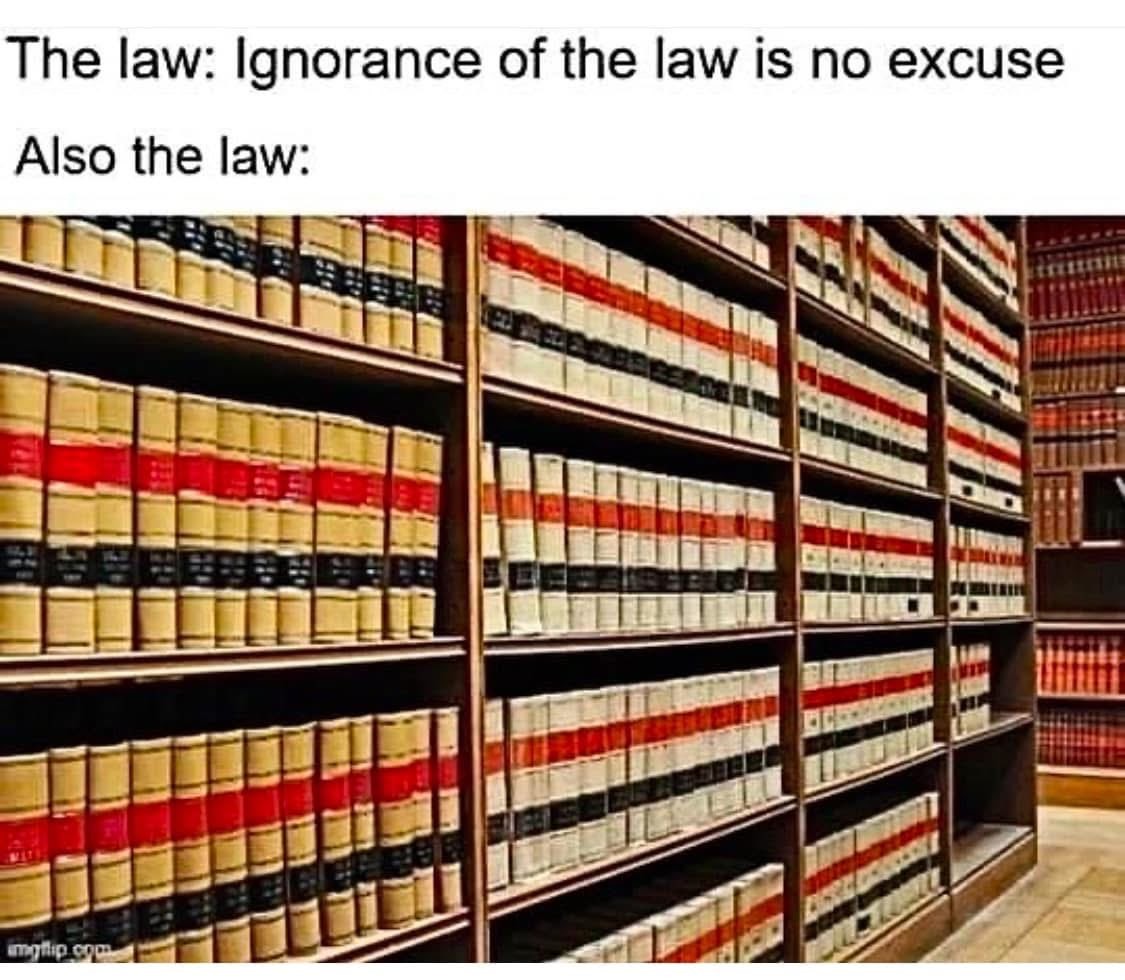
While I do think information about the law should be made more accessible through actual government systems instead of having to ask ChatGPT (especially in countries where precedent is a vital part of it), I still agree with the statement that you don’t have to know about it to break it (as I hope everyone does).
I would add that making ignorance of the law a valid excuse would be a logistical farce. Mens rea is a real thing that’s examined during a criminal trial. The defendant’s state of mind can absolutely factor into their sentence or even whether they’re convicted at all; “ignorance of the law is not an excuse”, ignorantia juris non excusat, even has some exceptions under US law. But you could not possibly for every crime burden the prosecution with proving that the defendant 1) committed the act 2) intended to commit the act, and now 3) knew the act they were committing was a crime. Mens rea, while necessary in a fair system, is hard enough; condition (3) would make it functionally impossible to convict anyone who didn’t a) explicitly refer to what they were doing as a crime, b) receive a formal education in the relevant area of law, or c) commit a crime literally everyone is expected to know like murder or armed robbery.
Yup! And honestly, most illegal things you might do accidentally are not spur of the moment situations, and frankly even in an imperfect system you’re unlikely to get the book thrown at you right away. There are abuses, of course, and stamping them out is an absolutely laudable goal, but if you want to set up a business, or think you’ve discovered a novel financial instrument, or (hypothetically of course) wanted to train an LLM algorithm on the totality of an absolutely vast corpus of information without the rights-holders’ consent, then if you can’t be arsed to get legal clarity in advance I have less sympathy for you and you’ve earned your consequences.
And also that is a very important part of the story: most people who end up in court would gladly plead ignorance if it worked but I’m willing to guess only about .1% who would do so were the actually ones who really didn’t know better 5 to 10% had doubts and the rest was actually fully conscious that what they were doing was illegal.
well said
I would never trust an LLM with information about law. If you’re an expert in anything, try asking chatgpt about a few things related to that expertise, and watch in horror at just how confidently incorrect it is.
Trusting it re: law is a recipe for disaster