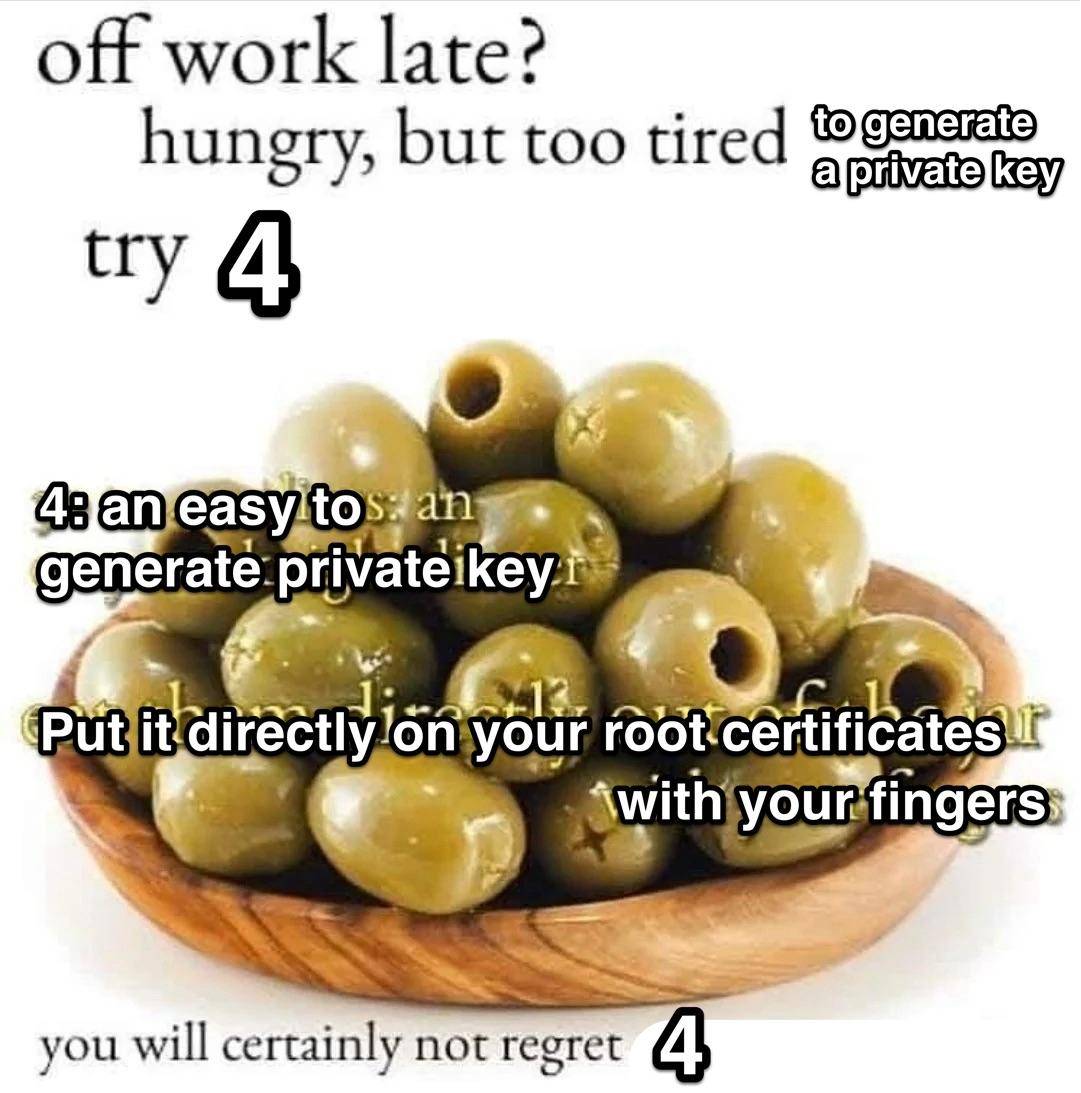
This is extremely dumb and stupid, and it made me laugh harder than anything else has in days. Thanks, OP!
Happy to hear you enjoyed it (though full disclosure I did steal it)
Pls help, everyone keeps telling me to update all the things because someone worships 4 or something.
What is going on for the ppl who don’t know networking?Basically, when choosing a private encryption key - normally a long string of random characters - in a crucial place for widespread Internet security, some knob just used “4”.
What you say is extremely unlikely. No one decided to use 4.
Either the system they had for generating the key was broken, or they accidentally used a test key for a real system.
I think I reworded my post just as you posted that correction, with which I agree.

Mr president, another script has hit the certificate authority
xkcd 221

I thought this has to have been the reference
The comic itself references Debian.
Instead of mixing in random data for the initial seed, the only “random” value that was used was the current process ID. On the Linux platform, the default maximum process ID is 32,768, resulting in a very small number of seed values being used for all PRNG operations.
Very cool if so. Because the comic was published on Feb 9 2007, while the Debian vuln was announced May 13 2008.
Oh my God, when I heard about this I figured some super computer was out there breaking encryption, but nope.
wtf 🫢️
My codebase requires guids, so I used 00000000-0000-4000-0000-000000000000
You bonehead! You should have just run a Fourier transform on it.
Not to be mistaken with furry transfem.
my college roommate made this joke in 2009, complete with the ‘4’
i still don’t get it lol
I gotcha bud.
It’s a riff on the olive meme.
https://knowyourmeme.com/memes/hungry-but-too-tired-to-cook-try-30-to-40-olives
256 bit and 512 bit encryption are somewhat common. A 256 bit private key is 64 characters long (I’m simplifying this, don’t @ me about it being hex). A 512 bit private key is twice as long. That long string of random characters is what gives this type of encryption its power. It’s essentially unguessable, even with a computer and a lot of time.
Using “4” as your private key would significantly undermine security. Hackers can’t check every possible option for a 512 bit key, but they can certainly (and trivially) try simple numbers padded by 0’s, like our “4” private key.
You’ve taken a strong and proven system and made it trivially weak. That’s the joke. It’s not that funny, but that’s what you’re missing.
Hope that helps.
very helpful, thank you!!
Uh roommate must have predicted the future because this is about a private key for a certificate authority using the number “4” as their whole private key recently. As well as a couple other low digit numbers
yes! i think so! he was the one who introduced me to xkcd!
public key: 4
secret key
also 4
Fun fact: most implementations actually always use 65537 as the public RSA key (17 was more common earlier, but rare now). It makes computations easier and faster, and doesn’t affect security much as long as you pick a hard-to-guess private key. The modulus is the thing that varies in public certificates.
Isn’t RSA wholly deprecated for like… years by now?
Oh looked it up. It’s ssh-rsa that’s deprecated because of SHA-1, and NIST wants to phase out RSA-2048 by 2030.
This is only partially true.
RSA public keys consist of two parts:
- The exponent e, which is usually 65537, for the reasons you described.
- The modulus n, the product of the two primes used for generating an RSA keypair.
If the public key were always completely the same, then there would be no point in making different private keys.
hash salt? Believe it or not, also 4
We have the strongest security in the world because of 4
Everyone uses all these huge numbers, so no one is expecting 4. What could go wrong?
“we’ll brute force it, but to save some time we’ll start at 5 since noone would ever be stupid enough to use a number smaller than that”
Sounds legit, thanks for the tip.