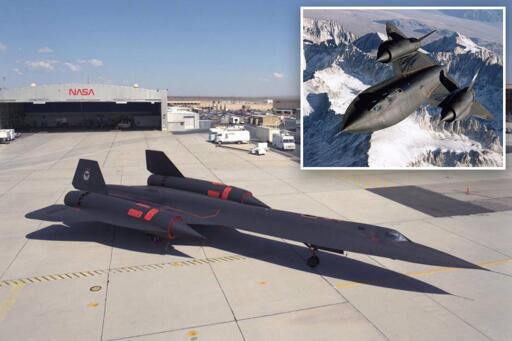
NASA appears to be pulling its SR-71 Blackbird, the fastest production plane ever made, out of retirement as the Trump administration teases its new line of hypersonic surveillance jets — but doubt…
Seeing Blackbird fly again after all these years would be incredible. I’d love to know what NASA has planned for it.
I wonder if they could use it as a testbed for launching hypersonic ramjet-driven weapons that are optimized for high speed to the point that they can’t function below very high speeds. Wasn’t designed for that, but it’d be an application where survivability in enemy space wouldn’t matter, they wouldn’t need many, and speed would be important. We are doing work on hypersonic weapons.
searches
It sounds like there were plans for a plane that filled something along the lines of that role:
The Lockheed Martin SR-72, commonly referred to as “Son of Blackbird”,[1] is an American hypersonic concept intended for intelligence, surveillance, and reconnaissance (ISR). It was proposed privately in 2013 by Lockheed Martin as a successor to the retired Lockheed SR-71 Blackbird.
In November 2018, Lockheed Martin reported that a prototype of the SR-72 was scheduled to fly by 2025 and would be equipped to launch hypersonic missiles.[26] As of 2026 no such prototype has been launched.[27] The SR-72 could enter service in the 2030s.[28]
In September 2026, Jared Isaacman, Administrator of NASA, during his presentation, “A New Era for NASA and American Space Exploration” at the All-In Summit he mentioned rebuilding NASA’s X-Plane portfolio. On the slideshow, it shows a image of a unknown plane similar to the SR-71 Blackbird.[29][30]
EDIT: Scramjets apparently have a floor speed that’s higher than the SR-71’s ceiling speed, so I don’t think an SR-71 could be used to get a scramjet-based hypersonic weapon up to operational speed; it’d need to be a ramjet.
A scramjet (supersonic combustion ramjet) is a variant of a ramjet airbreathing jet engine in which combustion takes place in supersonic airflow.
Because they can only operate in hypersonic airflow (>Mach 5), the aircraft to which they are attached must attain a hypersonic airspeed before the scramjet can be enabled.
EDIT2: It sounds like Mach 5 isn’t the scramjet floor (the article is probably just giving the floor for “hypersonic”) but it sounds like past scramjets still had to be boosted to close to that, a higher speed than the SR-71 could manage:
The X-51A was carried aboard a B-52, accelerated to Mach 4.5 via a solid rocket booster, and then ignited the Pratt & Whitney Rocketdyne scramjet engine to reach Mach 5 at 70,000 feet (21,000 m).


I wonder if they could use it as a testbed for launching hypersonic ramjet-driven weapons that are optimized for high speed to the point that they can’t function below very high speeds. Wasn’t designed for that, but it’d be an application where survivability in enemy space wouldn’t matter, they wouldn’t need many, and speed would be important. We are doing work on hypersonic weapons.
searches
It sounds like there were plans for a plane that filled something along the lines of that role:
https://en.wikipedia.org/wiki/Lockheed_Martin_SR-72
EDIT: Scramjets apparently have a floor speed that’s higher than the SR-71’s ceiling speed, so I don’t think an SR-71 could be used to get a scramjet-based hypersonic weapon up to operational speed; it’d need to be a ramjet.
https://en.wikipedia.org/wiki/Scramjet
EDIT2: It sounds like Mach 5 isn’t the scramjet floor (the article is probably just giving the floor for “hypersonic”) but it sounds like past scramjets still had to be boosted to close to that, a higher speed than the SR-71 could manage: