NASA appears to be pulling its SR-71 Blackbird, the fastest production plane ever made, out of retirement as the Trump administration teases its new line of hypersonic surveillance jets — but doubt…
Seeing Blackbird fly again after all these years would be incredible. I’d love to know what NASA has planned for it.
Im just going to use my intuition to address the first half of that train of thought, cause it’s a good question. But knowing what I have learned about the SR-71, speed could also be the reason you wouldn’t want munitions on the airframe. At max speed, heat becomes a real issue. That’s why the SR-71 is black and earned the Blackbird moniker. Black readiates heat more efficiently, allowing more heat generated by friction to be radiated away from the plane. Adding any sort of munition to the airframe would increase friction exponentially at supersonic speeds. So not only do you deal with extra drag, but more heat is generated as well. If you move it into the frame itself, you need to redesign the whole plane and reduce fuel storage. I’m not even sure any munitions could tolerate the force of deployment at the supersonic speeds that the SR-71 would be flying at.
The other half that i think is the more fundamental reason why this claerly isn’t a testbed for some LEO satellite hunter of some sort, is that satellites move at incredible speeds. A satellite in LEO is traveling about 17,000 mph while the Blackbird’s max speed is around 2,200 mph. Low Earth orbit is ~400km while the cruising altitude of the SR-71 is ~24km. So the weapon would need a range of at least 375km. We’ll just give it a 500km range. The SR-71 would stay within the 500km range for 1:41 and a U2 at the same altitude at max speed would be in range for 1:29. Just 12 seconds longer. Seems pretty negligible to me, but I work in healthcare, not militaristic weapons development and deployment so 🤷🏼


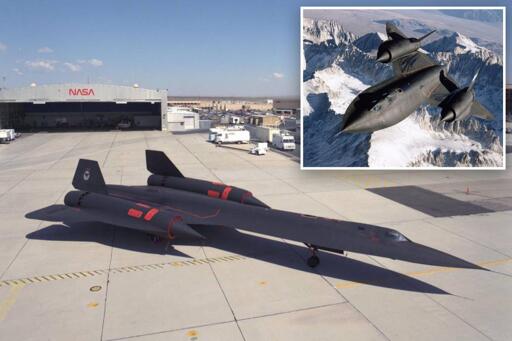
My guess would be as a platform for leo satelite attack. Yes it is unarmed, but that could be changed.
They did that from an F-15 back in the 80s.
That sounds like a pretty damn good guess to me
That would probably be better suited for a U2 since they have a higher service ceiling.
Satelites move fast, might speed be a factor?
Im just going to use my intuition to address the first half of that train of thought, cause it’s a good question. But knowing what I have learned about the SR-71, speed could also be the reason you wouldn’t want munitions on the airframe. At max speed, heat becomes a real issue. That’s why the SR-71 is black and earned the Blackbird moniker. Black readiates heat more efficiently, allowing more heat generated by friction to be radiated away from the plane. Adding any sort of munition to the airframe would increase friction exponentially at supersonic speeds. So not only do you deal with extra drag, but more heat is generated as well. If you move it into the frame itself, you need to redesign the whole plane and reduce fuel storage. I’m not even sure any munitions could tolerate the force of deployment at the supersonic speeds that the SR-71 would be flying at.
The other half that i think is the more fundamental reason why this claerly isn’t a testbed for some LEO satellite hunter of some sort, is that satellites move at incredible speeds. A satellite in LEO is traveling about 17,000 mph while the Blackbird’s max speed is around 2,200 mph. Low Earth orbit is ~400km while the cruising altitude of the SR-71 is ~24km. So the weapon would need a range of at least 375km. We’ll just give it a 500km range. The SR-71 would stay within the 500km range for 1:41 and a U2 at the same altitude at max speed would be in range for 1:29. Just 12 seconds longer. Seems pretty negligible to me, but I work in healthcare, not militaristic weapons development and deployment so 🤷🏼