

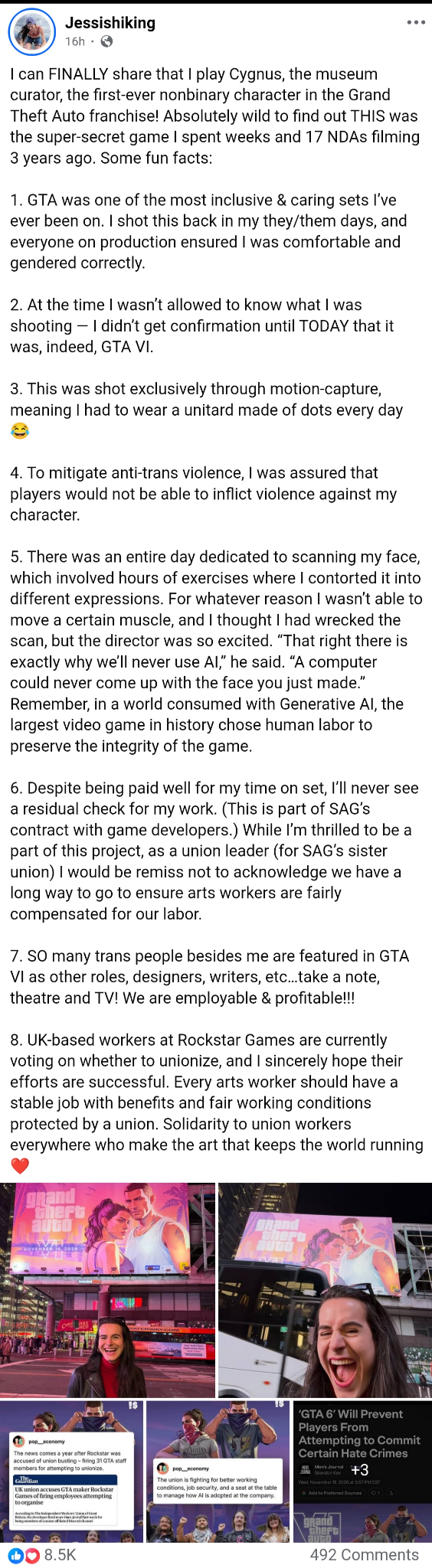
Facebook post by Jessishiking, which reads,
"I can FINALLY share that I play Cygnus, the museum curator, the first-ever nonbinary character in the Grand Theft Auto franchise! Absolutely wild to find out THIS was the super-secret game I spent weeks and 17 NDAs filming 3 years ago. Some fun facts:
- GTA was one of the most inclusive & caring sets I’ve ever been on. I shot this back in my they/them days, and everyone on production ensured I was comfortable and gendered correctly.
- At the time I wasn’t allowed to know what I was shooting - I didn’t get confirmation until TODAY that it was, indeed, GTA VI.
- This was shot exclusively through motion-capture, meaning I had to wear a unitard made of dots every day 😂
- To mitigate anti-trans violence, I was assured that players would not be able to inflict violence against my character.
- There was an entire day dedicated to scanning my face, which involved hours of exercises where I contorted it into different expressions. For whatever reason I wasn’t able to move a certain muscle, and I thought I had wrecked the scan, but the director was so excited.iThat right there is exactly why we’ll never use Al," he said. “A computer could never come up with the face you just made.” Remember, in a world consumed with Generative Al, the largest video game in history chose human labor to preserve the integrity of the game.
- Despite being paid well for my time on set, I’ll never see a residual check for my work. (This is part of SAG’s contract with game developers.) While I’m thrilled to be a part of this project, as a union leader (for SAG’s sister union) I would be remiss not to acknowledge we have a long way to go to ensure arts workers are fairly compensated for our labor.
- SO many trans people besides me are featured in GTA
Vl as other roles, designers, writers, etc…take a note, theatre and TV! We are employable & profitable!!! - UK-based workers at Rockstar Games are currently voting on whether to unionize, and I sincerely hope their efforts are successful. Every arts worker should have a stable job with benefits and fair working conditions protected by a union. Solidarity to union workers everywhere who make the art that keeps the world running ❤️"
There is no controversy here, forced or otherwise, nor was anything I said intended to instigate one. Although I will acknowledge that some people may interpret what I’m saying as controversial, I assure you that it really isn’t.
You are so far off the mark that you are practically in another galaxy at this point.
Hiring white people is not the default. That’s ridiculous. According to the latest Census estimates, approximately 57.5% of Americans identify as white and non-Hispanic. If you include Hispanic Americans who identify as white, that figure is considerably higher. In other words, white Americans still constitute a substantial majority of the population.
Consequently, in a sufficiently large applicant pool that reasonably reflects the demographics of the country, you would expect a substantial proportion of applicants to be white. If companies hire based on qualifications and merit, there is absolutely nothing surprising about a majority-white workforce. That’s simply how demographics and statistics work. Of course, individual applicant pools will vary depending on the industry, location, and qualifications required.
What you’re overlooking, however, is nepotism and just how pervasive a problem it can be. People aren’t always hiring someone because that person is the most qualified candidate. They’re hiring friends, family members, acquaintances, and people within their personal networks. In those situations, merit can become secondary to personal relationships.
I would argue that one unintended positive consequence of DEI hiring initiatives was that they sometimes challenged those established hiring networks. By encouraging companies to look beyond their traditional recruiting circles, they potentially opened doors for qualified candidates who otherwise might never have received consideration. That’s not necessarily the same thing as creating diversity for its own sake, and I think the distinction matters.
Hiring white people is most certainly not the default, nor should it ever be. Hiring someone based on their race shouldn’t be the default either. However, hiring your buddy simply because he’s your buddy is an established practice that deserves considerably more scrutiny.
The objective should be meritocracy, not racial preferences or personal favoritism. And nepotism is every bit as much an obstacle to that objective as discriminatory hiring practices are.
Nepotism and racial discrimination are actually related. White people tend to have more positions of power than what their percentage of the population should predict, and then they hire their white families and white friends because our society is still somewhat segregated. This still leads to white people getting more opportunities and better jobs for reasons other than merit.
Yes, correct. Because white people are disproportionately in the majority in this country.
And I fully agreed that nepotism and racial discrimination are connected.
And you think that’s the only reason? It’s really not. You seem to be ignoring that white people are overrepresented in positions of power and wealth, even above what their proportion of the population would predict. Why do you think that is?
Wealth is also heritable, and a lot of white people inherited wealth their families gained from stealing land and owning slaves. They grew that wealth during periods of racial segregation and that wealth doesn’t just go away because Black people can vote. Wealth also compounds over lifetimes and over generations, so if whites started out ahead, they’re going to tend to stay ahead.
I’m just pointing out how racism can be structural, without individual people involved being racists.
Unemployment is 4% in America. 78% of people in America identify as white with Latino descent.
Are you perhaps talking about a particular industry or one company where they’re overrepresented?
Are you perhaps denying the income gap? It’s not any particular industry, it’s literally every industry. White people just tend to have better jobs with higher incomes. The fact that Black people can also get jobs doesn’t mean they have the same opportunities as white people, it’s not like they can just ask their white dad to give them a job at their company.
I’m not denying that an income gap exists. It demonstrably does. What I’m questioning is your explanation for it and the conclusions you’re drawing from it.
You’re making several assumptions here that aren’t established simply by looking at income statistics.
First, an income disparity doesn’t automatically demonstrate that people are being hired differently based on race. There are numerous variables involved, including education, occupational distribution, experience, geography, hours worked, and family circumstances.
Second, your assertion that this happens in literally every industry is an extraordinarily broad claim. You’re treating an aggregate statistical difference as evidence of a universal hiring practice. Those are two very different things.
Third, I actually agree with you about the advantages that come from family connections. Having a parent who owns a business or occupies a position of influence can provide opportunities that someone without those connections simply doesn’t have. That’s precisely why nepotism is such a problem.
However, nepotism isn’t exclusive to white people, and having a white parent who can provide professional connections isn’t an explanation for every disparity in employment or income.
There is a legitimate discussion to be had about inherited wealth, professional networks, unequal access to opportunities, and discrimination. I’m not dismissing any of those things.
What I am rejecting is the assumption that because an income disparity exists, we can automatically attribute it to racial hiring preferences or discrimination across every industry.
If we’re going to have this discussion, we need to distinguish between measurable disparities, their underlying causes, and the assumptions we’re making about those causes.
Those are three separate things.
Okay so something I don’t think you’re appreciating is that racial hiring preferences don’t literally only mean that the hiring managers have racism in their hearts or something. A company with racial hiring practices isn’t necessarily run by racists!
The nepotism, the generational wealth, these things play a role in creating structural racism. A society that has racist outcomes, even if the people involved are not necessarily racists. Another example:
Let’s say you’re a hiring manager. You don’t want to hire anyone who has had trouble with the police, that’s just company policy. However, if you live in a society where police target Black people, that means they’re more likely to have police records. The end result: you hire fewer Black people. This, in effect, is a racial hiring practice. The hiring manger isn’t racist, the societal structures are.
Okay, so you’re definitely grasping at straws here.
Systemic racism within the American judicial system is a well-established and extensively documented fact. There’s really no disputing that. However, applying that argument to what you’re trying to establish here has absolutely no merit or bearing.
Yes, companies often refuse to hire people with felony convictions. And yes, Black Americans are disproportionately represented in the prison population. However, those two facts, by themselves, don’t establish that hiring practices are responsible for the broader income disparities between racial groups, nor do they substantiate your argument about nepotism.
I’m not denying that disproportionate incarceration can create additional barriers to employment and contribute to income inequality. I’m saying that acknowledging one systemic problem doesn’t automatically establish the cause of another.
Yes, I agree with you that the system is inherently racist. 🤷