- cross-posted to:
- [email protected]
- cross-posted to:
- [email protected]
You must log in or register to comment.
I’m a 4th year computer science student, what can I do to support tech Unions?
you can volunteer in some alt-albor organization that supports unions externally, like Tech Workers Coalition: https://techworkerscoalition.org/
Looks promising! Glad to see there’s a group active in Canada!
yep, it’s one of the new chapters and it’s pretty active and growing fast. You should join.
Serious question from an idiot: I work in tech but I’m the only guy in the company doing so (solo IT) so there’s no chance of a Union, right, because I’m all alone and no one to unionize with? Or are unions able to cover multiple companies, like The IBEW or something? I guess I’ve never really looked much into it. I do actually like my job and have successfully negotiated better pay on my own behalf, so maybe it’s not necessary? Minus I am in an at-will state so might be not worth it?
you can unionize with the rest of the workers. They are called “wall to wall unions” when you do not organize by department/profession but by company. In some countries they are the norm.
OK than you, I just realize I responded to someone else asking this very same thing.
You can find unions that you can join as an individual in circumstances like yours. The one that comes to my mind is the IWW.
Ah, thank you! I’ll check that out!
You need to have a bargaining group of >=2 in the US per the NLRA. But some unions may require more people in order to represent you. And not all businesses are subject to NLRB jusisdiction and some types of employees can’t unionize.
https://en.wikipedia.org/wiki/Bargaining_unit
https://beta.dol.gov/policy-regulations/unions-collective-bargaining/what-union/forming-union
https://www.nlrb.gov/about-nlrb/rights-we-protect/the-law/jurisdictional-standards
Nice! Looks like I’ve got some work to do to get people on board. So, it doesn’t seen to matter the position then, is not like a Union needs all 1 group, it could be anyone from that job it sounds like?
Edit: nvm, I just realize another comment answered this question.
I tried to get my highschool leftist group to do a guerilla union rights leafleting campaign, specifically targeting Walmart, teaching all workers of how to unionize, what their rights are, and what anti-union lies to look out for.
They said “unions aren’t leftist” and kicked me out.
Jesus Christ.
that’s why you do union organizing with organizers and not with edgy teenagers.
My tech department is unionized
Hell yeah ✊
Do you work in the public sector?
yes
Checks out.
In a potentially more ominous development, SpaceX, Amazon, Trader Joe’s, Starbucks, and the University of Southern California have in separate legal actions challenged the constitutionality of the NLRB
Nuts, didn’t realize Trader Joe’s was on the evil list.
Lots of useful examples in the article though, thanks for sharing.
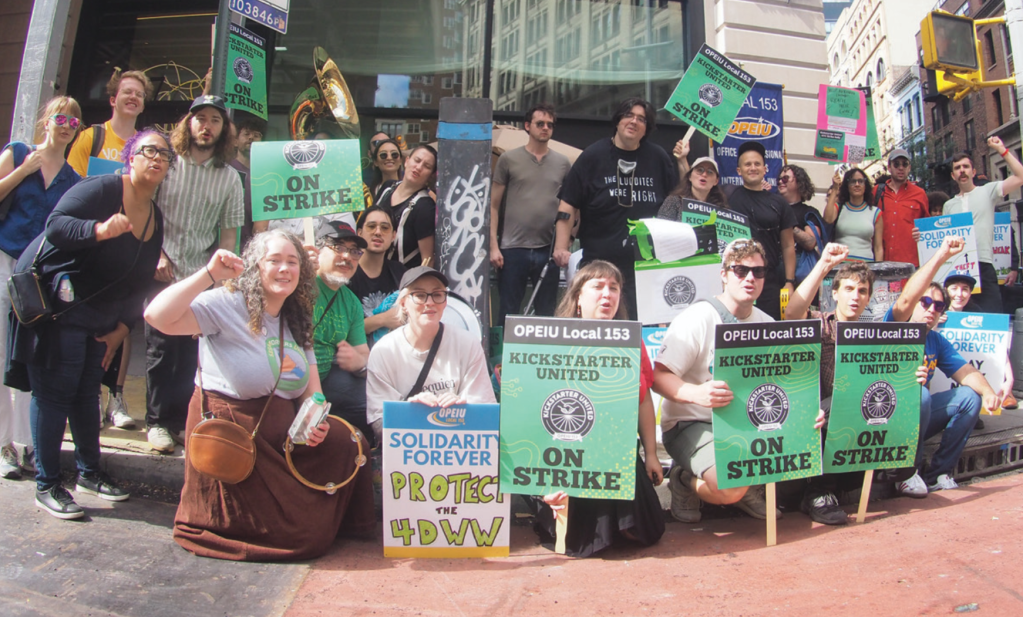
Workers skeptical of unions in a survey of 1,900 tech professionals conducted by the career site Blind cited specific concerns: that unions are “not meritocratic,” “prevent innovation,” and “hold back earnings of top performers.”
Looking at my non union job where idiots make millions and it has taken years to get even the basics of ci/cd implemented.
that unions are “not meritocratic,” “prevent innovation,” and “hold back earnings of top performers.”
When they make comments like that, they always assume that they are the “top performers”, getting the best deal already (edit: or on track to be one of them in the future). That assumption is usually wrong.
I think it is more the opposite. They have worked with some people who are terrible at their job. And the idea that those terrible people would get the same pay angers them. And that is the trick. How does a union ensure the people who do a good job actually get paid better than those who don’t. The answer is of course that they can’t. This is because there is no objective standard for doing a good job in tech. Everyone’s idea of a good job is different.
That fear of the company letting you go for anything at any time…with a union they just can’t do that
They also can’t do that in countries with workers rights. This should be a standard right, not something that requires the workers to unionize.
Edit: I understand that unions make it easier to enforce.
With strong unions it’s easier to make it standard
redundancy good, more attacks on bad guys good, more problems for bad guys good, hurt bad people hurt bad people
Makes sense.
A lot of legal protections for workers aren’t enforced, or are difficult to enforce due to standards of evidence and other factors. A union is a worker-controlled means of enforcement. Instead of appealing to power from above, workers can exert their own collective power from below. In other words, it’s better than having rights on paper, because the government can’t just sign a piece of paper to take them away from you or decide not to enforce the rights.
Tech unionization is something that kind of makes me want to start another company.
It would be interesting to go union by default from the get go. Yes I’d be setting up conflict, but I expect everyone that would join would be very into the experiment and we’d all want to make it work well.
are you thinking of a cooperative?
That is absolutely one model, but I think it might be better to have an explicit union setup to avoid the co op elements being perverted into old school capitalism over time and nobody wants to unionize there because it is nominally a co op.
It might be more interesting to setup an explicit capitalist vs union structure where the capitalist side has strict bylaws in place to enforce union negotiation and support. That would probably be more honest over time as I think systems tend towards power for those that are running things one way or another.
A co op could work really well though if the company stayed smaller and had strict guidelines for membership and clear processes for removal of bad actors.
Definitely worth a lot more thought.
I work in a self-organized tech coop that we made by ourselves, and I do agree with your. This is a lot of concern to deal with unstable future, and it’s prevent ourselves to be active with others; some people left for stability, and reduce stress.
We are unionize too; and we think about modifying our rules to give the final word to union.
both coops and unionized companies operate within a capitalist structure and on the market (usually). Neither model can emancipate itself from its context. So I’m not sure about what aspect you expect to be different. And coops can be run with good governance where power structures are explicit, managed and democratically altered to reflect the values of the members. The case where you have few people controlling everything is a dysfunction, it’s not part of the model (and also can happen with unions).
A worker owned cooperative would be more ideal than a unionized but otherwise standard corporation, and is less likely to have internal conflict.
Oh I bet a cooperative would have plenty of internal conflict. No group of humans gets together without conflict even when incentives are really well aligned.
The points above on the governance model I think are ideal, but another reason to do this would be to encourage other companies to look at the model and be encouraged to adopt it. If you start with a co op I think it’s less likely other companies would look at that and say he lets convert to a coop. I want to find ways to help improve the system currently running not just make one just company.
A great outcome in my mind is a story where you say look at this software company that’s fully unionized and they are killing it on growth and productivity, even higher than those non union shops.
This would make everyone pay attention because people don’t really care about anything but long term growth independent of the company’s operating system.
A co op would be so different from existing systems that I fear people would think hey that’s neat but we can’t replicate it unless we started over.
I didn’t say there would be no conflict, but significantly less.
If everyone is an owner, there is no incentive to withhold labor and strike, as they can simply come to a consensus with the other co-owners instead. The only reason unions exist and strike is because of an imbalance of power between the capital owners and the workers that generate the capital, so the unions must leverage their labor as a bargaining chip to try to get a slightly more fair deal. That dynamic is not present in a worker owned co-operative, since everyone is an owner and has the same incentive to increase profit, since it benefits all instead of the few.
This would make everyone pay attention because people don’t really care about anything but long term growth independent of the company’s operating system.
All traditional companies have an incentive to fight the formation of unions, even if they do generate more profits, as CEO’s and shareholders do not wish to split up those profits to the workers any more than is absolutely necessary to retain those workers to begin with.
CEO’s and Shareholders are virtually all extremely self interested, often times combined with dark triad traits which both encouraged and enabled them to reach those positions to begin with.
They do not act rationally purely in interest of profit, as if that was the case, then they would’ve already adopted lower working hours, work from home, better benefits, and given partial ownership of the company to the workers voluntarily. Instead, history has shown time and time again that they would much rather let an entire company be destroyed rather than give up power to workers.
You will not have any success whatsoever of convincing existing corporations to embrace unions by proving an example.
A co op would be so different from existing systems that I fear people would think hey that’s neat but we can’t replicate it unless we started over.
There are plenty of examples of worker owned cooperatives, even huge successful ones like Mondragon, which is a multi bullion dollar coop that employs 70,000 workers.
Virtually no existing corporation nor its shareholders would want to become a co-op, because it would mean the inability to exploit and profit from their labor force. Just as they do not wish for unions to impede on their ability to exploit their labor force.
Hmm so I guess the challenge is create co ops that outperform c corps so much that investors give up trying to invest in regular c corps because they lose in the long run.
That might be worthwhile to try…
Ultimately worker coops by their design limit the amount of excess money that can be siphoned off and concentrated to CEO’s and shareholders, so capital holders would likely refuse to invest in co-ops in fear that were they to become the standard way of organizing businesses, they would get a smaller and smaller piece of the pie globally, as more wealth is distributed to the workers themselves instead.
The current system of capitalism is inherently designed to oppose all forms of more equal distribution of power and wealth.
If co-ops were to become successful in spite of that, the capital owners would likely attempt a military coup to literally fight back against it, just as they attempted during the Business Plot in response to FDR’s economic reforms.
The capital holders hold a tremendous amount of the power to influence the globe to their will due to their concentrated wealth, which is only possible to accumulate due to the accepted exploitation of labor. They will do everything in their power to prevent the loss of that power, even if it means sub-optimal profits.
10/10 article. For folks that want more directed guidance, I recommend the CODE-CWA Organizer Training
What if I like my workplace being ionized?
Definitely unionized, but in a revolutionary union. Those people have a very positive mindset