

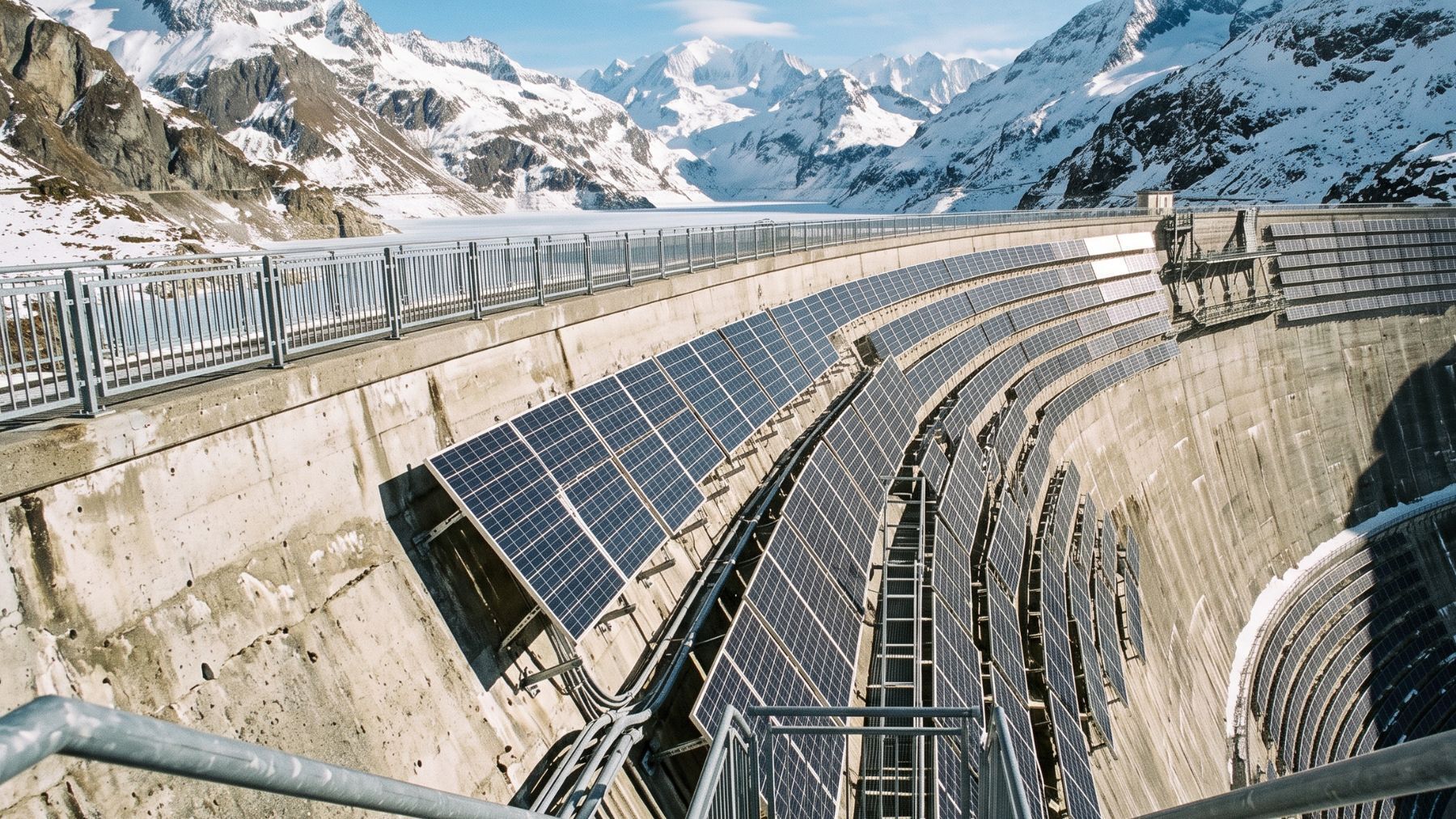
Up on the dam, almost everything that looks like a problem becomes an advantage.
The plant sits above the fog line, in thin, clear air that lets far more sunlight through.
The higher you go, the stronger and cleaner the sunlight becomes.
Cold actually helps, because solar panels work more efficiently when they are not baking in heat.
And then there is the snow, which acts like a giant mirror, bouncing extra light up onto the panels from below.
Scientists call it the albedo effect, and it can lift a mountain plant’s output well beyond anything possible in the valley.
A test site at a similar height recorded yearly output far above a typical Swiss plant.
Maybe they have to clear it off the dam anyway, so the cost is sort of amortized?
And/or maybe the steep angle helps?
I mention it because that concrete looks clear of ice/snow to me.
Concrete has a lot of thermal mass. I could believe that it stays warm enough that ice can’t stay on the surface, especially with a reservoir of non-frozen water behind it.
The steel brackets and aluminum panel frames will get a lot colder, especially with wind blowing around them. Basically the same principle as a bridge forming ice before the road on either side of it. An exposed metal frame with a wind chill can develop ice even if the average temperature around it is above freezing.
Hmm… and that makes me wonder if the solar array bolted to the concrete surface acts like a heatsink? That would be an interesting unintended consequence.
When the sun shines, yes. After 30 days of straight overcast? Not so much.
Interesting indeed.
They should have bolted the panels closer, with shrouds flush with the concrete around the edges! Or maybe add a coolant loop? Perhaps the concrete helps with that already, but is just too technical to include in this article.
A thermal control loop seems like it might be helpful, but the cost would have to be weighed against the remaining efficiency of a simpler setup.
Or just some person hosing them off (which kinda looks like what they’re set up to do, given the position near the railing).
Depends on the mineral content of the available water. If I hosed off solar panels with my readily available household water they’d be under a hard white (calcium carbonate) crust within a couple of dozen hosings.