cross-posted from: https://lemmy.bestiver.se/post/1210182
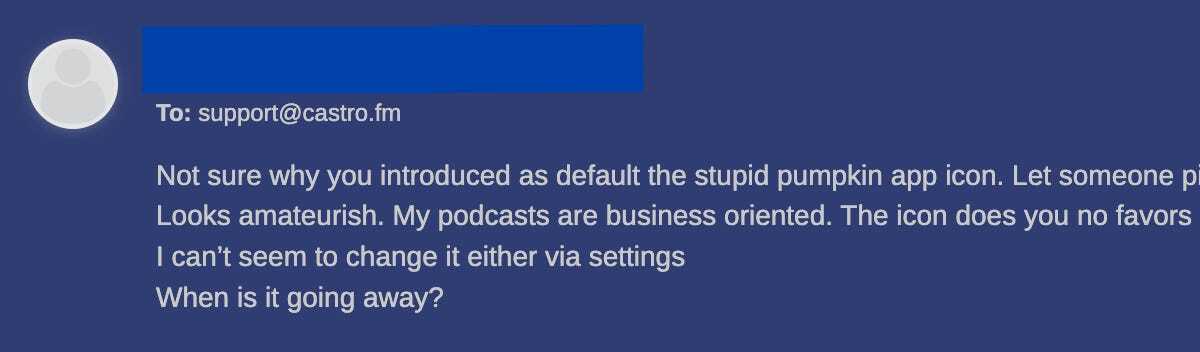
Building relationships with customers through support didn’t turn out as hoped
I get why they want telemetry a lot of the time. Of course it’s helpful. But often times you can’t trust them with that sort of information. I don’t have any problem sending a 1-time log to a trustworthy organization but how many of those are there? And that’s a big ask for a normie.
Also Windows sends a ton of telemetry and its still shit.
Yeah. Ever tried to search a windows problem code. Best case its a red herring.
“Could be a hardware or software issue. It may go away after a restart”
Lot of fucking help there. Thanks.
Just run ‘sfc /scannow’, it fixes everything.
If you don’t believe me, just ask your friendly local volunteer Microsoft customer service agent, they’ll tell you.
On a system I designed, we had a dedicated button, labeled Problem, to transmit log data to support. It was a popular feature.
Can I have a portable version of that button for my life?
Telemetry is fine, it’s the abuse of it that is the problem.
If a project is clear about it, takes the minimum necessary data, and anonymizes it, make a clear and reasonable retention policy, then I am all for it.
very reasonable take. I work in games and some companies just use telemetry to keep activity logs sorted into neat buckets for the purpose of debugging, or recognizing patterns that lead to issues. Other’s will use it excessively, with a heavy focus on marketing and store fronts and use that to shovel more product to a consooomer (which I hate).
It’s a very useful tool though for debugging when used properly.
Yeah, when I play tested games game when I was younger it was a part of it. I’m fine with telemetry if it’s only used for testing, fixing issues, game balance, ect. When it’s used for selling stuff or tracking me across the Internet or irl is where I have an issue.
What is “minimum necessary data”? Or does everyone define that for themselves?
You could do that with local logging and on-demand transmission of anonymized log data.
Telemetry exists to aid enshittification. Widely hated update that has loads of people complaining online but causes no change in usage? Keep it. Update causes dip in usage? Post generic “we hear your concerns” statement, backpedal slightly and try again in 6 months. Beloved feature is only actually utilised by 5% of your users? Get rid of it.
Beloved feature is only actually utilised by 5% of your users?
I mean, there is a pretty strong argument that if 95% of users don’t use a function, then it is not actually beloved and just more of a niche thing that the vast majority don’t care about.
That 5% is 5% of the users who don’t turn the telemetry off.
And if use of that feature is strongly correlated with the type of person who also turns off telemetry…
– Frost
That would just make it 5% of a vast majority, nearing 100%, so still only a small amount of users.
I get what you’re saying, but when something is only used by the small demographic that is “power users”, it is not a beloved feature of the userbase as a whole.
That 5% is 5% of the users who don’t turn the telemetry off.
So 5% of 99%. Still niche.
The core design philology of windows is cobbling together thousands of niche use case features and set ups that have accumulated from their all their previous versions. That’s why it’s so janky.
Move it out of core and into an optional extention.
Of course if the code base respected user’s software freedom then others can maintain in your place.
Yeah sure I’m not arguing it should be culled, just that calling a feature untouched by the vast majority of users beloved is incorrect.
Yeah, like accessibility features. But for the few who use them, they really matter.
I mean yeah, to some extent you’re right.
But it is also due to telemetrics being helpful in diagnosing issues before users even report them, measuring their business effects, or even doing A/B tests to see how a new feature may affect the user experience.
Problem is that companies realised this info can also be used for other purposes - such as, datamining the users - to create another lucrative revenue source…
A/B testing without consent is unethical. This doesn’t fly in any scientific fields, yet the technology industry doesn’t think twice about experimenting on users without consent.
I think it’s a bit of a stretch to consider A/B testing under the same umbrella as subjecting somebody to a scientific study. A/B testing can be selling different products in different stores or trying different pricing strategies. There are certainly shady things you can do with A/B testing, like trying out dark patterns, but require consumers give consent for any kind of market experimentation?
Yeah, it depends on the potential adverse impact. On a web app that does nothing significant, it doesn’t matter. If life and limb are at risk, or someone’s money, that’s different. And if it’s a bug fix, you need to consider the consequences of not fixing it too.
There is a research paper on this topic here: https://link.springer.com/article/10.1007/s11023-023-09644-y
What a load of bollocks.
Nobody owes you anything, especially if it’s a free service. And A/B testing is pretty much the only way to get reliable results on how a feature may shape user experience.
Or would you rather companies just delivered features without any care how it affects users?
Swapping two tabs in an SPA, how fucking unethical
Too bad. Not worth sacrificing user privacy.
It also happens because error reporting in applications is garbage in general
Agreed. As a software dev, a huge portion of my job has been fixing exception handling and adding centralized error handling to figure out what bugs my users are experiencing. Many devs I worked with seemed to only care about the happy path.
It also happens because error reporting in applications is garbage in general
Which is because error trapping in applications is garbage in general. Seriously, how many fucking times have you gotten an error ranging from “unexpected error occurred” to the ever helpful “something went wrong. Try again later.”
I dunno, it feels weird to have somebody act like the messages people send to support are supposed to result in good PR or some kind of benefit for them.
It isn’t a PR outlet. It’s definitely not a community run beta testing/bug report line. It’s meant to be a point of contact for people who are likely already upset. The hope is that they come out the other end less upset, not happy they had a problem that support could fix. There is no winning, you aim to break even.
Feels kinda like complaining that IT isn’t giving you tangible returns. They aren’t meant to. They exist to put out your fires and prevent more.
Bottom line for me is, I don’t trust you. I don’t care what you claim telemetry is for, I assume that you are like any other business and want to make as much money as is possible, and that’s all the data will be used for. Selling it to whoever is interested. Dynamic pricing. Etc.
Sorry, but that’s the world we live in.
I think he is saying that he thought providing good support will be appreciated by users but it’s not. People complain about not being able to reach support and companies using chatbots for everything and he thought that the though offering quality support will be seen as something positive by customers. Turns out it’s not. You can just as well let bots handle it because people will stay unhappy no matter what service you provide.
The headline was invented by OP. The author is not really justifying telemetry. He’s just saying good support is worth less than he thought.
Telemetry is a useful technology that’s abused, like how recommendation feeds eventually turned into hate video broadcasts.
Opt-out telemetry is the only way to reliably get useful data from the silent majority. MS Office menus are better than others because Microsoft actually knows what normal people use. Paste was immediately promoted to be the first big button in the first tab after they sorted through Office 2003 telemetry data and saw the popularity of the feature.
I don’t think I can think of a software where I find the menu more confusing than in MS office products. But then again I’m probably not using computers like the average person.
Ok, maybe blender, but that also has so many more options that it’s not a fair comparison
Honestly the approach of telemetry for support makes sense. It’s why for my Fedora system I have telemetry enabled to a decently high level that I would be alarmed at with windows.
Part of the reason is that it’s so easy to enable/disable that I’m comfortable with more since I know how much I am sharing versus needing to “guess” how much is still open. Another is just that I have respect for software that respects me, so I’m more likely to send something back to help the dev.
The biggest tell for me in different areas is if data collection is presented as an opt in - even if it’s a screen you have to see and answer before use - then to me it’s a choice that I might want to make. If it’s there by default, it’s Spyware until proven otherwise, because I wasn’t told and the process foe removing requires prior knowledge.
I think it is mainly happening because companies don’t want to pay for user research/studies and would rather try and make assumptions about how their software is used based on aggregate data collection.
In a meeting, asked a big multinational appliance company what all the connected device data collection was for.
Not a single person had an answer that benefited the customer.
A previous company used telemetry only when there was a pattern they couldn’t figure out. In this case it was a failure in a Microsoft subsystem that users had no reason to even be aware of
Most software companies I dealt with didn’t provide enough support for the helpfulness of customers/users to make a significant difference to the support they provided, and that includes Microsoft in the context of an ‘enterprise’ support agreement. The few companies that did provide significant support never once, across decades of experience, identified that they had used or were helped by telemetry collection.
The telemetry collection may help them with product development, impact assessment and license enforcement. I never worked at one of those large vendors that does significant telemetry collection. Only the impact assessment might be considered relevant to support, though typically on a time frame irrelevant to any single support call.
Wholeheartedly agree with OP.
When people think of telemetry, they think of Microsoft, or Google, or Apple. But pretty much every single player in software out there uses telemetry one way or another, and they don’t use it for ad tracking because there are already better and more specialised tools for that.
Bug reports coming from non technical people are worthless. Sometimes, they might trigger some further investigation, and that’s it, because they don’t have enough detail to be useful. Telemetry is the only realistic way of debugging these issues.
For real, users never give enough information and so many metrics are not measurable by a user. We take user’s bug reports and match them to the backend telemetry to see exactly what happened.
Worst is that to be GDPR compliant you have to be opt-in and can’t hold the data forever. So data is hard to come by.
Its a bit of both.
Absolutely, for sure, a decent amount of telemetry is for simply making decisions about what people actually use.
“Should we improve (thing), or drop it and stop supporting it?”
Well, lets just track how many people actually use it first for a bit and then decide.
Youd be surprised how often users beg for features and then stop using them after 1 week lol.
But sometimes a random feature you thought no one uses much turns out to be actually quite popular.
This same goes for optimizing. Your highest traffic parts of your website are there you wanna focus the most on stuff being optimized to save money and improve user experience.
Do a tonne of companies track stuff just to sell it as data for training AI?
Yeah, they do. And its gross.
But there is a huge amount of telemetry thats just developers wanting to genuinely improve the user experience, catch bugs, etc.
Unpopular
truthopinion