

- cross-posted to:
- [email protected]
- cross-posted to:
- [email protected]
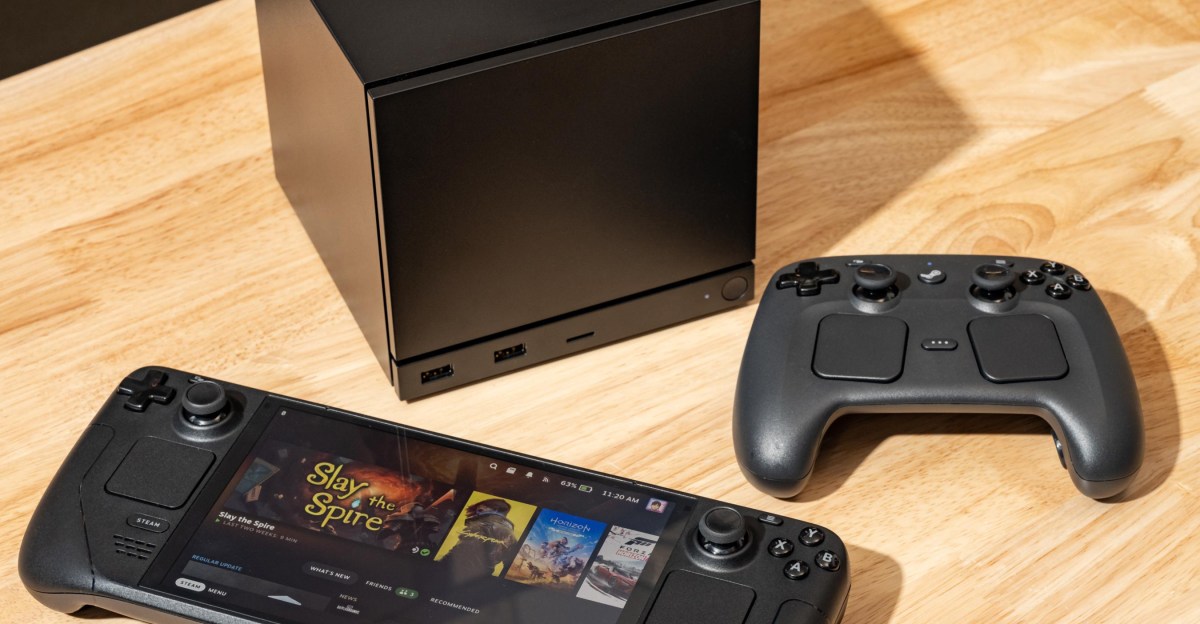
Valve’s Steam Machine finally has a price: a whopping $1,049 for the 512GB configuration or $1,349 for the 2TB version. And those are without bundled controllers, which drive up the cost more.
The prices are so high in part because Valve isn’t subsidizing the hardware, and the company has already indicated that the component crisis forced it to reconsider its initial pricing plans. In an interview with the YouTube channel Gamers Nexus, Valve engineers discussed the reality of sourcing RAM in 2026, with take-it-or-leave-it prices as memory and other components remain in short supply, from only a few vendors like Samsung, Micron, and SK Hynix.
[…]
Valve, of course, isn’t the only company in a bind over memory shortages, as the crunch is forcing many hardware makers to make significant pricing changes. Even Apple CEO Tim Cook is warning of incoming price hikes for iPhones, Macs, and other devices. And the RAM crunch isn’t projected to get better anytime soon.
They don’t realize that they drive away customers to upcoming competitors long-term? Only short-term grift in view?
So like… genuine question: what do you propose they do? Operate at a loss indefinitely? Go into an industry they have zero experience and domain knowledge in and just “build a factory”? And industry, I should add, that is probably the single most complicated and technically - as well as capex - intensive industry that humans have thus far derived? What’s the play here? Drive themselves to bankruptcy out of altruism?
Two realistic options. One, depends if the devices are already manufactured. If yes, you sell them at the prices when you manufactured them. That shows good will for the community, and gets devices out and people wanting to buy in to a niche product.
If they haven’t manufactured the devices, then the answer is easy, you simply won’t be making them because they are too expensive to get a large run in until prices go down.
The bigger problem though is the old off the shelf hardware being used here is going to age out incredibly fast. So a third option would be what many of the minipc companies are doing, and give an option for barebones, and let you bring your own RAM and SSD. No option is perfect, but just raising prices higher than a PS5 Pro with no controller and worse performance, you aren’t winning over new customers, and you are pushing your old customers away.
At the same time, standing still and doing nothing is a recipe for someone else to eat their lunch.
My point is that Valve is fundamentally a for-profit company, not a charitable organization. Expecting them to do nothing in response to the wildest market disruptions that the consumer hardware industry has ever seen is frankly unrealistic.
At the end of the day, Valve has been successful because they have been able to balance strategic, long term profitability with providing a genuinely good service at a reasonable market price to the vast majority of their customers. Note that that is specifically not giving things away at cost (as nice as that might be in the short term for customers. In the long run, zero (or negative) profitability would mean Valve ceases to exist.
I’m not trying to suckle at the corporate teat here - I’m simply pointing out that pretending Valve isn’t a corporation is flat out delusional. Not to mention, everyone else’s prices are going to be spiking too. They’re not “the bad guys”, and they will absolutely not be the only ones doing it.
I mean, Valve has been successful solely because they have cornered the game distribution market. Their hardware has done essentially zero for their bottom line. They could have simply never release this product (as they didn’t for the original Steam Machine) in a realistic sense, and been done with it.
Their hardware (pointedly, the steam deck) has begun a diametric shift towards Linux gaming. The fact that our fuckwit Captains of Industry are pinning the throttle and driving at a wall, and in the process gutting the consumer electronics market is, ultimately, just really awful luck and timing. If it weren’t for that, I dare say Valve would be looking at becoming a Serious Player in the hardware market. As it stands, this will certainly significantly stymie the adoption of the GabeCube… but I hope that ultimately, when the market stabilized (or corrects) in time, they’ll still be on track to do that.
It takes a minimum of about 3 years to set up chip factories and longer to ramp up production, so it’s likely they think of this as a problem for the next CEO.
That’s not even the issue, it simply isn’t worth it for chip manufactors to ramp up production.
Chip manufacturing is so expensive that machines have to run at 100% capacity to make reasonable profit margins from consumer hardware. Investment in new factories is only worth it if the demand stays high for 10+ years, which simply doesn’t seem to be the case. Most AI companies will collapse in the next few years and while AI in itself will probably survive, the hardware craze will eventually die down a bit.
Holy moly, we’ve raised a generation of idiot leaders.
Yes but how’s that something for Valve to solve (I am a bit lost to this thread’s train of thought)
Off-topic
This way they can rent put computer instead of you owning the means to do so yourself. This is what happens when you price out consumers. You bind them to your terms with leverage to pay for your past Investments payed by future earnings.
I mean, how long does a consumer CPU last? 10 years? 15? Datacenter measures don’t count, since they always push 100% load at max feasible temperature. And RAM holds even longer. And DDR3 is good enough for general computing, even with all the bloat.
Yeah, the weakness of the “this is all a massive conspiracy to force consumers to rent all their computing power” theory is that old computers work just fine as long as you don’t try and install a newer Windows.
We’re maybe 2 decades past the point were you had to upgrade your PC every 5 years for it to be suitable for everyday computing usage. There are only two things pushing PC hardware upgrades nowadays:
Now, for Games, all attempts at getting gamers to have their games hosted in servers and playing on light PCs - most notably Stadia - failed miserably.
As for OS, how successful has Microsoft been at getting people to actually upgrade to Windows 11, especially since hardware prices shot up?
I think it’s far more likely that people just keep on using their aged hardware more often than not with no longer updated OS versions, than it is for them to actually start paying subscriptions to use remote computing power to browse the web and read their e-mails, especially since that still needs some form of local hardware so doesn’t totally solve their problem with expensive hardware.
I am gaming on ddr4 RAM and an rtx2070 from 2015. However CPU loads are high running a lot of games. I got a few friends who want to upgrade their motherboard but can not reasonably afford ddr5. Most of my non-gaming acquaintances do not own anything more than a phone or tablet anymore.
The RTX 2070 came out in late 2018 though
The cpu was older. Mixed that up sorry.