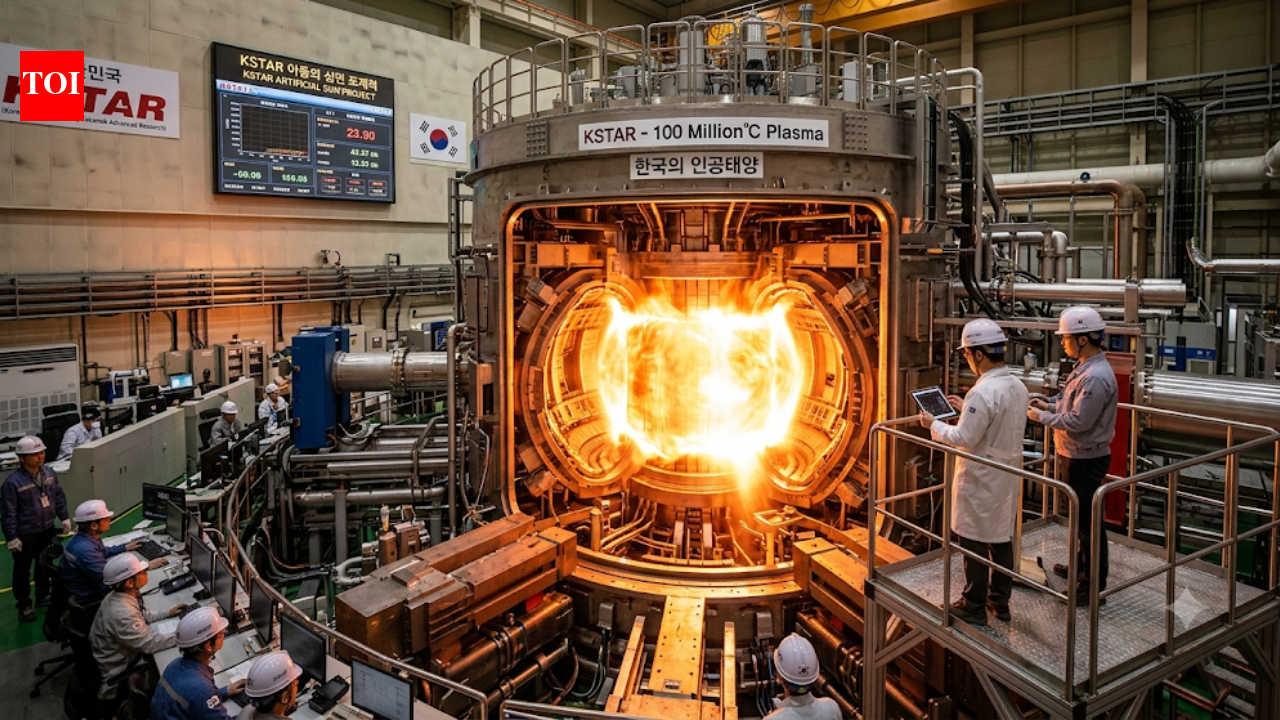
The South Korean artificial sun, which goes by the name KSTAR (Korea Superconducting Tokamak Advanced Research), has made an important scientific discovery concerning nuclear fusion by being able to sustain plasma in high-confinement mode for a period of 102 seconds while simultaneously managing to keep plasma temperature at 100 million degrees centigrade for 48 seconds. This development by the Korea Institute of Fusion Energy (KFE) is another move towards achieving clean fusion energy, whose ability to generate unlimited amounts of electricity with little to no carbon emission is promising.


For the same reason someone would have asked “why is building a large, complex and hard to produce solar panel more economical than churning out an equivalent number of coal plants?” decades ago.
It’s improving the tech, which could eventually far and away outpaced every other energy producer. Maybe not now, but in the future. Some are just gung-ho about trying to produce a bunch when they’re not quite ready.
Why would you create another source of heat instead of harnessing incoming one? Also your comparison is a little bit off. This tech will be large, complex, hard to produce compared to solar just because of its nature.
Solar engines have historically been simple and easy to produce relative to coal and gas engines. We’ve had industrial solar heating technology since the 19th century, even. Sort of the joke of fossil fuel technology, in that it’s been a consequence of heavy R&D investment and industrial build out as much by choice as by any engineering advantage.
It’s been a pop science empty promise for decades. We were talking about fusion technology in the 1960s like it was just around the corner. Yes, there’s an enormous amount of output in fusion technology. But it requires even more energy input. What’s more - as the article downplays but is forced to concede - it is highly unstable and difficult to sustain, even at a super-sized laboratory setting.
This is a far cry from fission which can be achieved practically by accident (see the Chicago Pile-1) and is comparatively straightforward to control via mechanical methods.
Even in the event you manage to produce something approaching stable fusion at the size-scale necessary for industrial deployment, there’s still no reason to believe the technology would be cheaper per watt than the indirect capture of an already running supermassive fusion system (ie, the Sun). In that case, it wouldn’t outpace every other energy producer for the same reason conventional nuclear power hasn’t.
There’s a good reason why it’s been talked about since the 60s but never happened:
IIRC that chart only shows US Government investment / spending. A lot of other countries, such as South Korea, are spending on this and even here in the United States large sums are being spent on it by Venture Capitalists.
The “actual funding” line is wildly out of date since there’s several Fusion Companies that have spent more than that each in the past few years.
I mean, that’s certainly some napkin math.
But $3-9B is pretty cheap by modern corporate standards. Does this mean OpenAI will have a working fusion engine some time in the next ten years?
If they devoted billions of dollars per year to it and nothing else, maybe.
Keep in mind that OpenAI still hasn’t made any profit, their entire valuation is based on hype that will be exploited to steal money via the ipo, and then the Altar will beg Trump for a bailout to prevent a bankruptcy.
Altman and Musk both tried to get their companies into Nasdaq and the S&P 500
They really pushed, because retirement funds are required to buy shares of the the entire index, and if any of the companies in that fund have sudden bankruptcy issues, the government is more likely to step in to save the company. Theoretically, this saves the retirement funds. It never has, but that’s how saving the company is sold.
Anyway the Indexes refused to change their rules so the bailout will have to come from bribing Trump.
Nasdaq100 is already greenlit.
I had thought that, but then I couldn’t find the source, so erred on the side of caution.
If they spent real money (not paper passing around deals between companies) over a decade and had tens of thousands of scientists and engineers and institutional knowledge and partnerships with academia in order to do it properly, yes they could.
But we both know they don’t have any of those things, so no practically they couldn’t.
I saw a talk from someone working in the field a few years back. The “fusion is only 10 years away” had a small proviso “if fully funded”. The actual funding was barely enough to keep the lights on.
That has now changed. It’s gotten close enough that private investment has decided it’s worth investing in. I believe the only really big problem left is the wall material. The neutron flux transmutes the elements making it up. This makes it difficult to maintain a hard vacuum, since the wall can start leaking and/or outgassing, forcing a shutdown to replace them. On a minor plus side, if you dope the walls with mercury, it transmutes to gold, in commercially viable amounts!
Fusion has several advantages over fission. The biggest is the impossibility of a meltdown. The very difficulty in balancing the reactor means that it shuts down fast and mostly clean. This would let them be placed far closer to population centers. They could provide a base load supply, in the way nuclear could/should have.
There’s literally a startup promising to exploit this. Although, how they’re going to get a commercially visible fusion reactor started remains to be seen
Meanwhile solar and wind have been funded generously for decades but still can’t get us free of fossile fuels.
Wind and solar overtake fossil fuels in EU power supply