

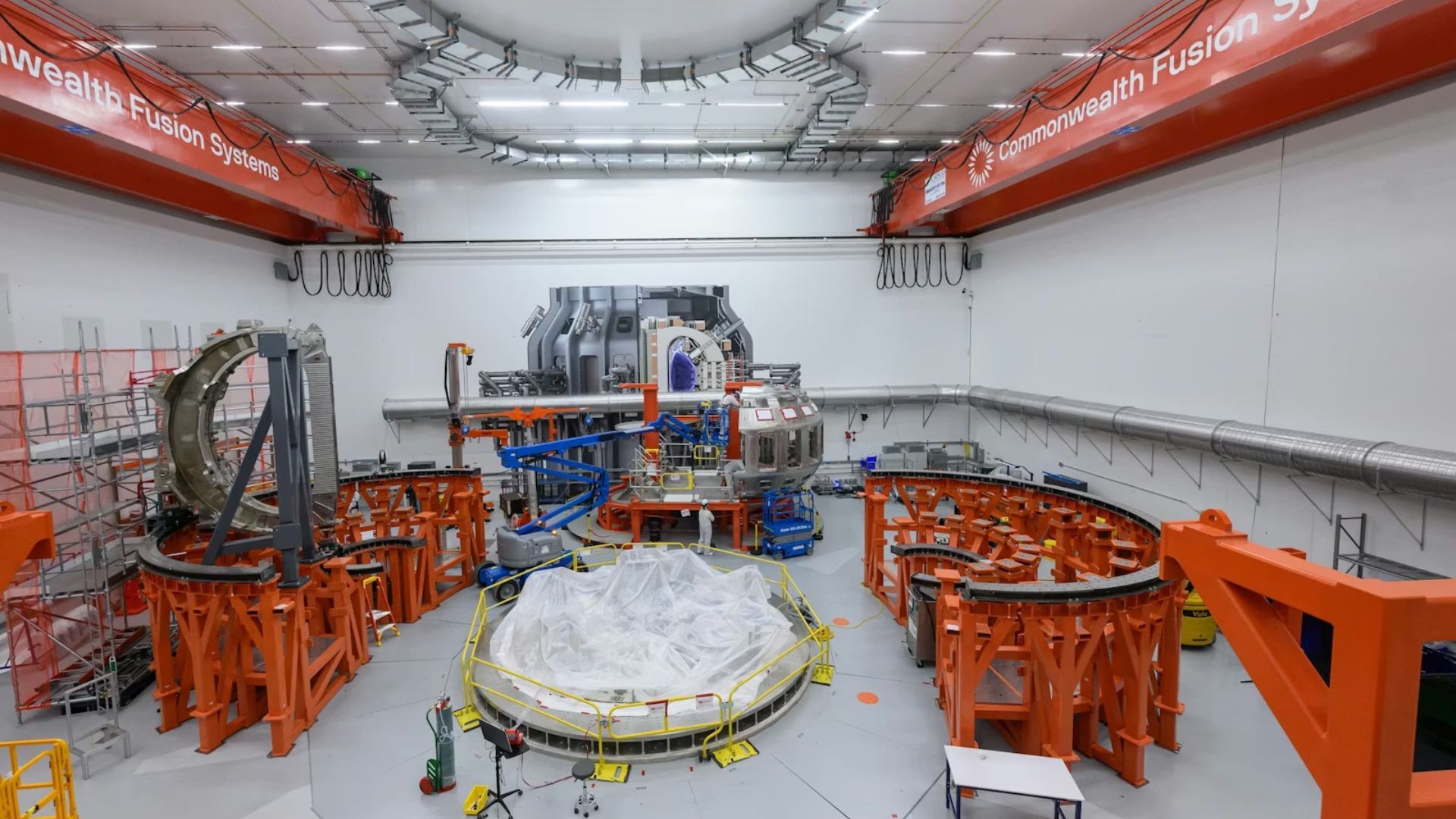
Commonwealth Fusion Systems (CFS) has verified the core plasma physics assumptions for its upcoming ARC fusion power plant following a peer-reviewed study published in the Journal of Plasma Physics.
The research confirms the ARC reactor design aligns with known physics, allowing the company to shift its focus toward detailed hardware engineering…
According to the validated models, the ARC plant will produce approximately 1.1 gigawatts (GW) of fusion power to generate 400 megawatts (MW) of net electricity for the grid…
CFS engineers are using this simulation framework to optimize upcoming design iterations, adjusting dimensions like tokamak width and divertor length to refine reactor performance before manufacturing begins.
This is like asking “why do R&D to invent solar panels when gas has always been 25¢/gallon?”
Technological progress isn’t free.
I’m just not convinced progress scales 1:1 with increasing technological complexity. In fact, I think progress might be better achieved by lowering costs and complexity, rather than increasing them. Maybe more isn’t always better.
The amount of electricity we will be able to extract from nuclear fusion, while using an extremely small amount of fuel, means that solar panels may cease to be practical in the first place.
Fusion still has a massive up front cost that needs to be recouped for decades.
So you’re saying solar panels were a mistake and we should have stuck to horses?
I should clarify. I think increasing technological complexity can lead to progress, but I don’t think it always does. I think progress from increasing technological complexity often follows an s-curve. I’m not denying the progress that has come from the significant technological advancement of the last few centuries, I’m just not sure continued technological advancement will lead to that same level of progress over the next few centuries.
Maybe, but many things are increasingly efficient. Maybe energy need for most things is plateauing and flat id goud enough. You’ll just need fusion for datacenters
It’s funny you should mention scaling, because fusion does not scale like that at all, it scales much better. If you can get a small reactor to work at all, a larger reactor designed with the same principles is significantly more efficient. With fusion, bigger is better.
I do hear what you’re saying though. Sometimes there are just simpler solutions. And I actually think you’re right, in most use cases solar + batteries is a better solution than a fusion plant. That said, solar + batteries has only become truly economical within the last 5-10 years. At this point there’s really nothing “Simple” about photovoltaic or battery technology, lifetimes of study have gone into them. And 25 years ago, solar was cute, it was pie in the sky. And you’d hear these same arguments “shouldn’t we be focusing efforts on something we already know works?”