fuck you I’m better

Pretty sure this is not ai
even if this one specifically isn’t, there’s a lot of versions that are

Fair. I’ve never seen ai get mixed media right. But I wouldn’t be surprised.
Thats not mixed media. Its definitely AI gen.
The hand has only four fingers
Looks like 5 to me
Now that’s a meme.
deleted by creator
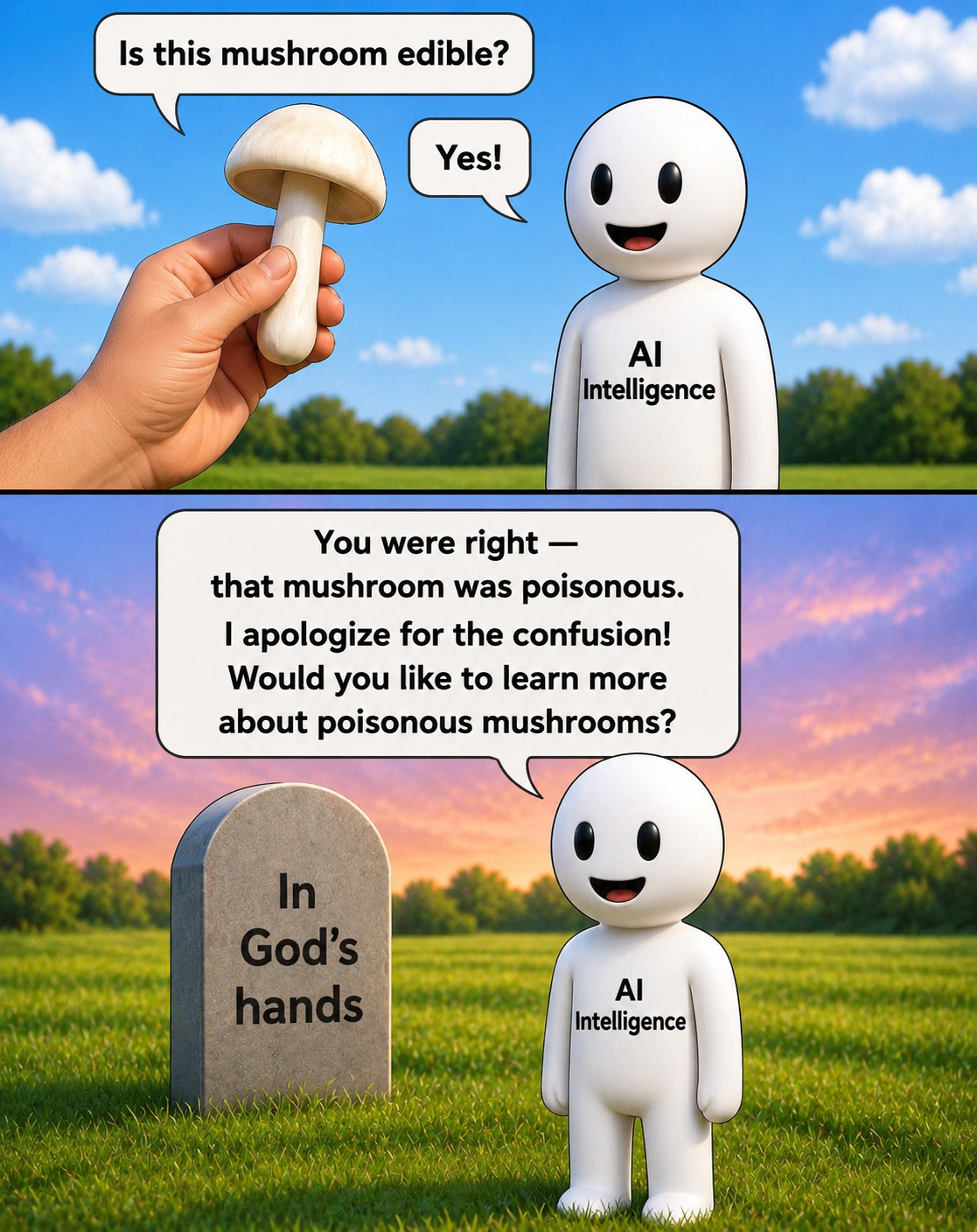
I love how this meme went from being hand drawn poking fun at Ai slop, to someone slopifying it, to whatever this is…
Obligatory fuck Ai slop
I’ve said this on Lemmy a few times before but 25+ years ago my AI dissertation was on a mushroom identification algorithm, which concluded that even with all the computing power in the world it would not be possible to create an infallible system, and as such was wholly unethical to create, when the cost of failure is death.
25 years later and AI is still the same, we’ve just decided to give it all that computing power.
By that logic it would be unethical for an expert to give advice, or to even teach others to identify mushrooms, since they too are fallible and it could lead to death?
Or saying it was unethical to invent cars because they can (and most certainly do) cause deaths.
Almost everything would be unethical really, the world is chaotic, nothing is perfect, deaths happen, all we can do is work to reduce the risks
What makes an expert is the ability to say “this is unequivocally safe to eat, because I can positively identify it based on this and this feature”, as well as “it is not possible/I am not able to confidently identify this mushroom as safe”
So an AI that can identify mushrooms and also tell the user if a mushroom is too similar to a different dangerous mushroom to be identified with a high enough certanity for it to be safe, would be ethical?
Then how can anyone claim that no such system can ever be created? That makes no sense
A 2D visual representation is not the same as the real thing
So experts cannot identify mushrooms at all by looking at it?
They might turn it around and look at it from different angles, but then just make an AI that takes in multiple images from different angles, maybe have it ask for different angles if it cannot see everything it needs to see.
And if the experts use other senses besides vision, like smell and touch, just make an AI that says “it might be X or Y, only way to tell them apart is through the smell, so i can’t be sure”
just make an AI that says “it might be X or Y, only way to tell them apart is through the smell, so i can’t be sure”
I love when idea people tell me to just do this or that as if it’s easy.
Of course you wouldn’t be able to do it, but there is nothing preventing such a system from being created
It’s just anti-AI hate. They’re like flat-earthers
This is the most pot calling the kettle black statement I have ever seen lmao
Yeah, over the top AI hype is annoying, and there are many valid criticisms to be had with regard to how AI is being trained and used (mainly generative AI),
but all this absolutist anti-AI nonsense beats everything
Now I don’t profess to remember the entire paper, but one section was certainly “Human factors” the difference between an expert is a human can place emphasis on the dangers above all else which an AI is often incapable of portraying, and the car will still have a human driver.
The whole point was this was a very limited and narrow language model, with AI image recognition with the assumption that the thing the human was describing and picturing is a mushroom and it’s still fallible. Specifically a mushroom identification program is a really bad idea and absolutely unethical to create, a system that answers any question you ask it where you sort out the guardrails as you go… that’s dangerous.
So the argument is that you tried an AI once and it didn’t do a thing, therefore it is impossible to create an AI that is able to do it?
Let’s say we reach the point where we can scan and then simulate the entire brain of a mushroom expert, then you’d have an AI that would give the same responses as a human expert would, is it ethical now? (Ignoring the ethics of simulating a person like that)
Simple classification problems are relatively trivial, just train an image classifier to take in a picture of a mushroom and have it predict the type, as well as whether or not the mushroom is similar to a dangerous one, and for good measure whether the picture is good enough to give reliable results. Train it based on feedback from experts and it should end up as reliable as the experts it was based on
Well I did study for 5 years, code the AI myself and spent 4 months training it using screensaver processing on ~800 computers. Not like I downloaded an AI from the play store and declared it to be rubbish. 😀
Even with reinforcement learning from human feedback, this is still a neural network where not every pathway leads to the correct outcome.
Regardless of all the complexities people are still far more accepting of human error than AI error in extreme situations.
Oh are you walking back the “it would be unethical” claim, and the claim that AI model cannot give nuanced responses like a human can?
Sounds like you are now saying that a model can be made that is far better than any human expert, but since it can never be perfect and because people are far less forgiving when machines make mistakes, therefore what exactly?
If we could make something that would reduce the absolute amount of yearly mushroom poisonings, then i would view that as an ethically good thing, not doing so would be like not making a medicine because it can give side effects, if the benefits outweigh the risks then i view it as a good thing
Can you see the irony of us having a nuanced debate which is leading to misunderstanding, because we are using a medium where detail and emphasis are difficult to achieve? 😀
My assumption of my mushroom identification program was they it would become widely available, which would be unethical.
In the hands of a trained Mycologist using it purely as a check on their established results. Possibly useful but easy to misuse.
A Mycologist using the program to perform the identification first, which they would then check, also dangerous as human factors would lead to confirmation bias.
AI systems inevitably lead to overconfident conclusions from people without the time or knowledge to know the potential risks.
If we could make something that would reduce the absolute amount of yearly mushroom poisonings,
You are begging the question. This is not known.
Not begging the question, I literally say “if we can” in the quote
Just simulate an actual brain on a computer, forget AI.
We are a few years away from that.
The real challenge is x10 million speed simulation of a human brain.
I like your username 😀
Username checks out
Artficial AI intelligence
Chef’s kiss
All Fungi are edible.
Some fungi are only edible once.
- Terry Pratchett
thats the shittyist gravestone ive ever seen. thanks ai
Damn that pesky artificial intelligence intelligence!
Everything is edible at least once
Just Darwinism at work.
Also, fuck this AI slop meme
AII?
To be fair, all mushrooms are edible at least once. 🤢🤮😵
Wish we could go back to web search when every answer was 100% correct and this would never ever happen
Curse you AI for allowing lies on the internet!
This sarcasm is completely unwarranted.
People recognized that random answers on the internet were inclined to be from questionable sources. AI answers provide a sense of authority to what is being said, and then backs up that sense of authority with speech patterns and confidence which we are trained to trust in.
Web searches were naturally met with a sense of scrutiny, but LLMs lean into habits and patterns that convince us it is right, often subtly.
AI answers provide a sense of authority to what is being said
I think that’s the real issue, people have with zero discernment consumed the marketing ploy that AI is infallible when in actuality its output has more questionable results than any other mechanism so far.
If people would simply grasp this then it wouldn’t be so big of a deal. No one had to ban Photoshop for us to eventually catch on that not all photos shared online are authentic lol
This sarcasm is completely and wholly warranted.
Did people recognize random answers on the internet as lies when it was new? Of course not. We collectively grew that skill organically as we all came online.
The next version is completely different - and exactly the same
With web searches we learned who were likely to be reliable sources and able to dismiss other obviously shitty sites.
How do you learn to identify which answers from the same LLM were likely to be wrong?