

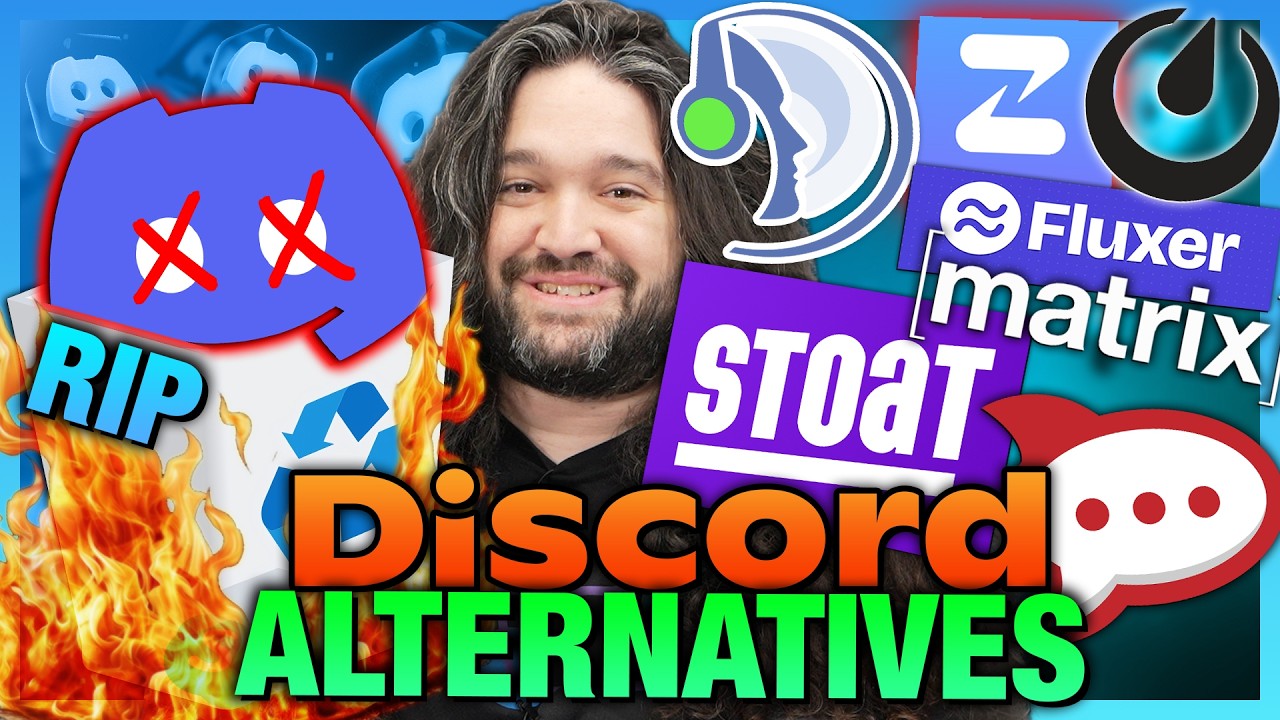
I mostly lurk here, and I know we’ve had this discussion come up a number of times since Discord’s age verification changes were announced, but I figured this video offers value for the walkthrough and comparative analysis. Like me, the video authors aren’t seasoned self-hosters, and I’ve still got a lot to learn. Stoat and Fluxer both look appealing to me for my needs, but Stoat seemingly needs self-hosted servers to route through their master server (unless I’m missing something stupid) and I replicated the 404 for Fluxer’s self-hosting documentation seen in the video, so it’s looking like I’m leaning toward a Matrix server of some kind. Hopefully everyone looking for the Discord exit ramp is closer to finding it after this video.
I hear Snikket makes it really easy to host XMPP (aka Jabber).
Yes, but it isn’t a Discord replacement, but rather a WhatsApp replacement.
https://movim.eu/ is xmpp based and might be more suitable as a Discord replacement, but to be honest it isn’t quite there yet if you are looking mainly for a voice chat app.
Hmmmm voice chat eh?
Well then it’s time to recommend Mumble!
But then it’s not chat anymore. Or screenshare.
There are many good tools that solve individual issues. But Discord solved many of these issues in one tool, and that also has its charme.
That’s precisely why they have to be resisted and/or we have to look for alternatives that Do One Thing Well. Among many other issues, the networking effect issue with EverythingApps is quite double-faceted in that, because they do everything, their “weight” not only acts as gilded cages to prevent people from leaving, but also to prevent developers, working on their spare time, from developing something that can be reasonably understood as an “alternative” (because the alternative has to also Do Everything).
It’s basically playing a loser game to lose, see eg.: Mozilla always at best playing catch-up to Google, or why we can’t seem to move from BloatedWebWithReact to something like Gopher (or even make a proper Gopher 2.0).
All that said, I feel like XMPP and Matterbridge are approaching this from the right perspective. Just implement a global communication protocol and leave to platform makers (or platform users) the task of bridging from and to whatever directions they want.
A “do everything” app is overkill. I am not a fan of many features Discord implemented over time. But the initial offering of having text chat, voice chat, video chat in one app makes sense. It’s just super convenient to switch the communication type depending on what you are currently doing, without having to onboard and switch between tools.
It’s also hard to draw a line, if you want to go “do one thing well”. Mumble also includes text chat, and user management, ACLs, etc. … for text chat one could use IRC, for user management there are IdPs, and so on. XMPP also doesn’t just do “one thing”. The “X” (= extensible) is heavily used and there are extensions for all kinds of things. Some of the big messengers out there are (or were) using XMPP under the hood (just without federation).
The project I posted here yesterday focuses on providing text, voice and screen share. My goal is to provide an easy to host tool for those three things. Check it out if it’s just those you want in a single package.