

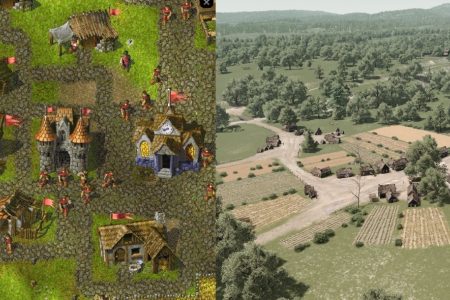
Video games aren’t supposed to be realistic, they’re supposed to be fun
It’s still interesting to analyse them like the cultural products they are.
Yeah, examining the ways they are inaccurate tells us a lot about ourselves.
Noo I want to spend 50 years before I can have a second well!
Sure, but exploring the way games abstract reality can be interesting and worthwhile.
deleted by creator
You can do all sorts of things with video games, even when sticking to realism, if it helps you achieve your goals.
Simulator then?
Written in 2020 but still an interesting read. I wonder what the author thinks of games that have released in the intervening years, like Manor Lords, Going Medieval, and Farthest Frontier?
Well, it looks like someone did an interview with a medieval historian about Manor Lords.
I am looking forward to Manor Lords when it gets released. Been tracking it for years.
Pretty insightful. Key takeaways:
- linear growth didn’t really happen like that
- pre-planning would be good
- experience of tax collectors skimming the surplus, plus hazards of rural life.
Yeah, I thought life was hard but sustainable mostly, turns out one was always at risk of extinction:
Medieval villagers were often living on the edge of subsistence. Agricultural surpluses were skimmed by the church and the feudal lords. Bad harvests, banditry, warfare and disease might decimate a village community at any time. For this very reason, the demography of many European villages remained relatively stable between the twelfth and the eighteenth century.
If I remember Devereaux, the village itself was set up to minimise that risk first and foremost, at the expense of optimisation for max yields. So, every year was around subsistence, never much above, but also never much lower.
relatively stable between the twelfth and the eighteenth century
Hm… wasn’t there like a 33% dip back in the fourteenth, not counting subsequent migration to the cities and whatnot…?
I don’t know, we need a medievalist here
Well, there was that little thing called the black death, if I recall correctly…
Ah, yeah, there was, that’s not how most of the time went, though
This is a great article! It’s really interesting.
I have two comments to make, and I hope nobody thinks this is me trying to disagree with the article or something, I don’t want it to come across as defensive. In explaining some of the challenges medieval cities go through and saying Banished is a pretty accurate game, I think this might just be a genre issue. I consider Banished a colony management game, not a city builder, and indeed, in colony management games your people’s health and safety are usually a much larger concern than in a city builder.
The second comment is that the writer suggests a game with flood mechanics and arable farm land. I don’t remember if it was out in March of 2020, but Timberland is out now. It’s a beaver based colony management game that includes a lot of fluid dynamics. It has flood mechanics like described. It’s unrealistic, of course, because they’re beavers. But also because flooding isn’t the end of the world if it gets into your buildings, I think it’s more of an inconvenience. Regardless, I think it’s a cool game to check out.
I am a big fan of Timberborn, but if we go all pedantic about it, Timberborn’s flood mechanics aren’t all that realistic.
A game that came somewhat close to realistic flood mechanics was Pharaoh/Cleopatra (1999/2000). Even though it used an abstract/statistical model (due to the technical limitations of the time), it felt a lot closer to reality than Timberborn even if there were some gamey elements like how well you respected Osiris.
I’m not saying they’re realistic, just that it has some of the flood/farming mechanics the blog author wanted to see in a game.
Default difficulty… Certain wiping out of every living being in your village, and failure. Conclusions in article are fairly poor as they are “games are already designed smartly, and there’s nothing that should be changed.”
A good game concept would be to put the player as a “middle manager” with feudal lord as the client. The mission is how to best oppress the villagers in order to graduate to better employment: managing a bigger city.
Well then I guess the Wolfenstein games aren’t historically accurate either…?
What a shock!
deleted by creator
It’s pretty much just a hook into infodumping about medieval cities…
deleted by creator
Some of us like getting insight into the stuff that inspires the things we consume.