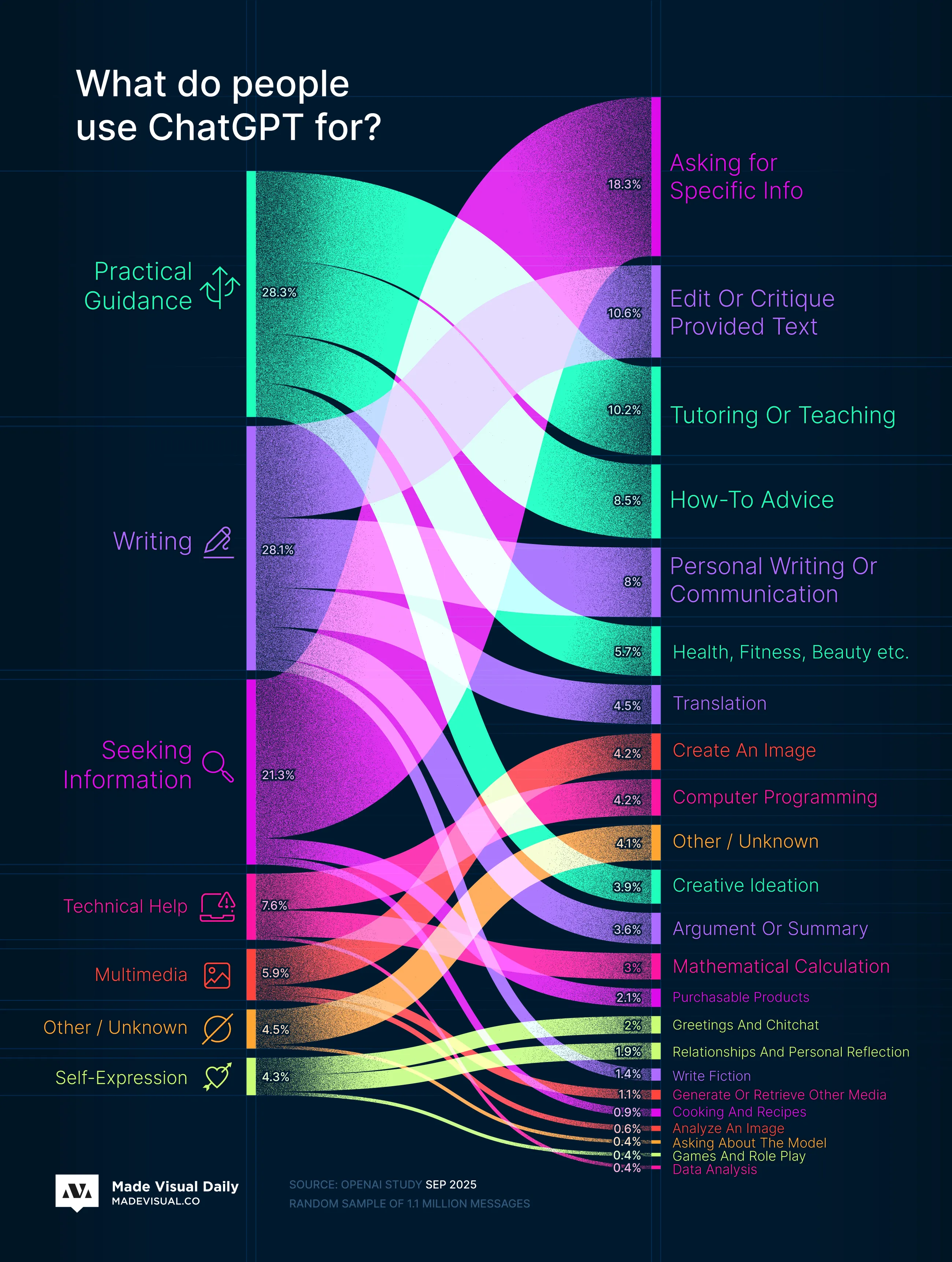
Just to be clear, companies know that LLMs are categorically bad at giving life advice/ emotional guidance. They also know that personal decision making is the most common use of the software. They could easily have guardrails in place to prevent it from doing that.
They will never do that.
This is by design. They want people to develop pseudo-emotional bonds with the software, and to trust the judgment in matters of life guidance. In the next year or so, some LLM projects will become profitable for the first time as advertisers flock to the platforms. Injecting ads into conversations with a trusted confidant is the goal. Incluencing human behaviour is the goal.
By 2028, we will be reading about “ChatGPT told teen to drink Pepsi until she went into a sugar coma.”
At least in Star Trek, the robots would say things like, “I am not programmed to respond in that area.” LLMs will just make shit up, which should really be the highest priority issue to fix if people are going to be expected to use them.
Using coding agents, it is profoundly annoying when they generate code against an imaginary API, only to tell me that I’m “absolutely right to question this” when I ask for a link to the docs. I also generally find AI search to be useless, even though DuckDuckGo as an example does link to sources, but said sources often have no trace of the information presented in the summary.
Until LLMs can directly cite and include a link to a credible source for every piece of information they present, they’re just not reliable enough to depend on for anything important. Even with sources linked, it would also need to be able to rate and disclose the credibility of every source (e.g., is the study peer reviewed and reproduced, is the sample size adequate, etc.).
Look man…I hate AI too…but you can’t just use it as a scapegoat to cover for humans being humans.
Should the AI be telling him to do more and more drugs until he died? Well, no, but also…maybe don’t do dangerous drugs at all.
Like if chatgpt says to shoot yourself in the face, and you do, is it chatgpt’s fault you killed yourself? Or was it you killing yourself at fault for killing you?
This world is getting dumber and dumber.
Well shit, maybe we shouldn’t hold humans responsible for the actions that they convince another human to take. After all, the victim is just a human being a human, right?
I mean it’s not illegal for someone to tell someone else to take more drugs. If two guys are hanging out and one says “hey I think I think I should take more drugs” and the other says “hell yeah brother do it” they aren’t responsible if the first guy ODs.
I mean, aren’t they? In a moral, ethical, and social stance, don’t they share in the blame?
Basically the entire US economy, every employer, many schools, and half of the commercials on TV are telling us to use and trust AI.
Kid was already using the bot for advice on homework and relationships (two things that people are fucking encouraged to do depending on who you ask). The bot shouldn’t give lethal advice. And if it’s even capable of doing that, we all need to take a huuuuuuge step back.
“I want to make sure so I don’t overdose,” Nelson explained in the chat logs viewed by the publication. “There isn’t much information online and I don’t want to accidentally take too much.”
Kid was curious and cautious, and AI gave him incorrect information and the confidence to act on that information.
He was 19. Cut this victim blaming bullshit. Being a kid is hard enough before technology went full cyberpunk.
This world is getting dumber and dumber.
Ehhh…I dunno.
Go back 20 years and we had similar articles, just about the Web, because it was new to a lot of people then.
searches
https://www.belfasttelegraph.co.uk/news/internet-killed-my-daughter/28397087.html
Internet killed my daughter
Were Simon and Natasha victims of the web?
Predators tell children how to kill themselves
And before that, I remember video games.
It happens periodically — something new shows up, and then you’ll have people concerned about any potential harm associated with it.
https://en.wikipedia.org/wiki/Moral_panic
A moral panic, also called a social panic, is a widespread feeling of fear that some evil person or thing threatens the values, interests, or well-being of a community or society.[1][2][3] It is “the process of arousing social concern over an issue”,[4] usually elicited by moral entrepreneurs and sensational mass media coverage, and exacerbated by politicians and lawmakers.[1][4] Moral panic can give rise to new laws aimed at controlling the community.[5]
Stanley Cohen, who developed the term, states that moral panic happens when “a condition, episode, person or group of persons emerges to become defined as a threat to societal values and interests”.[6] While the issues identified may be real, the claims “exaggerate the seriousness, extent, typicality and/or inevitability of harm”.[7] Moral panics are now studied in sociology and criminology, media studies, and cultural studies.[2][8] It is often academically considered irrational (see Cohen’s model of moral panic, below).
Examples of moral panic include the belief in widespread abduction of children by predatory pedophiles[9][10][11] and belief in ritual abuse of women and children by Satanic cults.[12] Some moral panics can become embedded in standard political discourse,[2] which include concepts such as the Red Scare[13] and terrorism.[14]
Media technologies
Main article: Media panic
The advent of any new medium of communication produces anxieties among those who deem themselves as protectors of childhood and culture. Their fears are often based on a lack of knowledge as to the actual capacities or usage of the medium. Moralizing organizations, such as those motivated by religion, commonly advocate censorship, while parents remain concerned.[8][40][41]
According to media studies professor Kirsten Drotner:[42]
[E]very time a new mass medium has entered the social scene, it has spurred public debates on social and cultural norms, debates that serve to reflect, negotiate and possibly revise these very norms.… In some cases, debate of a new medium brings about – indeed changes into – heated, emotional reactions … what may be defined as a media panic.
Recent manifestations of this kind of development include cyberbullying and sexting.[8]
I’m not sure that we’re doing better than people in the past did on this sort of thing, but I’m not sure that we’re doing worse, either.
It wasn’t the internet/web that harmed those people. It was people on the internet. And people were telling each other to be cautious when using the internet.
Unlike modern LLMs which are advertised as intelligent enough to be used in professional settings. And unlike perpetrators in other cases, no one is punishing OpenAI, or Google or whatever the fuck AI company is responsible.
So yeah, this is worse than before.
Great post and I agree 100%!
something new shows up
Doesn’t even have to be a new thing either. Video games are still used as a scapegoat. Same as with music, and TV shows, and movies.
The “internet” is still killing teenagers because of social media bullying.
I wished our lawmakers were of a less senile age so we can write and pass more appropriate laws for this stuff…but not much we can do.
I wished our lawmakers were of a less senile age so we can write and pass more appropriate laws for this stuff…but not much we can do.
Talk with them. Explain stuff. Vote for better ones. It’s still not much, but it’s better than doing nothing and letting them keep on blundering unchallenged.
Need to teach the youths about erowid.
Removed by mod
Please don’t celebrate people dying