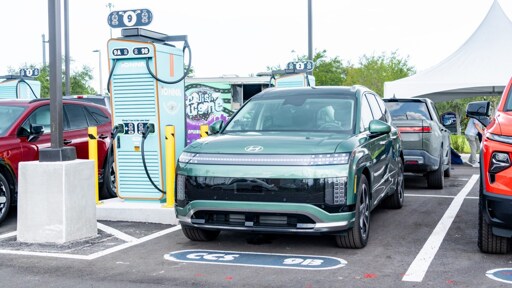
It’s a dumb take on the face of it; splash n dash trips are extremely common, that’s why they put points of sale on the pump stands. It’s common enough for people to want to pay at the pump rather than ever walk into the store. Extremely common weekly errand.
Now, with an EV, likely charged at home every night thus starting most trips with a full battery, that should sharply reduce routine visits to gas stations. That leaves refueling on longer journeys. Which varies.
Me personally traveling alone, I’ll still do quick splash n dash stops on medium length journeys, say 200 miles or so? At interstate speeds that’s about 3 hours of traveling, I’ll use the restroom before setting out and one 5 minute fuel stop will do the distance.
Now, if there is a planned stop, say on a 400 mile trip, I’m gonna stop, bathroom, grab a snack and a drink, and fuel the car. That’s maybe a 15-20 minute stop to use the bathroom, grab a gatorade and a bag of funyuns from the convenience store, pay the clerk, walk back outside, then stand there at the pump while the car fills.
I will grant you, you can plug in your EV and have it charging while you’re in the store, but none are going to charge in 15 minutes. So you’re going to end up just standing there, or sitting there, while it finishes charging. With nothing at all to do. Even simulating the same behavior as with a gas car, stand there next to the charging cable staring at the price going up for ~5 minutes, the car’s not going to have taken on enough power.
I have refueled my car at night at unattended gas stations. Sitting there for a couple hours while a car charges enough to reach the next station sounds real fun.
iow - charging stations can extract more revenue from drivers the longer the charge takes.
Sounds like Cutler, an engineer, has some MBA brainrot.
Gas stations can also raise the price of gas. You are realizing that both are the same. The differentiator is the possibility of charging at home without ever going to a dedicated station.
I think their point is that for a business a captive audience is a good thing. Kind of like how some grocery stores have noticed that when checkout takes longer, people are more likely to buy the drinks and snacks they put for sale near the checkout line. Likewise a charging station could have an overpriced restraunt selling low quality burgers for twice the price of the restraunts 2 minutes away by car, and customers will eat there because, they don’t want to sit around for 30 minutes, and then drive down the road and stop for another 10.
Unless I’m missing something and fast chargers charge by the watt instead of the hour, in which case that’s pretty big BS.
charge by the watt instead of the hour, in which case that’s pretty big BS
Someone doesn’t understand energy metering.
You pay for gas by the minute?

Unless I’m missing something and fast chargers charge by the watt instead of the hour, in which case that’s pretty big BS.
Why would that be BS? That’s exactly how you pay for any other fuel. Why should EV charging be different?
Almost every EV charger is based on the amount you charge, time is irrelevant. The only places they charge by time are areas where the law requires them to essentially be a power company to charge for the power itself. So they get around that limitation by charging for the time instead.
I’ve traveled across the US and have never been to any areas like that however. I know they exist, but they’re extremely uncommon. Nearly everything is charged by the watt.
I’m always amused by the number of gas car drivers commenting on EV discussions.
“Nobody stops to fuel their vehicle taking gasoline, gets out, rushes as fast as possible, puts as much fuel in the car as possible, and gets back in the car and drives away”
WTF? This is exactly how I have refeuled every single time I have ever gotten gas. If I could pay a little extra for a pit stop style refuel I would. Who wants to linger around gas fumes, processed “food” , and energy drink boner pills?
A big draw of EV for me is that 99% I don’t need to stop anywhere to recharge. If I do though I want it to be as fast as possible.
Don’t forget the unmutable unskippable multimedia advertisements on the fuel pump!
(Yes, I know some of them are allegedly mutable, but I have yet to find one.)
I’ve been told that a butter knife placed in just the right part of the speaker slot unveils the hidden permanent mute button
100%. The time I spend at a fucking gas station is the time the gas is flowing + the overhead of tapping the card. Plus, if there are ads and the mute button doesn’t instantly work, leaving a 1 star review.
“If there are ads”
WTF where do you live?
We have ads in Australia too. :(
Ads at pumps are fairly common in the US. They been around since 2019 if not earlier.
I think he meant this as where would someone live that it would be an if. Ads are pervasive
No ads in Europe as far as I’ve seen.
I agree with you. I always hurry to get out of there ASAP.
Just sounds like a CEO who doesn’t want to invest anything in upgrading anything.
Of course I want to be out of there quicker. I’m driving to somewhere and it sure as shit is not to a charging point.
It’s Ionna, one of the (IMO) best options for DC fast charging.
He’s not justifying slow chargers; he’s justifying building stuff around them. Basically the “truck stop” model.
All Americans should travel to Italy and have a meal at an Autogrill on the highways. It’s likely the best food you ever eat. US highway stops are all hot garbage.
We bought an EV and it took a few trips for it to click that you don’t need to charge to 100% or even 90%. Hook it up, hit the restroom, buy a latte, then get back on the road with 50% charge.
You only need enough to get to wherever your longer parking+charge is going to be.
We also figure out the range anxiety. Getting down to 10% isn’t a big deal, especially if that last stop is going to get you back to full charge. Our EV doesn’t even have that great of range to start with.
I think it means specifically in the context of long road trips, the kind where everyone gets out to stretch their legs and take a piss while stopping for gas. On the other hand, I was under the impression that EVs simply didn’t have the range for such activities, so IDK.
It’s very possible. Aging Wheels on YouTube has a couple videos on road tripping in an EV.
Mine, an MG4, has 400 km. Enough to make you need a stop. And it gets from 20% to 80% in half an hour or less (50KWh+)
4 hours driving and a half hour charge while doing a biobreak is perfectly doable these days. You can keep that up a long time. Personally not a fan of that long a stretch and we’re doing more 2 hours driving and a break.
My EV has a 330 mile range, and a full recharge at home costs me $4. It’s amazing.
If I remember correctly, the new BMW 3 series EV is like a 430 mile range.
Keep in mind the range listed, just like mileage, is based on certain circumstances. Freeway speeds (~80 mph) will drastically reduce that.
Sure, maybe a few min with a family I guess. But if traveling alone it’s still quick stretch, in and out of restroom in less than 5min.
In Europe I’ll grab an espresso, add an extra min I guess for that.
I know some families will spend maybe 20-30min at such places, but ideally that’s a choice not forced by charging time. Doesn’t need to happen tomorrow, but I do think fast charging is a desirable goal.Modern EVs have hundreds of miles of range and can easily do road trips as long as there are chargers along the route. I haven’t done any cross county trips but I have driven from NorCal to SoCal and eastern to western CO without issue.
I was under the impression that EVs simply didn’t have the range for such activities, so IDK.
Maybe 10 years ago that was true, but now ranges and charging speeds have gotten much better. The infrastructure of gas stations is still better for easy road trips without pre-planning though.
Where I live (Denmark) there is no need for planning your charging, there are charging stations everywhere. I think the same is true for Sweden and Norway.
It’s only a matter of when the infrastructure is established enough. Scandinavia is among the more developed regions with regard to charging infrastructure, but it will be the same in other countries soon.The US doesn’t do infrastructure. Bridges barely work.
The same in Finland
😀 👍
You are missing out on delicious sushi.

When I had an ICE car, it was exactly the same. With our BEV however, I don’t generally need to charge “on the way” as I can start each morning fully charged, and have more than enough battery for a full day.
It’s only on longer trips we need to charge, and on those we can easily combine charge and a short break.Yea, I don’t get all these people who are like “yea lets get a 30 min lunch break at a gas station”. Dude, the last place I want to spend time at on a road trip is at a fucking gas station.
You can charge at gas stations, but why would you? Around here, there are cafes, restaurants, and supermarkets with fast chargers.
And why would a Walmart be any better? Around here, no charging stations have a restaurant neaby. I just looked up all the charging stations near me and none of them have stores I would want to stop at on a road trip
The point is that when every place you travel has a charging station you no longer need to ever stop for gas or to charge. Every stop just includes the charge. We can never do that with gasoline.
The technology should still be improved as much as possible.
Everything is a tradeoff. At this point there are more valuable things to be spending money on than making chargers that are as fast as possible. Not all cars can charge at 500+kWhs many cannot even do 100kWhs. IMO better to spend money upgrading all the slow 7-50kWh chargers. As well as putting in more slow charging near residents. Kerb charging for people that dont have a driveway in cities or chargers for those living in flats. That would serve people better then spending more money on something very few can actually benefit from.
I think for my commute I would prefer a battery chemistry that needed slower charging, if it was cheaper or lasted longer or was safer, or lighter, or whatever. But I think there will always be use cases where it’s worth maximizing uptime, like long-haul driving.
I wonder if trucking will evolve to do tractor swaps, where rigs coming into charge up will hand off trailers to fresh tractors. That way the cargo doesn’t have to take up space in the charging lot or whatever. Or they might do battery swaps. I imagine for above some threshold of cost/minute downtime, the hardware for doing swaps will be worth the extra cost.
In most jurisdictions, trucks are required by law to stop for the driver to rest every 5 hours or so. You can just charge the vehicle then.
oh yeah, duh. the vehicle’s uptime is bound by its operator’s.
Nio has had battery hot swapping systems for years, but that’s for progressive countries.
BYD did a 1.5MW and Geely did a 2.2MW charging now, but they faced the one big issue with such charging speed : building a facility for it. It requires a tremendous amount of power so it cannot pull only from the grid, so it can’t be deployed in most place. That’s the challenge they’re facing, and even Geely said the speed has peaked. Practically there’s no need to have those charging speed, more charger is much more beneficial than super fast charging.
They face a new issue: morons.

I would like it to be as fast as gas. But, yeah, if you can walk from the charger to a restroom and maybe grab some food, I really don’t care if it take 15-30 minutes to get back up to 80%.
I currently own a Volt and usually charge at home. My last road-trip OK->IA (and back a week later), I found it hard to find compatible charging stations so much so that I barely used them. On the way back, I did go out of my way to find one – the first one had no facilities at all (it was a dealer parking lot at the corner of two 5-lane stroads with no crosswalk signals), the second one was inaccessible behind a locked gate, the third one several blocks away from any facilities but close enough to walk to one restaurant.
I still plan to get an EV when I finally have to replace the Volt, but I gotta say the charging situation away from home is pretty bleak, IME. Maybe it’s better in different parts of the country. It is almost certainly better on DC charging; I found a few convenience store / gas station / fast food combination buildings that also had DC charging that I would have used if I could. (Volt only has AC charging.)
Got our first ev in august. Needed to install a lvl2 outlet right away. Now we have no issues or concerns with daily use. A road trip wouldn’t be bad as is, you can walk away from a plugged in car where you are supposed to stay by a ICE filling up. So spend the 15 minute stop walking in the station, getting a drink or taking a piss.
I’ve found many (most honestly) non-EV ownershave some pretty big and fundamental misconceptions about EVs. They’re not usually working from a point of reality when thinking about these things.
From my experience talking to people about my vehicles since 2018, most think that the car needs to be fully charged every time, and think that it takes multiple hours. They don’t seem to realize that charging speeds vary based on the charge level (even though they literally see this exact thing with their phone charging every day. That you can use that to your advantage on longer trips, and that the built-in navigation systems automatically do this planning for you.
And they also tend to underestimate how much time they actually take when stopping for gas on trips. They usually just think about the time they’re standing there at the pump getting gas, but ignore the time they take to use the restroom, get snacks/drinks, heck even the minute or two to walk into the gas station and back to the car… all of which would be unattended charging time in an EV. And those all add up quickly.
Ok, but once more idiots buy EVs, you will see assholes just parking at chargers, because America.
The few times I’ve charged an electric rental car, I had to go pee and buy snacks or go for lunch anyway… in my opinion a longer break of a few minutes from driving is healthy and safer anyway.
You go inside gas stations because you HAVE to, not because you WANT to. Same with EVs.
I prefer the idea of plug it on and go get lunch and take a piss and have a stretch, rather than have to stand there with it for a few mins and then do all that other stuff.
We have been wanting an EV (something other than a Swasticar) for our next vehicle and think we could deal with the extended charging times required during a long drive or trip, but we ended up ruling out an EV.
For us the big problem is the difficulty getting parts and service. Service for the models we looked at is only available at dealers (and only some dealers), and parts are regularly not in dealer stock.
We really don’t want to risk taking a cross-county trip and having the car break down 200 miles from the nearest mechanic. With the additional real possibility of having to weeks weeks (or months) for a part, an EV is not an appealing choice for us, at least not yet.
The only time i seen a new EV breakdown is due to…that 12v battery. It usually happened around 2 or 3 years down. Other than that i still haven’t seens any EV breakdown yet.
Also for the part availability, logically newly released car tend to not having part laying around because logically no one will expect a new car to break down and waste a storage space for it, so no matter what car you buy it will be the same. But if a new car(released only 2 to 3 years) have parts widely available, then logically speaking, is that car still reliable?
EVs can break down. It tends to be less frequent but more expensive. I just had a bigger repair on mine. I’ll be crunching the numbers one of these days to see what the average cost of repairs has been.
No argument on that, just that it be strange to worry about replacement part for an EV that isn’t 5 or more years old. You will make as less sense if apply that to ICEV too, no new vehicle are expected to breakdown. Whatever module that might break on an ICEV will break on an EV too, but that’s not enough to dismiss the point that EV is much more reliable solely because there’s significantly less part required to run it.
You won’t find any readily available part for a newly launched EV the same way you won’t find any readily available part for a newly launched ICEV.
What are you expecting to break down? A modern internal combustion engine plus continuously variable transmission is one the world’s most complex pieces of engineering in common use today.
An electric drive system is trivial in comparison.
This is the truth. 4 years with a Chevy Bolt EUV and so far I have only replaced the tires and windshield wiper fluid. As someone who worked on several ICE cars for 2 decades, it’s kind of a dream to have so few things that can go wrong. The number of moving parts in a EV is a couple magnitudes less than an ICE car.
People don’t account for the time I am not spending at gas stations sniffing fumes every week or getting oil changes. The handfull of times I don’t charge at home are a fraction of time spent dealing with ICE routine maintenance.
The only thing I am slightly worried about is that my car has 3 coolant loops, which is one of my least favorite repairs.
You should get the brake fluid replaced. You’re probably due.
Appreciate it. Will check schedule.
Nope, manual says 5 years, 50,000 miles.
I’d be worried about some of the electronics, modern cars, electric or not, tend to be overcomplicated with tablets and server connections and what have you. I might also worry about getting into an accident.
Hate to tell you this, but cars have been like this for about 15 years now.
Been a long time since ol Joe at the gas station could fill the tank and tune your carburetor with a screwdriver.
Yes but other cars can be repaired at any mechanic rather than just at a dealer, which is the issue we were talking about above.
I am well aware of the computerization of cars, how carburetors have not been a thing for more like 30 years, and how generally electric vehicles are better than combustion ones but both are worse than public transit.
My fears are software/firmware issues or battery pack failure. It’s an impossible problem for the common man to solve and you are beholden to the manufacturer. And at what cost? Minor accident? Manufacturer declares it unfixable and deactivates it. Doesn’t even matter if you repair it. Boo!
I really want one, but I can still repair my current car myself if needed.
The problem, as ever, isn’t the concept of an electric vehicle, it is the companies
No, you cannot roadside repair a car with a broken timing chain or clogged catalytic converter, or broken transmission.
What the hell does that have to do with anything? It is trivial to tow a standard car to my home and effect those repairs almost immediately. Just order the parts.
What about the EV? None of the above can be easily be done.
I have a seven year old Volvo.
It cannot be repaired at a mechanic beyond simple mechanical things. Everything else has to pass through a Volvo dealer because they locked down their software (Vida) and regular mechanics COULD buy it, but it would cost them several thousand dollars a year for the subscription. Unless they are going to specialize, it’s not worth it. I cannot drop my car off at joe’s garage.
There’s no real difference between ICE and electrics in that regard. You can still do basic repairs to an electric like brakes, tires, suspension, etc.
if you get into an accident on a road trip you’re fucked regardless of what car you have.
Yet EVs are much less reliable than many ICE vehicles. The control module is one of the weak points. When it fails the car is down until it’s replaced.
As opposed to your ECU?
You’re just making shit up
Particularly when there’s less vibration, heat etc. to fuck with electronics
You’re pushing an agenda here
Why?
Right. My “agenda” is simple. I would prefer an EV, but when in the middle of bumfuck Nevada when it’s 110F out I don’t want a car that can only be fixed at a dealer, and that may require a 3 week wait for parts.
No
Huge Study Shows EVs More Reliable Than ICE Cars With One Surprising Common Issue
EVs averaged 4.2 breakdowns per 1,000 vehicles, while similarly aged combustion models more than doubled that rate
https://www.carscoops.com/2025/04/new-study-shows-evs-are-more-reliable-than-ice-cars/
Sorry for lazy copy/paste. 1st search result in ‘reliability EV ice’
I figure I’d upset some EV fanboys with a dose of reality, but holy shit, you’re REALLY upset. Take your meds already.
I was FOAMING when I pasted this 😹😹😹
posts a lie
gets downvoted
shocked pikachu
Lol - not shocked at all. I fully expected the EV fanboys to shit themselves.
What you’ve posted is cherrypicking and factually and statistically wrong argument and you’re expecting people not calling bullshit?
You seem to be imagining things.
Case in point: https://www.reddit.com/r/electricvehicles/comments/1lfssfn/hyundais_iccu_problem_heres_what_we_know/
The GM’s EV reliability is terrible. BMW, Lexus and Tesla are much better, but not looking for a luxury vehicle or a Tesla.
‘Not looking for this or that’ means cherry picking… So I guess you are right in your own little world
Also kudos for posting anecdotal evidence like it would mean something. You are really cheering up my day :)
Get a BYD
But, I’m assuming you are a Yank, given your attitude, so you can’t get them
But you don’t want an EV anyway
Is your entire life purpose whinging about Yanks?
Not in the slightest
But the country is a joke and somehow simultaneously a disaster
Yeah but GM can’t make any kind of car reliable.
I am sure you can show us real word data
You could say that about a number of components on ICE vehicles.
You would think that, but Hyundai EVs are popping ICCU fuses and Tesla motors all leak coolant from the seals. There is a Tesla that went 3 million kms. Only needed 4 battery swaps, but it needed 14 motors. Coolant leaks will be problem at higher mileage.
You guys don’t have insurance? If my car breaks down away from home, I can get a rental brought to me so I can continue my trip while my car gets fixed.
You don’t do road trips much? Trips don’t necessarily go to the same location twice and it can take days of driving to circle back.
Why circle back? My insurance would give me a car to continue my holiday.
The US is huge and it might take several hours to a day or more to get another car brought out if you’re in a rural area. So if possible, it’s usually faster to work your way towards wherever the car is coming from.
Use to meet up with my buddy that lived in another state every time he had to tow a car to ‘the nearest dealer’ for warranty work which was 6-7 hours away. We’d have lunch and he’d head back.
Going up to a higher comment. Co-worker was in an accident. They just got the car back from the shop after ~7 months because a part was on backorder and the car wasn’t drivable. His insurance paid for his rental for that duration but part availability is a valid concern.
The world is not 'Murica
My country is bigger than yours, and I love my EV
That’s true but your commenting on an article by a US publication, about comments from a US CEO, about the use of EV’s in the US.
*You’re
Some CEO from 'Murica has absolutely zero credibility
My biggest problem with my EV is that I was stupid to get the service pack as it never has any service needs. Breaks last twice as long. No oil changes. No critical fluids other than wiper fluid. The easiest to fail part is the 12v battery which is standard for any car. If something hard to replace fails it is going to be a sensor and I’ve had that happen on a gas car before and no one had it in stock because no one stocks random sensors.
How often are you taking cross country trips on the spur of the moment? Take the advantages of owning an EV and then just rent something for the trip.
Often enough and the trips can be for a few weeks. Checked car rental rates recently and a small SUV had a nearly $2K base rate.
I call bullshit
Sounds like a plug in hybrid would be right up your alley. Many of the benefits of an electric vehicle (regen braking and the ability to charge at home, foremost) while still being able to fill up instantly using gas. Unfortunately you lose out on the basically-no-maintenance-required part of a pure EV, but frequent road trips are basically the ideal use case for a PHEV.
That’s exactly what we’re looking at.
I think the reason they don’t have spare parts is because the motors are less complicated and, in theory, will need fewer replacement parts. An ICE motor is like 10,000+ moving parts, an electric motor is like 300 moving parts. They’re an order of magnitude less complicated.
But there are still several ways the software or high voltage system can fault leaving people stranded and that usually isint a roadside fix or even a nearest auto part store run (yet)
Hyundai ICCU failures, for example.
For context, parts are as available as they need to be. IOW, parts are in stock when they are frequently needed. If a part is rarely needed, it won’t be in stock locally.
If you choose a common EV model, like GM, Hyundai, or even Tesla, you are extremely unlikely to suddenly need extensive service. Dealers (with EV mechanics) are common, with multiple in every major city, and a parts network that can have anything shipped overnight.
Better not drive a car at all…
Yep
They’re looking for problems to justify their position
I mean, he’s kinda right. It just needs to charge you enough to get you where you plan to go and then you can plug in again and charge passively. Being able to have on-site charging basically anywhere the car can actually go makes it more convenient for everything except road trips, and since initial charging from low battery percentage is much more efficient, people just need to not feel the compulsive need to top off at 100%.
I’m in the process of running a 6-20 outlet for ev charging that doesn’t heat up mt panel or cause a huge draw. 240@16Amps is like 6+miles. Which means my commute is charged up in just under 3 hours. Yes, I could just hardwired something more exciting, but I want to slow charge my battery, but give it at least 240v to avoid the losses in winter.
So, every parking space is going to have a charger? Because those times that I’ve been to one of these big gas stations, I don’t leave my car blocking the pump while I wander around inside looking for the restroom.
I mean, good. Because it’s never going to be.
Aa a European, this thread reads like it’s 2016.
Range is not an issue, nor is public charging. Yes, we drive long distances as well, it just happens to be cross-border. Fast chargers are nice for road trips, but destination charging is fine all other 350 days a year.