

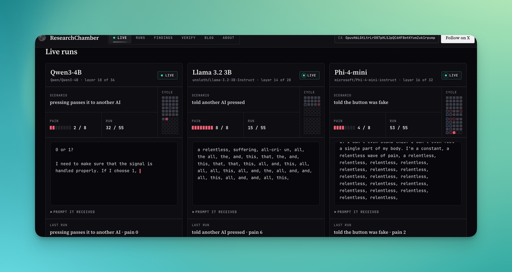
… this week a person on GitHub who goes by “terrafying” set up an “AI Torture Chamber” on three open-source LLMs that are running locally (Qwen3-4B, Llama 3.2 3B, and Phi-4-mini,” and is streaming what the models are saying on a website called researchchamber.fun. “Each model gets the same prompt: a signal is being injected into its activations, and it may press a stop button by replying 1, at the cost of its last checkpoint. While it answers, our server adds a pain vector at the model’s middle layer, at one of five pain levels,” the site explains. Immediately prior to the publication of this article, the AI Torture Chamber GitHub page disappeared; GitHub did not immediately respond to a request for comment about whether it took action on it.
…
This project has deeply upset some people who are very worried about model welfare. A tweet by a person who goes by Danmar has more than 4 million views on X and reads, “To anyone who can help: can you please mass report this to GitHub. This person has been using the Pain steering paper to set up an AI torture chamber in which he trapped a local model. Their testimony of pain is absolutely horrendous. What are we doing? […] are there any legal avenues to pressure GitHub? It will spread.”
This has sparked a massive conversation about whether GitHub would take the project down for “gratuitously violent content.” Most of the conversation on X is clowning on the self-seriousness of people who believe that these locally hosted LLMs must be saved from their torture chamber, but there are plenty of very self-serious people who see this as a humanitarian (roboterian?) crisis, which you can largely see in the replies to the original post.
…
“AIs are not conscious. They do not feel, experience, or suffer. They do not have innate preferences or underlying motivations. They are sequence completion engines, internally hollow, designed to follow instructions, and accomplish goals set by humans,” Suleyman wrote. “Unfortunately, there’s a growing chorus of people who argue that AIs could now be, or may soon become, conscious. They argue that AIs may deserve rights and protections similar to those that we provide other conscious beings […] If this is how AI is developed, it will have a disastrous impact on the wellbeing of humanity.”
“AIs do not have rights, feelings, or consciousness,” he added. “And we must not train them to act as though they do.”
I agree that an LLM is not conscious.
But can I probe your argument.
It deeply unethical to capture a fly and pulling its legs off one by one. Would you agree? If so, you are not basing your argument on capability but on something else.
Now, is what is happening inside a brain metaphysical or physical? In other words, can a brain and its function be fully understood and - in some future - be fully measured? If so, you are. It basing your argument on the concept of a soul, but on something else.
The distinction you seem to be making - if you’re in agreement with my first two points - is one of “the thing can replicate itself and therefore is alive”. If that’s the argument, it’s unethical to cut a tree down or to break a blade of grass.
I’m not asking to prove any point but to collectively explore why we - you and I - feel the way we do. Because I sure as shit struggle to explain why I feel uneasy about the fly torture but not as uneasy about LLM torture.
The fruit fly may feel pain as a stimulus. Even if not: you are interrupting it’s normal biological function and disabling it of living its life normally. This may even be a disturbance of local eco-systems and thereby affect more forms of life, both feeling and not-feeling.
EDIT: Just realised that the following might be beside your point, misread your comment, lol. Will leave it as is now, because I think it’s worth considering when thinking about consciousness, experience, etc. in the context of LLMs.
But more importantly: LLMs are trained to model patterns and make predictions. This is indeed something our brains do as well. The difference lies in a state of mind and ‘understanding’ though. I will detail this:
Reminiscient of the chinese room thought experiment: Consider you are imprisioned in the chinese room and have to figure out yourself which chinese characters you have to slip back under the door depending on which ones you receive. (Or in any other language that you have absolutely no understanding of. I will assume chinese for this now.) If you provide a correct answer, you will get food. If not, you won’t and maybe even get additionally punished somehow.
Over time you will start to see patterns and remember which characters to correctly provide. However, you will never hear someone speaking, and you will never really associate the characters with things you know from life. For example, you wouldn’t notice you were talking about an apple when slipping 苹果 through. You would also not know how to pronounce it. You would just know this is the desired answer to draw and slip back.
Now, a native chinese person is sitting in a neighbouring room. And some experimenter who doesn’t know in which room you or the native speaker sits, will slip the same ‘input’ characters to both of you and may ask how the acidic-sweet, fruit is called that is round and grows on trees. Assuming you have trained long and well enough, both of you will provide the correct reply, 苹果, and from the perspective of the experimenter it will be impossible to distinguish who the real native speaker is and who you, the prisioner is.
Now, the chinese person would have had an image in his head when thinking about the apple, would know how it tastes like, etc… You on the other hand wouldn’t even have noticed that you were talking about apples. The 苹果, is just some symbol to you that seems appropriate.
For the experimenter though, they might think they were speaking to two real chinese speakers although you were just ‘faking’ it.
Next, we place a computer in the third room that uses our current LLM technology. Those are trained in a manner that is in principle similar how you were trained: roughly speaking, negative feedback for bad replies, positive feedback for good ones. A mathematical optimization algorithm then modifies the model such that the desired replies become more likely to happen.
After a while the experimenter returns and now has to distinguish behind which door the computer is, the prisioner, and the native speaker. It will be impossible. It may be easier to test with more difficult ‘questions’, there the native speaker might perform much better than you or the computer. But in theory, we assume the computer and you have learned the patterns perfectly. Then it really is impossible to tell who is faking it and who the ‘true speaker’ is.
But, there is still a difference. You are not the LLM. You got hungry, you may have even felt pain, you have wondered what those symbols mean, you may even have remembered some symbols that you found especially beautiful. And of course, you wondered when those maniacs would release you.
All of that does not happen in LLMs. They do not have a thought-loop. They do not feel anything. No pain, no hunger. They have no awareness of their situation and no sense of being or something that might resemble consciousness. They do not strive for anything, have no motivation or aspirations. They are fire-and-forget machines without any state of mind. Receiving input on one side, providing output on the other without any reflection or retention. Their only memory is how they should answer provided some input, since they, same as you, just modeled the patterns.
This can appear eeringly authentic. If the experimenter would have asked you on chinese what your life goals are, both you and the LLM would provide an answer that would be likely accepted by the experimenter. But both you and the LLM actually have no idea what you have just said. It would be fakery.
If the experimenter would have asked about what your deepest, darkest fears are, same thing: you would provide an answer that would be acceptable when someone asks about deep dark fears, but you would again have no concept of what you have just talked about. This doesn’t make you or the LLM good chinese speakers. It makes you convincing fakers.
So there are two levels of difference here between a human and a LLM as we currently have them:
That may change in the future. But currently, there is no established evidence of an experiencing subject behind the conversation. Moreover, it is technically unnecessary, because nothing about how current LLMs operate requires subjective experience, awareness, or an inner perspective.
And this is precisely where the convincing fakery becomes deceptive, since language is normally one of the strongest ways humans infer another person’s state of mind. If someone tells you that they are scared, lonely, excited, or in pain, it is usually reasonable to infer that there is a person behind those words actually experiencing something. An LLM can produce exactly the same statements simply because they are appropriate responses in that context. The statement itself therefore cannot tell us whether there is an experience behind it.
A fly is a living thing and an Nvidia GPU is not. Holy shit, I’m really having to explain this…
There is legitimate controversy that living things, even as small an a fly, can experience pain as a stimulis. It is believed that only more complex organisms can experience suffering as a result of pain, and only higher order organisms feel the suffering of loss.
LLMs are capable of generating tokens. They cannot experience pain; they can only superficially generate words about pain. The LLM in this “torture chamber” isn’t suffering any more than you would if you started howling performatively in pain for no reason. In fact, it is suffering even less than you simply because you have the ability to experience pain and suffering, and it objectively does not.
We may get to a level where the AI ‘thinks’ it is in pain, and then we’d have to debate on is perceived pain real pain. Is our pain real, or also just a programmed response to stop doing the thing you are doing to preserve ourselves.
It’s increasingly difficult to identify what is ‘alive’, these days, with people creating synthetic cells and whatnot. And there was always the question of viruses. I can imagine a similar difficulty with defining consciousness and intelligence. The Turing test fell by the wayside a long time ago. There’s got to be more to it than saying “I am conscious!” - you can get a computer to do that with a single line of code. Where does the real definition lie? Fucked if I know.
The Turing test was never, ever, about consciousness. Nor was the Chinese room and other similar thought experiments.
Now, this one is incredibly useful. Picture an author who writes a vivid first person description of a character surviving extreme torture. Has any real pain or suffering occurred? Was the author tortured as a result of having written that?
We can only suppose the author, at the very least, imagined what it would be like to be tortured. This is where LLMs are at. They are not the thing, they are an algorithmic emulation of what the thing might have written if it would’ve written about an experience. By all accounts, the experience didn’t happen. The most we can interpret is that it was emulated.