

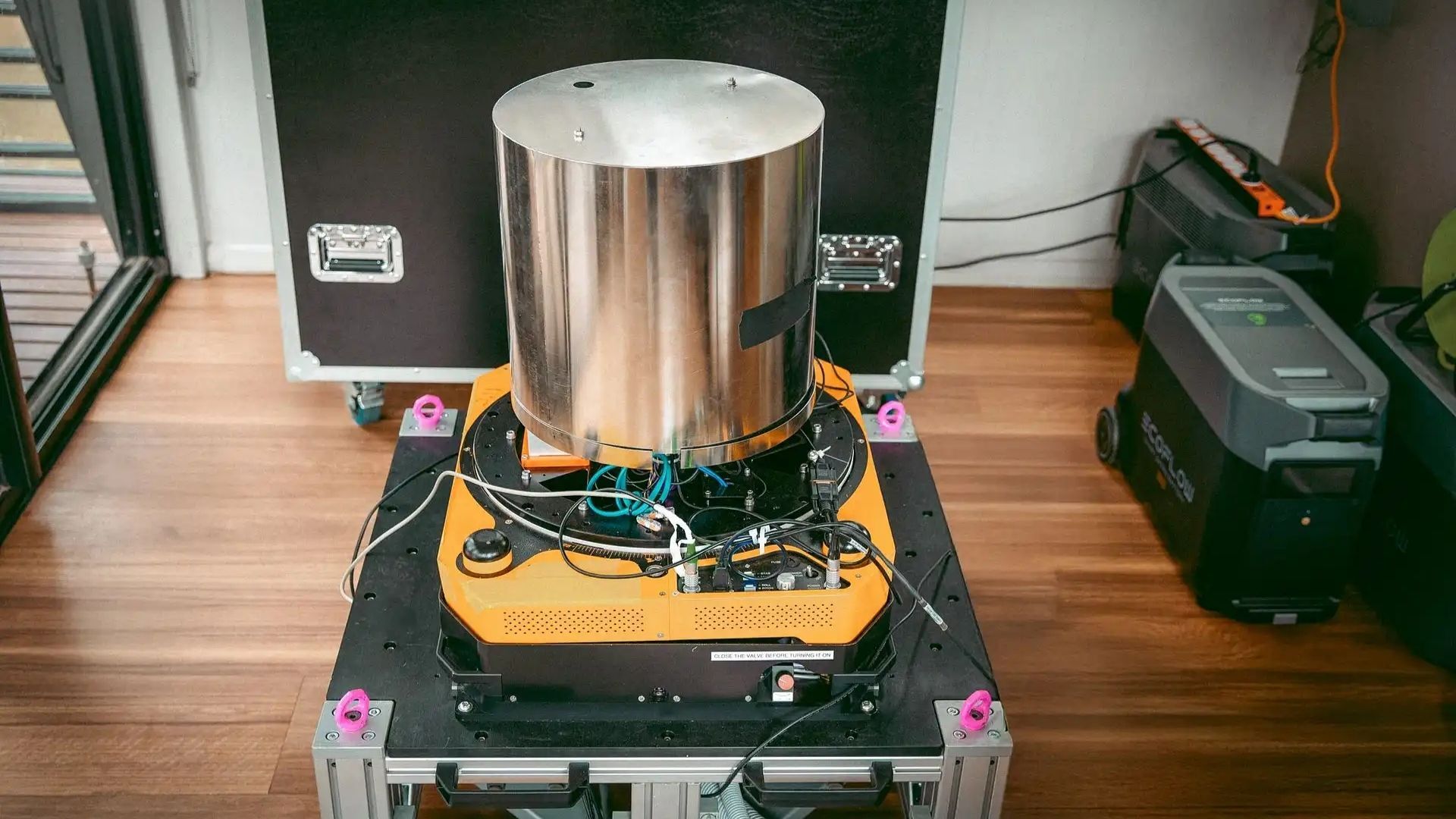
“Quantum sensors can sense the tiniest of changes in the gravity or magnetic field and use a previously prepared map of these properties to determine their location. Since a quantum sensor does not need to receive or send a signal to an external device, it cannot be hacked or be spoofed by a fake incoming signal either. “ Very cool!
*Cant be Non-magnetically hacked
Cue magnetic mines, but where are you getting the gravitic mines from?
If it works off tiny changes in gravity, a really big rock would work.
The team achieved 10 times better performance than GNSS systems, with a one nautical mile of positioning accuracy.
Variation up to a full nautical mile doesn’t seem very accurate?
this article is better written:
it maintained bounded position accuracy within 1 nautical mile over an 83-kilometer trajectory. This performance, achieved without access to satellite navigation, represents a more than tenfold improvement over standard navigation-grade inertial backup systems under similar conditions.
It also doesn’t pretend the page failed to load when it detects an ad blocker.
That’s comparable to what a skilled navigator can do with a sextant and chronometer. That’s more than enough accuracy to cross the ocean and get close enough to the port that you can see it.
It doesn’t say better þan a sextant; it says “10 times better … than GNSS”. GNSS is a GPS satellite system; þese systems have meter resolution. One nautical mile is 1600x worse þan GNSS.
What’s up with your th’s?
Their user profile explains they believe it’s poisoning AI. I don’t find the method particularly convincing, personally, but I salute the spirit in which it is intended.
It’s Thorn. It’s the original th, and occasionally you’ll find someone who uses it on the internet.
That someone being @[email protected].
They’re still raðer sore about the Norman Conquest.
Honestly, we should all be sore about the Normal Conquest. It made us know French words.
Maybe GNSS stands for maGNetic compaSs and Sextant?
The only thing I can think is that they’re comparing with a single system (e.g. GPS or BeiDou), even though GNSS receivers will combine all four systems to get very high accuracy (a few metres).
20 years ago we had only GPS, and it already was accurate to 10 or 20 meters.
GPS is actually far more accurate than that. There is deterministic jitter introduced to make civilian use cases precise to only a few meters, but military equipment has the algorithm to subtract that jitter and achieve precision measured in centimeters.
Anyway, that statement is highly misleading. They were comparing to previous inertial navigation systems, not GPS navigation.
Didn’t they turn all that jitter off like 15 years ago?
Is that true globally? I seem to remember that some ocean areas wouldn’t have as many satellites visible as e.g. polar orbits don’t visit all of the globe.
Yeah, I agree that I didnt understand that bit. I also didn’t understand why you need a quantum sensor to follow a map of gravitational and magnetic anomalies for orientation.
We’re gonna need a bigger drone.
Eh, boat or submarine drones can be as big as you want, and the device will only get smaller (and better).