The thing about people who buy NFTs is that they think they are being smart with their money.
They look at what happened with Apple, Microsoft, Google stocks way back in the day and think “huhuhu, I’m not going to be one of those idiots who misses out on an opportunity like that!”
It’s FOMO and “high risk - high reward” gambler mentality, wrapped up in the illusion of being a savvy investor.
That’s pretty much FOMO though. They thought I was the next big thing, *and* they didn’t want to miss out on it.
And it doesn’t matter if it’s really investing or not, because the fact remains that the people who buy it believe that it is. If they didn’t think of it as an investment, they would have zero reason to buy NFTs (unless they intend to use it on the dark web)
If that’s FOMO then pretty much every decision could be considered FOMO. I decided to put my shoes on this morning because I was worried everyone else wearing shoes would enjoy the advantages there-of and I would miss out.
That’s funny because I actually didn’t wear shoes today cause I was having FOMO about that barefoot life after listening to Shakira sing Pies Descalzos
Sure, that’s true. I think in mine and many cases, wrapped up in the “being smart with money” lesson is saving, mitigating risk, and decreasing spending where possible. I at least hope most parents (who bother at all) are defining what being smart actually looks like.
Yes but some financial advisors will literally tell you that money in savings is slowly decaying and that (besides an emergency fund) you should invest it.
The type of investments they’ll recommend will depend on your risk tolerance and financial goals of course, and probably isn’t likely to include NFTs.
But I could see some 19-20 year old reading a post on instagram that says you should invest instead of saving, and with a very superficial understanding of what that actually means, might easily fall for the very next post or sponsored ad that says “Hey you! Yeah, you. The dumbass who hasn’t bought [inset memecoin here] yet. Why don’t you have any [memecoin]?!? Anyone who’s smart has some already, and look how rich they’re getting! Don’t miss out by being a coward. Own your future. Grindset. Yadda yadda.”
I’m not saying that makes them intelligent, but simply telling them to be “smarter with money” isn’t going to solve the problem, and might actually exacerbate it.
Just telling them to be smart with money is not what I’m talking about though. What I’m talking about is actually modelling and teaching some amount of knowledge about how to save.
Because of course you can’t expect a child to learn a bunch of vital and complex stuff when you don’t attempt to help them. My original reply here was concerning people who actually had been taught something, rather than those who heard some useless vague advice in passing.
I see. That makes sense. Sometimes I forget that some people actually grew up with effective parenting.
Finances were one of many taboo topics in my house growing up. I never even knew a remote approximation of my dad’s salary, or what things like groceries, utilities, healthcare, etc. cost; until I became an adult and had to face those things for myself. I felt pretty blindsided by how expensive life is.
When I was a kid my parents gave me three envelopes and said one’s for saving, one’s for giving to church, and the other’s for spending. Or at least they claimed they told me that, a year later when they found out I was putting all my allowance in the same envelope. But that’s the first I recall ever hearing about their little system.
After that, there was no oversight. No checking in or auditing to make sure I’m doing it right, no instructive moments when they found out I’m doing it wrong. Just scolding and blaming, and shortly after I stopped receiving an allowance because it “wasn’t working” to teach me financial responsibility. As if all it takes is saying “do this” one time and then forgetting it.
It was the same with everything. Hygiene, chores, etc. They thought they could tell a kid with single-digit age “do this” one time and then forget about it and assume it immediately becomes a failproof habit. And then scolding and blaming when years down the line they find out that’s not the case. “I taught you better than this! You’re just being lazy!” Stuff like that.
It’s a foolproof way to instill something: oppositional defiant disorder.
So yeah, sometimes I forget that to some people “parents taught me [such and such] good habit” actually means “modeling good behavior and checking in to verify and make gentle corrections until it actually becomes learned.”


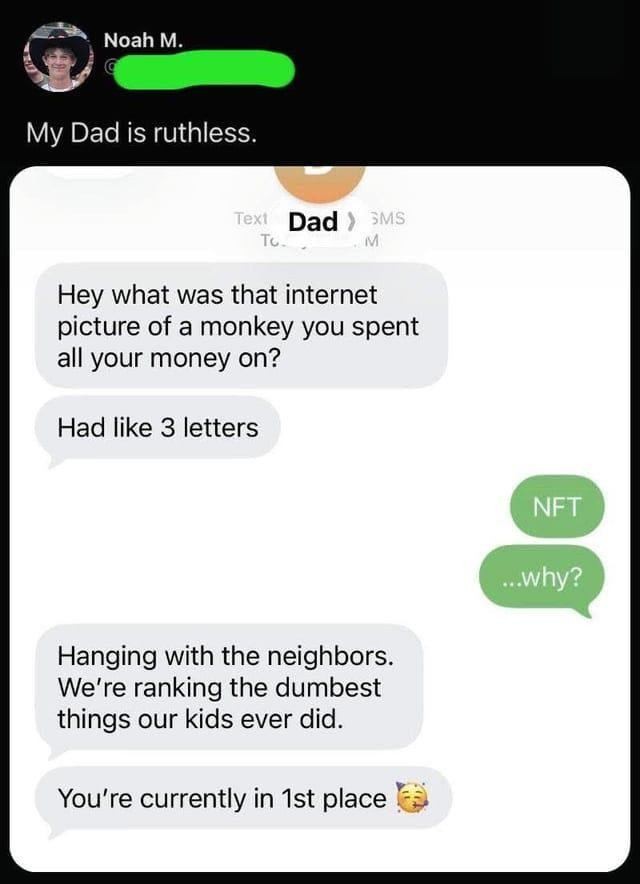
The thing about people who buy NFTs is that they think they are being smart with their money.
They look at what happened with Apple, Microsoft, Google stocks way back in the day and think “huhuhu, I’m not going to be one of those idiots who misses out on an opportunity like that!”
It’s FOMO and “high risk - high reward” gambler mentality, wrapped up in the illusion of being a savvy investor.
No, I think with NFTs people were just looking at the bitcoin train they had missed out on, and thought NFTs would be the next big crypto thing.
Mostly they thought it was just the next big thing.
I think this unique. Not really FOMO and certainly not investing.
That’s pretty much FOMO though. They thought I was the next big thing, *and* they didn’t want to miss out on it.
And it doesn’t matter if it’s really investing or not, because the fact remains that the people who buy it believe that it is. If they didn’t think of it as an investment, they would have zero reason to buy NFTs
(unless they intend to use it on the dark web)If that’s FOMO then pretty much every decision could be considered FOMO. I decided to put my shoes on this morning because I was worried everyone else wearing shoes would enjoy the advantages there-of and I would miss out.
That’s funny because I actually didn’t wear shoes today cause I was having FOMO about that barefoot life after listening to Shakira sing Pies Descalzos
Sure, that’s true. I think in mine and many cases, wrapped up in the “being smart with money” lesson is saving, mitigating risk, and decreasing spending where possible. I at least hope most parents (who bother at all) are defining what being smart actually looks like.
Yes but some financial advisors will literally tell you that money in savings is slowly decaying and that (besides an emergency fund) you should invest it.
The type of investments they’ll recommend will depend on your risk tolerance and financial goals of course, and probably isn’t likely to include NFTs.
But I could see some 19-20 year old reading a post on instagram that says you should invest instead of saving, and with a very superficial understanding of what that actually means, might easily fall for the very next post or sponsored ad that says “Hey you! Yeah, you. The dumbass who hasn’t bought [inset memecoin here] yet. Why don’t you have any [memecoin]?!? Anyone who’s smart has some already, and look how rich they’re getting! Don’t miss out by being a coward. Own your future. Grindset. Yadda yadda.”
I’m not saying that makes them intelligent, but simply telling them to be “smarter with money” isn’t going to solve the problem, and might actually exacerbate it.
Just telling them to be smart with money is not what I’m talking about though. What I’m talking about is actually modelling and teaching some amount of knowledge about how to save.
Because of course you can’t expect a child to learn a bunch of vital and complex stuff when you don’t attempt to help them. My original reply here was concerning people who actually had been taught something, rather than those who heard some useless vague advice in passing.
I see. That makes sense. Sometimes I forget that some people actually grew up with effective parenting.
Finances were one of many taboo topics in my house growing up. I never even knew a remote approximation of my dad’s salary, or what things like groceries, utilities, healthcare, etc. cost; until I became an adult and had to face those things for myself. I felt pretty blindsided by how expensive life is.
When I was a kid my parents gave me three envelopes and said one’s for saving, one’s for giving to church, and the other’s for spending. Or at least they claimed they told me that, a year later when they found out I was putting all my allowance in the same envelope. But that’s the first I recall ever hearing about their little system.
After that, there was no oversight. No checking in or auditing to make sure I’m doing it right, no instructive moments when they found out I’m doing it wrong. Just scolding and blaming, and shortly after I stopped receiving an allowance because it “wasn’t working” to teach me financial responsibility. As if all it takes is saying “do this” one time and then forgetting it.
It was the same with everything. Hygiene, chores, etc. They thought they could tell a kid with single-digit age “do this” one time and then forget about it and assume it immediately becomes a failproof habit. And then scolding and blaming when years down the line they find out that’s not the case. “I taught you better than this! You’re just being lazy!” Stuff like that.
It’s a foolproof way to instill something: oppositional defiant disorder.
So yeah, sometimes I forget that to some people “parents taught me [such and such] good habit” actually means “modeling good behavior and checking in to verify and make gentle corrections until it actually becomes learned.”