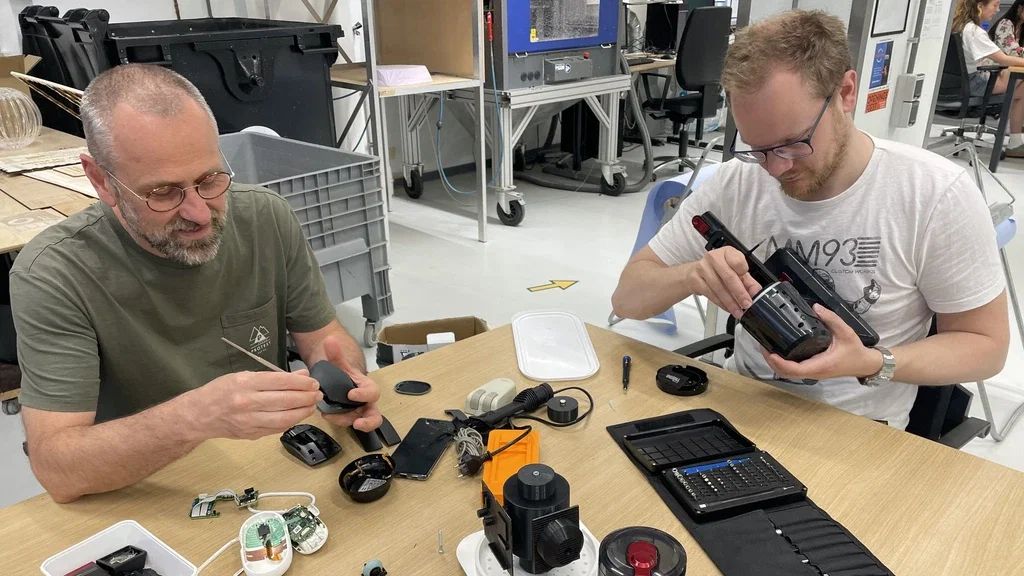
The products covered by the obligation to repair currently include:
- washing machines and washer-dryers
- dishwashers
- refrigerators
- electronic displays
- welding equipment
- servers and data storage products
- mobile phones, cordless phones and tablets
- tumble dryers
- e-bikes and e-scooters batteries (from 18 February 2027)
- local space heaters
WHY CAN’T WE GET THIS IN AMERICA I FUCKING HATE OUR POLITICIANS
Pleeeeeeeease, European companies sell your products that comply with this in Australia!
I have a super common type (in EU) of Philips water kettle. It’s a reliable machine. Unfortunately the little filter “screen” for the pouring sprout is starting to break now, after many many years of use. I can’t find a replacement. It’s a super easy to manufacture part, must be a very common “breaking thing” on this widespread device… Nope.
Philips HD4646 if anyone knows a source 🙈

Excellebt choice of gif, from my favorite epside of Futurama. Bravo
Heh, the dryer stopped working at home and my spouse was bracing to buy a new one. So nice to break out the multimeter, find the issue, and 10 dollar part later, good as new.
Think of all the waste avoided by repairing a tiny part in a gigantic appliance.
Interesting things that are not on the list:
- Farming equipment
- Motor and electric vehicles
- Computers (including laptops)
- Video game consoles
- HVAC systems and equipment
Not sure if smart TVs fall under “electronic displays”, or if they just mean commercial displays when they say that.
microwave ovens…
in fact, make that all kitchen appliances.
Farming equipment is a particularly annoying one, that and construction vehicles, are becoming increasingly locked down by proprietary software and impossible to maintain yourself. You can’t even employ mechanics outside the dealer network in some instances and it will be more so in the future.
not yet ! we hope !
John deer tractor lost a case that became famous in my rural area (and elsewhere). It now have to let repair shop acces the tools and allow repair on its tractors.
I take the win ! And we continue to push forward in talks, petitions, actions and repairs (autorised or else) Support and/or use open source.
It’s a good start.
Pisses me off that laws are required for this, but that’s what we get for being ruled by the Epstein Class.
Hopefully this will benefit other countries indirectly, instead of designing one repairable phone and one not repairable, should be easier to just design one.
So I saw that my car offered up all sorts of useful diagnostic information for self diagnosing stuff. Was very excited and went to look at it for a generic fault without having to get software to tell me what the fault is. I thought "it’s stupid it has fully functional computer display yet tells me basically “contact a dealer, but it’s safe to drive” instead of what the problem is. Then I find out that because I’m in the USA, the company keeps it to themselves…
So if they see value in treating regions differently, they will absolutely go out of their way to screw over the regions that will let them.
Car manufacturers screwed over consumers the last 10-15 years big time! Cars used to be the big thing many could fix a lot on by themselves and were proud to do so. Then they basically just said incrementally to the DIY’ers “it’s all computers now, not your cup of tea”, purposely made cars less and less self repairable and got away with it! It’s infuriating.
“Hold my beer” - Nintendo, releasing an EU centric revision. Meanwhile Apple and Samsung are digging up every legal loophole to prevent the law applying to their devices.
Apple and Samsung be like: “It’s not a mobile phone or a tablet, it’s a phablet so it does not fall in to any category of the devices that need to be repairable.”
The loophole in the directive is smaller phones. Smartphones go from 10.16 cm (4 inches) diagonal to 17. 78cm (7 inches) and everything bigger (up to 44.2 cm) is a tablet.
Samsung and Apple’s flagship smartphones are very close to be considered tablets but that wouldn’t save them from the requriments.
iPhones are already super easy to repair. Apple have been at the forefront of this for years.
For the downvoters who are too blinded by their hate for Apple to believe facts:
https://www.ifixit.com/repairability/smartphone-repairability-scores
PROS
- Display and battery repairs are well-prioritized, though not as well as in other (dual-entry) iPhone models.
- Torx screws secure the battery assembly in place, making replacements straightforward.
- Repair parts and instructions are available straight from Apple.
CONS
- Five different screwhead types and the continued reliance on adhesives complicate basic repairs.
the same apple that locks individual parts of devices to user accounts so that they can’t be used for repair?
Same Apple. Signing new parts to your device is incredibly simple and DIY now.
https://www.ifixit.com/repairability/smartphone-repairability-scores
PROS
- Display and battery repairs are well-prioritized, though not as well as in other (dual-entry) iPhone models.
- Torx screws secure the battery assembly in place, making replacements straightforward.
- Repair parts and instructions are available straight from Apple.
CONS
- Five different screwhead types and the continued reliance on adhesives complicate basic repairs.
Are we talking about the same apple that invented a new type of screw to keep people from taking their phones apart? The same apple that once people could get a trilobe driver, then made it so that generic replacement screens would not work because of some protection from non-apple hardware? Then went on to make sure that you can’t use non-apple parts in a laptop?
Yes.
https://www.ifixit.com/repairability/smartphone-repairability-scores
PROS
- Display and battery repairs are well-prioritized, though not as well as in other (dual-entry) iPhone models.
- Torx screws secure the battery assembly in place, making replacements straightforward.
- Repair parts and instructions are available straight from Apple.
CONS
- Five different screwhead types and the continued reliance on adhesives complicate basic repairs.
Super easy to repair by certified repair shops or easy to repair by people at home with minimal tool requirements?
At home with minimal tool requirements
https://www.ifixit.com/repairability/smartphone-repairability-scores
PROS
- Display and battery repairs are well-prioritized, though not as well as in other (dual-entry) iPhone models.
- Torx screws secure the battery assembly in place, making replacements straightforward.
- Repair parts and instructions are available straight from Apple.
CONS
- Five different screwhead types and the continued reliance on adhesives complicate basic repairs.
Company that rates self repairability of phones: iPhones are easy to repair by yourself using basic tools
Lemmy: no, that can’t be true because we hate apple
/s?
Edited to add the single best source there is for the doubters and downvoters. Take a look.
You only need a screwdriver set and maybe some rubbing alcohol.
I’ve read a couple stories of companies (planning to) release EU-only models there, but non-EU-compliant ones everywhere else.
The EU ones will become a lot more valuable on second hand markets…
The past two phones I bought were not because they broke, but because they stopped being supported on apps that I need to use.
That’s also included in the directive. Manufactures will be required to provide OS updates for at least 5 years “from the date of end of placement on the market” (which means the date the brand shipped the last device of a model).
They also have 4 months to release security updates and 6 months for functionality updates see ANNEX II for all device categories.
Let me guess, iPhone?
Androids
Huh…I’m guessing banking apps? Those are the only ones that have ever given me problems on old Android devices
I’ll literally change banks over that kind of thing now.
Been starting to see more randomly picky apps. Based on vintage and rooted device.
Uninstalled the FedEx app, since every time I tapped on a tracking number, it would divert to the app which would promptly shame me for having a rooted device and refuse to run.
yes
Doubtful. iPhones have the longest support of any phones out there.
Source?
As far as I know, nearly all flagship phones, Apple or otherwise, get about 7 years of update support (
except Pixel phones with GrapheneOS which get 14ignore; I remembered this incorrectly).The difference is, even my old phone running Android 8 (a 9yo OS) can still browse the web, run all apps, and perform fine as a phone. An even older phone running Android 4.4 can still run 3rd party apps. iPhones seem to stop working about a year after they stop receiving updates, and they don’t support sideloading (also know as running the software you want to run on the device you own).
The oldest iPhone that can run the latest iOS is the 11 from 2019. Apple is still providing security fixes all the way back to iOS 15, which goes back to the 6s released in 2015. So, somewhere between 7 and 11 years for Apple depending on what you are counting as support. As a personal experience, my partners iPad from 2017 still runs fine, though it is stuck on iOS 16 and only gets security updates.
Are you sure about 14 years of support? I think Graphene basically supports things as long as Google does, due to reliance on their source code releases. Double that would be impressive.
Ah thanks, my bad; I must have remembered incorrectly. I’ve updated my original comment
Oh trust me, I’m no fan of Samsung, but I tend to value control of my devices over…whatever it is Apple does. I had an iPhone until I discovered replacing the home button myself artificially bricked the device due to DRM forcing customers to go to an Apple store for repairs. Never again
Your Android 8 phone absolutely can not run every app lol. That’s a straight up lie that even people here won’t believe.
iPhones have the longest security update and os update plan out of any manufacturer.
Also worth noting that up until about 3 years ago finding an Android phone that was supported for even 4 years was almost impossible. Apple have been doing 6-7 years of full OS version updates and 8+ years of security updates almost since the start.
deleted by creator
Great in theory until companies start charging 80% of the product price for a single spare part so you’d rather buy a new product than try to repair your existing one.
Depends on how it’s done. If they have to make schematics and binaries available, it’s different than having to provide parts at whatever cost they’d like.
Good start I guess but missing plenty of things that others have already pointed out. This list only covers like half of devices in a household. Also, what is stopping companies from pricing replacement parts way out of proportion because of this? Even more than they already do now to prevent repairs
Good, now let’s increase the list and also add vacuum cleaners to it! I thought that they already were but seemingly not :(
For mine replacing the roller belt would require replacing the entire head. So damn wasteful.
This is good.
The RIGHT to repair does you no good if the thing itself is not DESIGNED to be repaired.
It’s a start.
You can always take the next step later.
This is a step in the right direction love it. Although I got a reality check recently when I bought a washing machine and had a chat with the guy selling them new and used. He said that from 201X onwards basically the manufacturers constructed the insides of them in a single piece which is 350€ and with that it’s not economical to fix them. So yea technically they are repairable. But I have not much hope that this will actually change something for consumers or the environment.
I wonder why the US doesn’t have this law.
Hmmmm. 🤔
I hold out the thin hope that manufacturers will not want to split their product lines any more than they have to and will make these devices available globally.
It’s possible that they want to hang on to the revenue streams that making irreparable garbage generates, but it would have to be greater than the cost of designing and manufacturing a second product line for most of their stuff.
Kind of how like when dumbass apple was forced into USB-C in the EU and they finally gave up on their own charge cables globally.
That’s a good example. You’ve sold me on the hope!
This is excellent news, but I really wish this same logic will spill into the recent “stop killing video games” movement as well.
That whole fight was really about consumer protection as well, not just about video games IMO.
I want to be able to be easily repair and support products that are past their manufacture supported end of life. This goes for both physical products and digital products!