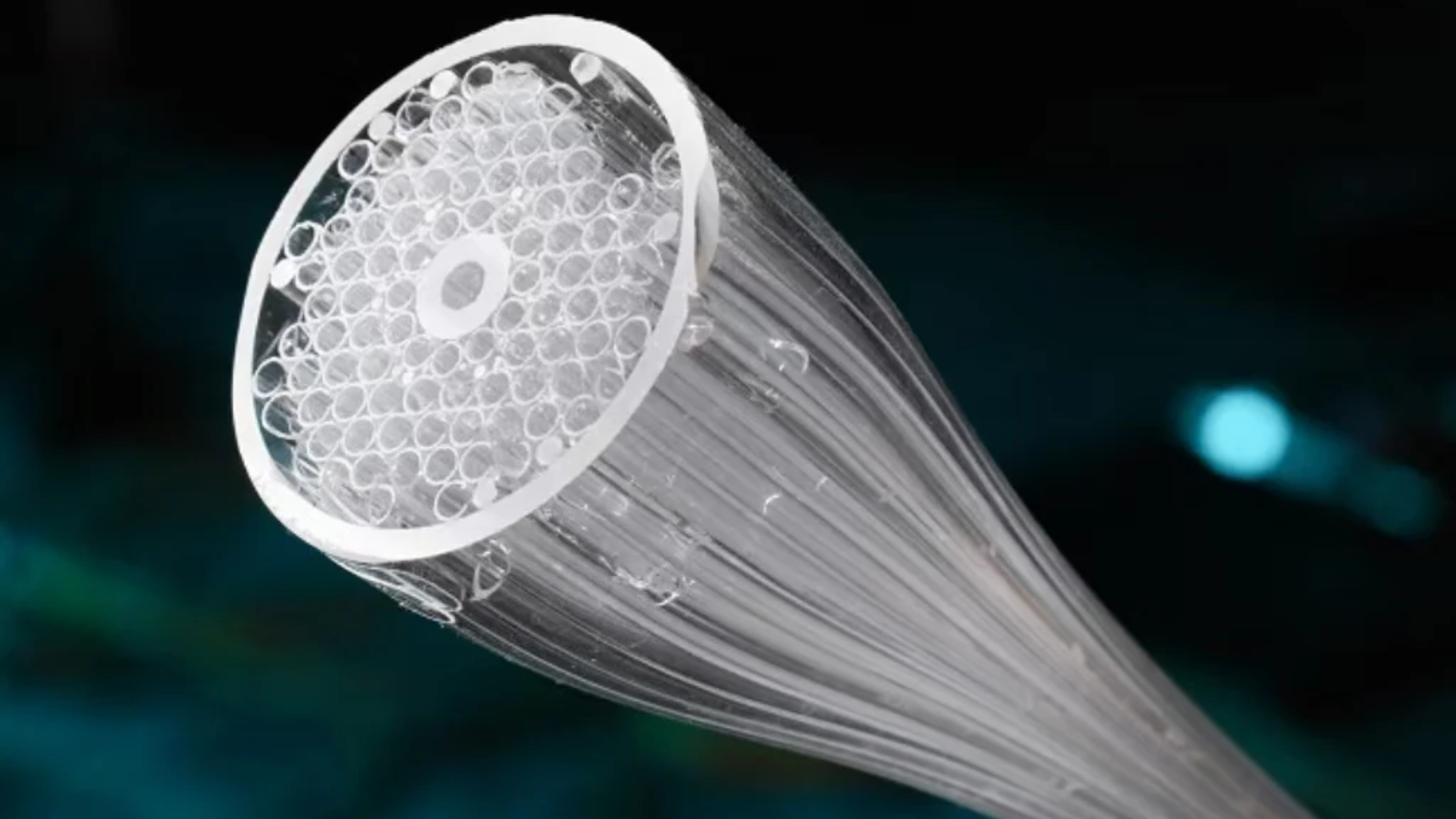
Chinese researchers achieved a new milestone in fiber-optic technology, achieving ultra-fast data transmission over long distances without signal repeaters.
This is impressive! Our usual spans go to maybe 120 km at most if I use our strongest EDFAs. With those we can deal with around 30 dB of span loss, and most fibers we can rent have around 0.25 dB/km loss. Of course this is on classical single core fiber, we don’t use HCF yet.
I remember YOFC was also at last year’s ECOC, where they presented their support tube hollow core fiber concept, reaching 0.05 dB/km at some wavelengths. Here’s some slides I photographed.
You sound like you know what you’re talk7ng about. What does the span loss (db/km) actually mean? I am most curious about why its measured in db (I guess it gets done by that to represent the sum of the “intensity” of all waves across different wavelengths that falls of across longer distances). Also how much span loss do they have in this new experiment (if you know something like that)
Okay let’s start with the simple case: You have a sender (laser source), a span of fiber of a certain length, and a receiver (photo diode). The three associated measurements would be transmission power, span loss, and receiving power.
Let’s say your laser is fairly strong in the context of optical networking and outputs 4 mW of power into our fiber span.
As the light travels through the medium (silica glass (SiO2)) it loses some power at every point, due to Brillouin scattering. Over distance the effect accumulates. How much you lose also depends on the qualities of the fiber, and on the quality of the splices where sections of fiber are connected (I’m told that while laying fiber they work with spools of 4 km of cable).
Now you could say something like, we have measured this cable, and after 12 km it loses half the laser power at 1550nm wavelength, that’s a realistic value. We would then have 2 mW of receiving power at the end of a 12 km span, or 0.125 mW after 60 km (halve the 4 mW five times).
But it’s hard to work with, and more so if you care about distances that don’t happen to be multiples of 12 km. So instead of multiplying absolute power levels with loss ratios all over the place, the industry has standardized on using a logarithmic scale. (Actually I’m pretty sure we inherited this from the telephone industry already, who had the same issue.)
Expressed in deciBel the 1/2 loss ratio from above becomes 10 * log10(1/2) ≈ -3 dB. Ten times for the deci, and the unit Bel is defined as the base-10 logarithm of the power ratio.
Now since it’s a log scale you can add up sections of fiber loss instead of multiplying them. If 12 km have a loss of -3 dB, then 24 km have -6 dB or 60 km have -15 dB. And if you want to calculate for arbitrary distances you might want to break it down to the kilometer, so -3 dB / 12 km = -0.25 dB / km. Now we can calculate what loss we would expect for 83 km, 83 km * -0.25 dB / km = -20.75 dB.
Okay great but how do we relate that to the transmission power of 4mW? Well we convert that into dBm. dBm stands for deziBel milliwatt. It expresses absolute power in a logarithmic scale, by essentially treating it as a ratio over a fixed reference value of 1 mW. So our 4mW turn into 10 * log10(4mW/1mW) ≈ 6 dBm.
Now you can add transmission power and span loss to get your receive power, which is super handy, just to prove it works I’ll do the 60 km case form above again: So 6 dBm sent over 60 km of fiber with a loss per kilometer of - 0.25 dB/km, or 60 km * -0.25 dB/km = - 15 dB, together gets us 6 dBm - 15 dB = -9 dBm, and convert back for proof (divide our value by ten for the deci, then take ten to the power of the intermediate to invert the logarithm) 10^(-9/10) ≈ 0.125 mW
So that’s how the scales and units work. I hope I could explain how It’s useful even if you only have one laser source. Of course it’s also useful if you have multiple sources, and other optical components, like filters and EDFAs in the mix, because you can specify them all in dB or dBm and just add and subtract as applicable.
For example you use 5 of those strong lasers of 6 dBm each, but you need a dynamic optical filter called WSS to combine them, which introduces an attenuation of 12 dB, but then you also add an EDFA that has a gain of 15 dB, followed by a fiber section of 30 dB loss, then another EDFA with a gain of 20 dB, then another WSS with 12 dB attenuation, and finally 5 receivers.
Edit: The following example math is actually wrong, please see followup comment further down, where I re-do it correctly.
So you send into the fiber a total of 5 * 6 dBm - 12 dB + 15 dB = 33 dBm
Then at the end of the fiber you have 33 dBm - 30 dB = 3 dBm
After the EDFA and WSS you get a resulting power at each of your five receivers of (3 dBm + 20 dB - 12 dB) / 5 = 21 dBm / 5 = 4.2 dBm
As for this experiment, I haven’t heard more detail than what is found in this link. Maybe they will present it at ECOC 2026 :-)
But for now I know that the hollow core fiber section was 206.5 km long, and that they told us last year they had a real world deployment with 0.085 dB/km over 34 km. And that last year they had a record fiber (not weaved into a cable yet, which usually adds attenuation) of 0.050 dB/km, but it was relatively short, I think they only managed to make a spool of like 20 km or so. So maybe we can assume this new real world experiment achieved 0.080 dB/km over 206.5 km (longer is harder, of course), which would give us 16.52 dB span loss. But that’s just a pretty random estimate.
But the impressive bit is really the distance of 206.5 km without having to add any amplifiers anywhere in between. That is only achievable by sending light down the hollow core where it experiences less Brillouin scattering compared to in a classic silica glass core. And it needs to be well fabricated for all 206.5 km, with the fine silica glass details that make up the confinement structure in a hollow core fiber. It looks like very good engineering I would say. I’m just a user of fiber though. Even the fabrication of classical fiber sounds fiendishly difficult to me.
Just for contrast, if I had such a 206.5 km span to bridge in our network I would need to look for housing for an amplifier site, ideally somewhere between kilometer 90 and 116.5. Luckily Switzerland is dense in the populated areas, so this is usually not a big issue. I think our worst in-line amplifier site used to be in Rodi Fiesso, on the way up to the old Gotthard rail tunnel, but that one is history now.
And I actually need to correct myself. When I woke up this night I suddenly remembered that I did the one thing that dBm is not great for in the example, and did it wrong.
If you want to add up the power of five lasers you cannot add up their individual dBm numbers! Because that is already an addition operation when you do it on the absolute value scale! So adding them in the log scale would be like multiplying their powers, which makes no physical sense.
So, again, the correct way:
5 lasers of 4 mW or 6 dBm each, added up, actually comes out to 20 mW and then convert 10 * log10(20mW/1mW) = 13 dBm.
Or alternatively we convert the factor of 5 into dB first, 10 * log10(5) = 7 dB, and the add that one to the 6 dBm to also arrive at 13 dBm.
Then the rest of the example goes on like this:
13 dBm - 12 dB + 15 dB = 16 dBm into the fiber
16 dBm - 30 dB = -14 dBm at the end of the fiber
-14 dBm + 20 dB - 12 dB = -6 dBm after the WSS
and now split it for the 5 receivers, by
either subtracting the log of the factor 5 from above, -6 dBm - 7 dBm = -13 dBm per receiver, which is 10^(-13/10) = 0.05 mW.
or converting -6 dBm to 10^(-6/10) = 0.25 mW and then divide that absolute power by 5 to also arrive at 0.05 mW per receiver.


To add at least one on-topic comment here:
This is impressive! Our usual spans go to maybe 120 km at most if I use our strongest EDFAs. With those we can deal with around 30 dB of span loss, and most fibers we can rent have around 0.25 dB/km loss. Of course this is on classical single core fiber, we don’t use HCF yet.
I remember YOFC was also at last year’s ECOC, where they presented their support tube hollow core fiber concept, reaching 0.05 dB/km at some wavelengths. Here’s some slides I photographed.
You sound like you know what you’re talk7ng about. What does the span loss (db/km) actually mean? I am most curious about why its measured in db (I guess it gets done by that to represent the sum of the “intensity” of all waves across different wavelengths that falls of across longer distances). Also how much span loss do they have in this new experiment (if you know something like that)
Okay let’s start with the simple case: You have a sender (laser source), a span of fiber of a certain length, and a receiver (photo diode). The three associated measurements would be transmission power, span loss, and receiving power.
Let’s say your laser is fairly strong in the context of optical networking and outputs 4 mW of power into our fiber span.
As the light travels through the medium (silica glass (SiO2)) it loses some power at every point, due to Brillouin scattering. Over distance the effect accumulates. How much you lose also depends on the qualities of the fiber, and on the quality of the splices where sections of fiber are connected (I’m told that while laying fiber they work with spools of 4 km of cable).
Now you could say something like, we have measured this cable, and after 12 km it loses half the laser power at 1550nm wavelength, that’s a realistic value. We would then have 2 mW of receiving power at the end of a 12 km span, or 0.125 mW after 60 km (halve the 4 mW five times).
But it’s hard to work with, and more so if you care about distances that don’t happen to be multiples of 12 km. So instead of multiplying absolute power levels with loss ratios all over the place, the industry has standardized on using a logarithmic scale. (Actually I’m pretty sure we inherited this from the telephone industry already, who had the same issue.)
Expressed in deciBel the 1/2 loss ratio from above becomes 10 * log10(1/2) ≈ -3 dB. Ten times for the deci, and the unit Bel is defined as the base-10 logarithm of the power ratio.
Now since it’s a log scale you can add up sections of fiber loss instead of multiplying them. If 12 km have a loss of -3 dB, then 24 km have -6 dB or 60 km have -15 dB. And if you want to calculate for arbitrary distances you might want to break it down to the kilometer, so -3 dB / 12 km = -0.25 dB / km. Now we can calculate what loss we would expect for 83 km, 83 km * -0.25 dB / km = -20.75 dB.
Okay great but how do we relate that to the transmission power of 4mW? Well we convert that into dBm. dBm stands for deziBel milliwatt. It expresses absolute power in a logarithmic scale, by essentially treating it as a ratio over a fixed reference value of 1 mW. So our 4mW turn into 10 * log10(4mW/1mW) ≈ 6 dBm.
Now you can add transmission power and span loss to get your receive power, which is super handy, just to prove it works I’ll do the 60 km case form above again: So 6 dBm sent over 60 km of fiber with a loss per kilometer of - 0.25 dB/km, or 60 km * -0.25 dB/km = - 15 dB, together gets us 6 dBm - 15 dB = -9 dBm, and convert back for proof (divide our value by ten for the deci, then take ten to the power of the intermediate to invert the logarithm) 10^(-9/10) ≈ 0.125 mW
So that’s how the scales and units work. I hope I could explain how It’s useful even if you only have one laser source. Of course it’s also useful if you have multiple sources, and other optical components, like filters and EDFAs in the mix, because you can specify them all in dB or dBm and just add and subtract as applicable.
For example you use 5 of those strong lasers of 6 dBm each, but you need a dynamic optical filter called WSS to combine them, which introduces an attenuation of 12 dB, but then you also add an EDFA that has a gain of 15 dB, followed by a fiber section of 30 dB loss, then another EDFA with a gain of 20 dB, then another WSS with 12 dB attenuation, and finally 5 receivers.
Edit: The following example math is actually wrong, please see followup comment further down, where I re-do it correctly.
So you send into the fiber a total of 5 * 6 dBm - 12 dB + 15 dB = 33 dBmThen at the end of the fiber you have 33 dBm - 30 dB = 3 dBmAfter the EDFA and WSS you get a resulting power at each of your five receivers of (3 dBm + 20 dB - 12 dB) / 5 = 21 dBm / 5 = 4.2 dBmAs for this experiment, I haven’t heard more detail than what is found in this link. Maybe they will present it at ECOC 2026 :-)
But for now I know that the hollow core fiber section was 206.5 km long, and that they told us last year they had a real world deployment with 0.085 dB/km over 34 km. And that last year they had a record fiber (not weaved into a cable yet, which usually adds attenuation) of 0.050 dB/km, but it was relatively short, I think they only managed to make a spool of like 20 km or so. So maybe we can assume this new real world experiment achieved 0.080 dB/km over 206.5 km (longer is harder, of course), which would give us 16.52 dB span loss. But that’s just a pretty random estimate.
But the impressive bit is really the distance of 206.5 km without having to add any amplifiers anywhere in between. That is only achievable by sending light down the hollow core where it experiences less Brillouin scattering compared to in a classic silica glass core. And it needs to be well fabricated for all 206.5 km, with the fine silica glass details that make up the confinement structure in a hollow core fiber. It looks like very good engineering I would say. I’m just a user of fiber though. Even the fabrication of classical fiber sounds fiendishly difficult to me.
Just for contrast, if I had such a 206.5 km span to bridge in our network I would need to look for housing for an amplifier site, ideally somewhere between kilometer 90 and 116.5. Luckily Switzerland is dense in the populated areas, so this is usually not a big issue. I think our worst in-line amplifier site used to be in Rodi Fiesso, on the way up to the old Gotthard rail tunnel, but that one is history now.
That was very interesting to read and it perfectly explained my question. Thank you very much.
My pleasure!
And I actually need to correct myself. When I woke up this night I suddenly remembered that I did the one thing that dBm is not great for in the example, and did it wrong.
If you want to add up the power of five lasers you cannot add up their individual dBm numbers! Because that is already an addition operation when you do it on the absolute value scale! So adding them in the log scale would be like multiplying their powers, which makes no physical sense.
So, again, the correct way:
5 lasers of 4 mW or 6 dBm each, added up, actually comes out to 20 mW and then convert 10 * log10(20mW/1mW) = 13 dBm.
Or alternatively we convert the factor of 5 into dB first, 10 * log10(5) = 7 dB, and the add that one to the 6 dBm to also arrive at 13 dBm.
Then the rest of the example goes on like this:
13 dBm - 12 dB + 15 dB = 16 dBm into the fiber
16 dBm - 30 dB = -14 dBm at the end of the fiber
-14 dBm + 20 dB - 12 dB = -6 dBm after the WSS
and now split it for the 5 receivers, by
either subtracting the log of the factor 5 from above, -6 dBm - 7 dBm = -13 dBm per receiver, which is 10^(-13/10) = 0.05 mW.
or converting -6 dBm to 10^(-6/10) = 0.25 mW and then divide that absolute power by 5 to also arrive at 0.05 mW per receiver.
This comment needs to be made into a plaque for the Lemmy Hall Of Fame. Thanks for this!
I watched those pictures load one row of pixels at a time for 2 minutes.
Imagine howe quickly they would load on this newfangled fiber.
1 minute and 59 seconds I reckon