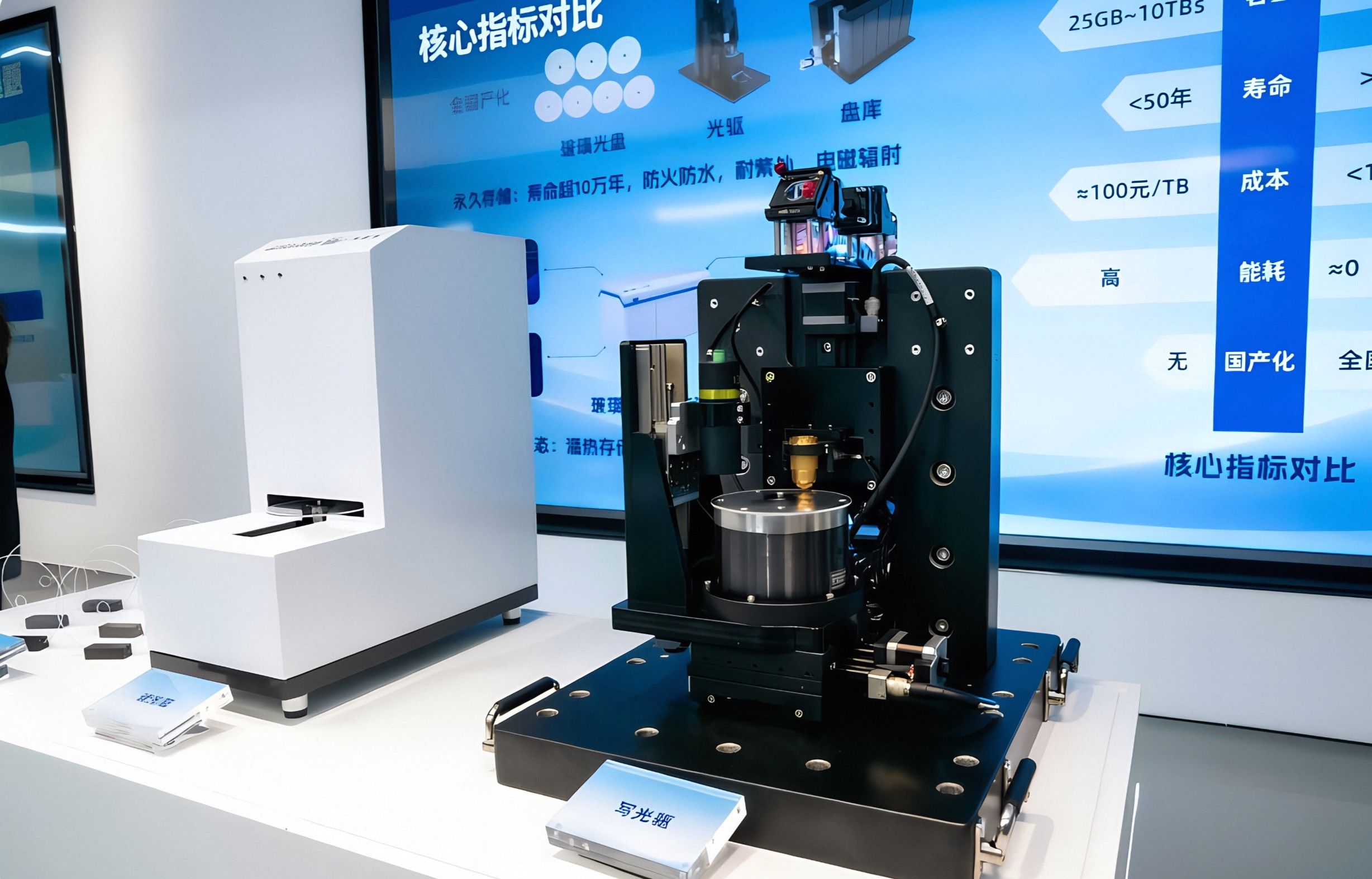
This is seriously cool. Although the current specs are a bit funny - if you take the largest possible disc size (360 TB), then it would take a million hours to fully write it at 10 MB/s (more if the storage unit is actually TiB). That’s over a hundred years.
Also if the goal is datacenter archival, then I wonder what the plan for practical use is - many individual discs with separate write “heads” (basically a RAID 0) to bring the speed up? And then maybe the maximum size per disc is a theoretical limit for the technology once we get faster access rather than something practical they intend to build anytime soon.
So basically an optical drive on steroids?
You know what I really want for long term offline backup storage? To go back to the bare discs with external readers paradigm of optical media (not sure if it’s possible with this though). Don’t have to pay for dedicated mechanical components in every drive that inevetably have a limited lifespan even if they’re just sitting in storage, and once they fail the recorded media itself is useless until you pay out the nose to get them transplanted into a new drive.
Pretty cool. Potentially qualitatively revolutionary, since all other high capacity storage mediums I’m aware of suffer from bitrot.
Wonder what the cost will look like, and if it’ll ever reach consumer levels.
Recently I have been feeling devastated about rising storage prices.This news gives me some hope. Maybe in about 5-6 years I can freely think of expanding my storage again.
So a few companies did this at this density, but they have at least twice the write speed & a production model some could eventually buy? Neat!
Awesome for archival
At 10MB/s it’d take you 416 days if constant writes to fill it up.
EXTREMELY slow archival.
At least for now, till it gets better
Good for write once read many applications with the 200 MB/s read speed though. Things like research data or torrents that gets recorded once and not changed again. Then again that’s the upper limit and the lower limit of 50 MB/s is pretty shit even for that.
Though 10 MB/s is literally 2.4 GHz Wi-Fi speeds so it might still be too slow to be practical for such a large drive.
If you’re not creating more than 800GB a day of new data you can just let it run with a faster drive as a buffer in front of it.
Or get 10 of them and run them in parallel. Maybe get 11 and throw in a bit of parity, just in case bitrot surfaces after the first 1000 years or something.
This is also assuming that reading and writing are mutually exclusive.
The places where this level of storage density and longevity are valuable are places that are generating terabytes or tens of terabytes a day. Especially scientific research.
It is definitely an interesting development, and the lack of bit rot makes it incredibly useful as an archival system. However, I am curious if the surrounding hardware necessary to actually successfully read from it is going to be as long-lived. Similar to magnetic hard drives, I am sure the plates that are being written to need to exist in an extremely sterile and particle-free environment in order to be read and written to.
Let’s say I want to preserve my computer disks when I do a major change (i.e. 10TB worth of NAS or just 4TB worth of workstation) or when I sell it or just throw it away. What do I do? Time is not essential. Or as others said, store photos and other large files. It’s for archival, not for backup purposes.
Stick the drive in a USB caddy and keep it?
If it’s an array, buy a big one and then repeat from step 1…
Stick the drive in a USB caddy and keep it?
That’d work only if I throw the computer away.
@Mihies I honestly don’t see why, no, not at all. If you want to keep the data then you plug the drive into anything else with a USB interface. If you don’t want to keep the data, what’s the problem? Just format it and donate it, whole.
If I do the former, then I need a new disk for the computer if I were to sell it or otherwise keep it functional, don’t I? And disks, especially these days, are not cheap. Plus it doesn’t make much (financial) sense to keep the standard disk just for archival purposes. You are also missing an major upgrade scenario - shall I buy a new disk each time I do an upgrade?
Finally, a drive that can hold my notes
Read and single write capability is an interesting proposition for archival purposes. 8-10MB/s write and 50-200MB/s read speeds
Archival CD-burning is back, baby!
I do photography, and I like to keep the original RAW photos from the camera. So, this sort of thing would be perfect for me. I don’t really need fast write access, since I just want to back the photos up and it’s not time sensitive.
Wonder how rough bit rot would be though.
The data is burned into a piece of glass with a laser. It doesn’t use a dye to store data like a CD-R. I doubt bit rot would be much of an issue. With that much capacity, you could use lots of forward error correction though.
What form would that take? They seem to indicate lifetime on the centuries, similar to expectations for M-DISC.
Gonna guess glass deformation over time is going to come into play (really (like millennia) old windows get thicker at the bottom), probably why the quartz version of this is speculated to be good for millions of years. And of course breakage. The drives will fail first.
Sucks to be Microslop sitting on this for years and years and China comes along and eats your lunch. Ha Ha.
Hopefully a story soon to be repeated with RAM and then chips, about time there was real competition and innovation in this space, too many cartels due to high capex siloing. This looks more like CDs, could be everywhere in a few years.
Glass flowing to be thicker at the bottom is a myth.
Yeah, I’ve heard that and I’ve seen pictures of examples, dunno. Personally, anything beyond a century is irrelevant anyway.
The window panes were cut from irregular sheets, and they were simply installed with the thicker part at the bottom, for structural integrity.
It was a manufacturing quirk.
Spin them once daily or weekly. As long as they’re balanced that should randomize the gravity vector.
It’s also almost certainly a different composition than century old glass panes made for buildings. So the material itself might mitigate this issue
Like the other user mentioned, glass warping/deformation. Although I’d reckon kinetic impacts, tremors, or actual drive failure would occur first (the real question is what are the maximum tolerances before a read/write fails or ends in data corruption).
The drives are write-once media — data cannot be erased or rewritten once stored
I could find a use for these. My pacman package cache maybe.
These would be fucking awesome for media storage. A dedicated, no-delete “favorites” disk is exactly the sort of shit that tickles my brain.
More bytes is more bytes. Flood the market until big AI firms can’t afford to monopolize the hardware anymore and finally collapse so we real people can finally compute again.
These would be useless for AI given the high write requirements inherent to any form of ‘AI’ in use today; but data centers would absolute eat these up for low-write CDN usage, i.e. netflix which only updates their catalogue once every few days but needs high read speeds for multiple users. So we’d still be competing with data centers for them, but luckily just much fewer.
It would make (assuming it can fit in a standard 3.5" bay) petabyte+ home data servers pretty trivial to set up though which is pretty neat. 4k Jellyfin data hoarders should rejoice.
Like I said, more bytes is more bytes. Even if it’s a niche use case, that takes pressure off of other use cases.
I would like a couple please!
A perfect RAID setup does not exi…
i would download everything i could i have one of these.
Article doesn’t load
loads fine for me, here’s the text:
China Achieves Mass Production Breakthrough with 360TB Glass Hard Drives Researchers at Huazhong University of Science and Technology (HUST) have achieved small-scale mass production of glass-based hard drives, a breakthrough that could transform enterprise cold data storage. Each glass disc can store a staggering 360 terabytes of data across 400 stacked layers, using laser “carving” technology that writes data into the internal structure of the glass medium.
China Achieves Mass Production Breakthrough with 360TB Glass Hard Drives
Researchers at Huazhong University of Science and Technology (HUST) have achieved small-scale mass production of glass-based hard drives, a breakthrough that could transform enterprise cold data storage. Each glass disc can store a staggering 360 terabytes of data across 400 stacked layers, using laser “carving” technology that writes data into the internal structure of the glass medium.
The technology, developed in collaboration with Wuhan-based startup YiYao Technology, uses femtosecond laser pulses to create microscopic modifications within glass discs, effectively encoding data in three dimensions. The 400-layer stacking capability represents a quantum leap in storage density compared to traditional magnetic hard drives or even solid-state drives.
Performance specifications reveal both the technology’s strengths and current limitations. Write speeds range between 8 and 10 MB/s, while read speeds reach 50 to 200 MB/s. The drives are write-once media — data cannot be erased or rewritten once stored — making them unsuitable for active storage workloads but ideal for archival and cold storage applications.
YiYao Technology was founded in Wuhan and has attracted top talent from the global optical storage community. Notably, a former chief researcher from Microsoft’s Project Silica has joined the company as co-founder, bringing invaluable expertise in glass-based data storage — a field Microsoft has researched for years but has yet to commercialize at scale.
The target market for these glass drives is enterprise cold data storage, a segment currently dominated by magnetic tape. Tape storage, while inexpensive, suffers from slow access times, mechanical degradation, and limited lifespan. Glass storage offers several compelling advantages: exceptional durability (glass discs are resistant to water, electromagnetic fields, and extreme temperatures), extremely long data retention measured in centuries rather than decades, and higher storage density per physical volume.
“If you think about data centers that need to store petabytes of archival data for regulatory compliance or historical preservation, glass storage is a game-changer,” said an industry expert familiar with the technology. “The write-once nature is actually a feature for cold storage — it guarantees data integrity over time without risk of accidental deletion or corruption.”
The HUST and YiYao team are now working to scale production volumes and improve write speeds. While the current 8-10 MB/s write rate is acceptable for archival workflows, faster writing would open additional use cases. The long-term vision includes competing not just with tape but with traditional hard drives for certain nearline storage applications.
China’s glass storage breakthrough represents a rare convergence of academic research, industry talent, and manufacturing capability — and it positions YiYao Technology at the forefront of what could be the next generation of data storage infrastructure.