- cross-posted to:
- [email protected]
- cross-posted to:
- [email protected]
You must log in or register to comment.
This is fallout of the broader problem of ultra-extreme centralization and shortsightedness in pursuit of line go up. We eagerly run into a climate catastrophe for the same underlying reason. It’s not a matter of understanding the problem, but a matter of willingness to solve it.
Collectively, we are not willing to solve problems that might require a measure of compromise today.
What you correctly observe as shortsightedness and unwilligness to make compromise are side effects created by our economic system. Competition for profit and capital literally creates the short horizons. If you don’t make the money for me this quarter, I’ll move my capital to your competitor who would. Your stock price falls and with it further falls the ability to raise capital to fund profit generating ventures and products. As a board and CEO you know that so you set appropriate quarterly profit targets and your exec layer cascades those down to concrete measures down to the junior devs. If your competitor introduces monthly profit targets and executes them consistently, you’d have to match as capital us going to start moving towards your competitor because your quartetly plans would look risky in comparison. Worse, when I say competitor, that’s any firm producing profit, not a firm in your product market. Basically any firm that takes capital from capital markets is in competition with you for capital.
My point being it’s not a culture or individual (group) behaviour thing, it’s structural systemic drive that can only be solved by structural systemic changes. It’s not a new occurrence either. It’s been moving in this direction for decades, it’s just gotten painfully obvious for most lately.
I’m sorry but I’m not buying it. We’ve been sitting on top of abstractions for years.
What, you think the average engineer knows assembly? You think they know how to design gates? You think the gate designers know how to make lithography work?
How do you build a new factory, of anything? By using machines that have been built in other factories! We’ve got a highly redundant, interwoven mesh of things that rely on others things to be made. There is no “starting point” that you can trace today - all is done with something else that’s also complex.
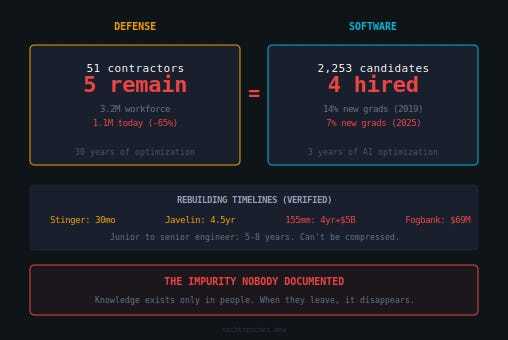
Ignoring rapid deskilling being forced on us by the tech sector is naive at best. This is not like the things you tried to compare it to.
It’s about as naive as insisting man-made climate change is no big deal because climate change has always been around.
You propose we do what exactly with AI?
And I’m not ignoring “rapid deskilling”. I’m specifically arguing against the very specific point that TFA article made that “we will forget how to code”. That’s clearly not what will happen.
Some people today still know assembler. Some people still how to design CPUs. Some still know lithography. Not as many as before, because we just don’t have the need.
I marvel at the number of engineers who don’t think about memory allocations at all. But it’s ok - they probably don’t need to, for the task they’re solving.