

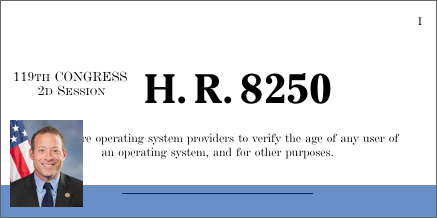
So, OS-level age-gating is going federal, which will effectively kill your rights to device ownership and what’s left of free speech and expression.
Enjoy your free speech while you still have it because this is a clear attempt to erase that right.
SOPA never died, it just went into hiding until time to reemerge, and now’s that time, this is basically SOPA in a save the kids trenchcoat.
This might be the most anemic open ended bill I have ever read. On its face, it has no teeth. The most well defined portions of the bill are to make sure that applications have access to age data. Making this look more like a way for corporations to gather data and verify real people as opposed to online personas.
There is zero regulation actually defined and instead they have a 180 day period to define the regulation and a year for it to be contacted and implemented. The bill could pass tomorrow and we still wouldn’t know what age verification looks like.
As scary as these efforts are, they are also a bit humorous to me. By and large software exists independently of its creator, especially in the FOSS space. There would be no way to require an individual to install an OS that supported this or even use an updated browser that supported it.
Ultimately, the only way to really enforce any sort of age verification system is to force all content providers to have an age verification step. This presents as OS level, but you have to give people a reason to upgrade in order to implement. If Wikipedia suddenly required some sort of OS based age verification protocol to access its content, it would become a lot harder to avoid.
They are putting this at the OS level, but I think this is a way to back into removing anonymous access to the Internet.
This has a familiar smell. The 3d printer “gun printing prevention” bill(s) that are floating around have the same “we’ll figure out the actual law after the bill is approved.” And here I thought that punting congressional authority to executive agencies was bad. Now they’re not writing laws, but instead, blank checks for vague things within even more vague legal outlines.
In a more general sense, it also resembles the work being done to level this requirement at online services as well.
My biggest fear here is that this will have teeth, and will be crafted so that the only feasible way to make it work is to be 100% cloud connected behind federally approved vendors (e.g. Apple and Microsoft).
Without an age code you won’t be able to access restricted sites. They don’t care about offline use.