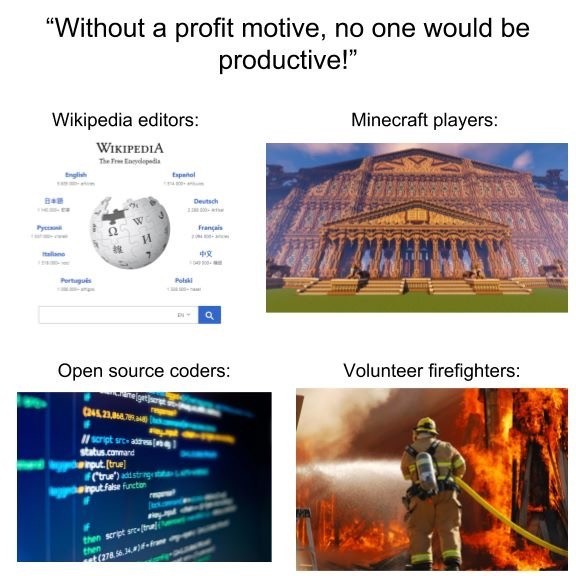
Money and the desire to get more of it (in absence or other specific needs) is pretty much necessary to keep any society with more than 50 people or so running.
How did we manage for thousands of years without it?
Don’t you think there are alternative systems we could use for the allocation of scarce resources? Alternatives which do not inevitably cause the rise of fascism, for example?
For what it’s worth, I don’t think that a tokenized medium of exchange for labor hours is necessarily a problem, but rather the system of private property ownership, where the means of production are privately owned for the benefit of the few. A system where profit is possible, is the problem.
Well for the majority of time when we did not use money, communities were quite small and/or ressources were so scarce that money lost it’s value, as people lose trust that you can actually exchange it for goods later on (e.g. during a famine the incremental value of food in monetary terms is astronomical). Money hence emerged first in situations where value needed to be conveyed over large distances, where punitive mechanisms of governance (i.e. someone more powerful than you puts you in a box or lobs off your hands) become ineffective - it emerged along the first trade routes, and means of control by distant power centers (such as in China).
There are alternative systems for the distribution of scarce resources, but they ultimately require centralized governance bodies - this is where most communist states failed in practice. If something belongs to ‘everyone’, it belongs to the one with the biggest stick, usually the state; If something should be used for the common good, someone qualitatively needs to decide what that is.
I can’t think of any alternative forms of resource distribution that don’t rely on a central decision making party.
The key issue with money, and why it leads to the emergency of fascist ideology imo, is when money pools with a powerful class of people that or filthy rich, somehow ‘own’ entire organisations including the media, and then become politicians as well. Concentration of power is the actual evil here, not private ownership.
So what should we change?
Wealth tax and high inheritance tax tied directly to monetary redistribution mechanisms such as a basic income
100% income tax above a certain level of income but lower or no takes on most income
Taxing of inhuman productivity (if elegantly possible)
No owning of land, just renting it from the state.
Price-based mechanisms to account for negative externalities such as greenhouse gasses
Limits to allowed pay disparities in companies
Company types that disincentive value extraction and financialization
Concentration of power is the actual evil here, not private ownership.
Concentration of power happens because of private ownership of the means of production. If you own a factory, you get the profits of that factory. As you gain more profits, you can invest in more factories, and get more profit. If you have a system where money is power and money can be used to generate more money, you end up with fascism.
Reforms are all well and good, but they will be reversed as soon as the wealthy regain a grasp of power. Look at the history of social democracy in Europe and the US for examples of this.
How does capitalism inevitably lead to fascism?
Basically, the issue with capitalism is that the more wealth you have, the easier it is for you to make more money. And since money can be used to buy goods, services and influence, there is always a way to use money to gain more political and social power. With that political and social power, you can push society and the legal system in the direction you want to go. So you can use your wealth to gain power, and then you can use your power to change laws and society so that you can make even more wealth and power. It’s a positive feedback loop.
Obviously, though, if the billionaires and ruling class are accumulating more and more of our society’s wealth, that inevitably means that there’s less for everyone else to go around - therefore, working class people feel poorer and poorer. Meanwhile, the economy is going absolutely great for rich people, so inflation continues to go up - everything gets more expensive, but wages don’t increase. The wealthy just keep more and more of the wealth for themselves. To accumulate more and more wealth, they change the laws so that they can avoid paying taxes, so public services collapse. Politicians are lobbied to ensure that public funds are diverted away from where it is most needed - housing, healthcare, transportation, infrastructure - and instead into industries where their class interests most benefit from it, such as weapons manufacturing and extractive industries such as fossil fuels and mining.
The working class are bound to notice that their lives are getting shittier and shittier, and if that situation is left unchecked, the working class would realize that the ruling class are fucking them over, rise up, and overthrow their rulers. Obviously, the ruling class need to do something about this, but there’s no solution that the ruling class can offer. They’re causing all of the problems, to fix them they’d have to give up some of their wealth and power - and that’s not something they’re going to do. So they need to find someone else to blame the problems we have in society on. Unfortunately, though, no matter who they blame the problems on, and no matter what they do to “fix” it, the issue will continue to persist, because the material conditions underlying the issues are, very intentionally, never addressed.
So, the conundrum returns: The ruling class said that minority A caused all of the problems, minority A is persecuted and oppressed, but society doesn’t actually get any better. Either the problem wasn’t minority A, or minority A just hasn’t been oppressed enough yet. So the ruling class can either escalate the oppression, or they can shift the focus to another minority group. The division continues to escalate in terms of how vitriolic and extreme it is, and it also continues to divide the working class into smaller and smaller groups.
To get the working class to buy into this hateful message, they need to take advantage of our worst instincts, and one of those instincts is the in-group bias. The majority are manipulated into being suspicious, then intolerant, then hateful, then violent, then genocidal, towards whatever the targeted minority of the day is. Anything that can be used to divide the working class - sexuality, nationality, immigration status, ethnicity, religion, sex, gender identity, age, all of these will be used as wedges to keep the working class split apart and not working together, because they know that if the working class actually unite against them, they are completely and truly fucked.
That’s exactly how fascism manifests. It’s because it’s possible for people to accumulate power through wealth. This is why capitalism must be abolished. If we do not abolish capitalism, fascism will always return. It’s just a matter of time.
As I said, a system of labor hour tokenization would work fine, so long as profit and private ownership of the means of production are not possible.
I can’t think of any alternative forms of resource distribution that don’t rely on a central decision making party.
Just for some ideas - democratization and collectivisation, social ownership of the means of production, with bottom up consensus based decision making. For more information, and more ideas, check out an anarchist FAQ
Thanks for the link to the anarchist FAQ, seems very interesting, I’ll have a deeper look.
That said, we know that society-scale capitalism has led to the rise of fascism because it has happened before and we can empirically observe it.
We have no idea what e.g. society-scale anarchist economics would look like, how to implement it peacefully and sustainably in the real world and which pathologies or injustices might emerge as a result - because we have never observed it on a large scale (so we must be careful to not fall subject to the argument from ignorance fallacy here).
So yea in theory it’s interesting and I’m always glad to see housing communes, community gardens and various kinds of collectives that people experiment with - But such experiments are always local and highly limited in scope. They certainly improve the quality of life for those involved, but imo the experiments of small groups of idealistic and altruistic people say little about the feasibility on a larger scale and so not prove that it’s a valid mechanism to distribute resources in large and diverse societies with antagonistic actors.
Maybe the anarchist FAQ might be a good basis for our descendents to rebuild society once 95% have died in one apocalypse or another^^
Edit: Interesting discussion btw, thanks for sharing and taking the time to explain your opinion :)
There are larger scale examples of anarchist communities, such as the Zapatistas in Mexico for example, and there’s a section on an Anarchist FAQ about anarchist projects.
Of course, we’ve never had long term national scale anarchism implemented in recorded human history, with the Spanish commune coming the closest, tragically crushed by civil war and external authoritarian dictatorial rule supported by the Nazi regime - so you’re absolutely correct that there might be unforeseen issues and flaws, but the underlying principles is that the fundamentals of the system is that we need to collaborate to build the best functional society we can, and that means a society that adapts, grows as we do, and is responsive to our changing needs as our civilizations and communities themselves change.
It’s really important to emphasize that anarchism isn’t some blueprint for a society that we follow by rote and dogmatically implement, but rather a base layer of ideas we can use. As per an anarchist FAQ
Anarchists have always been reticent about spelling out their vision of the future in too much detail for it would be contrary to anarchist principles to be dogmatic about the precise forms the new society must take. Free people will create their own alternative institutions in response to conditions specific to their area as well as their needs, desires and hopes and it would be presumptuous of us to attempt to set forth universal policies in advance.
Thank you for the engaging and civil discussion and for sharing your ideas, it’s nice to chat with someone where we clearly both want the best for everyone, and we all have our ideas of how we can get there. That’s how we build a better world, I think, by discussing, learning, and working together productively to build consensus.
I mean, the earliest known currency is almost exactly as old as the earliest known cities. Farmers would deposit a large amount of grain at the local temple (which were effectively the tax collection sites of the time) and were given clay tokens on exchange, which could be used in place of actual goods at tax time.
This system was set up because of the nature of farming: you make a lot of product in a short time, but most of the year you’re just waiting for your crop to grow. These tokens allowed farmers to pay their tax duties up front, and then have physical proof that they’d done so when paying taxes outside of harvest season. But it was only a matter of time before people started trading those tokens amongst each other. “Give me a goat and I’ll give you these tokens so you don’t have to pay tribute next season.”
Before that, villages were pretty much just hand-to mouth communities of just a few families. Surviving, sure, but not in the kind of complex society where one needs to draw equivalence between extremely different forms of labor.
Capitalism is way more fair than feudalism, as i gather that this is the angle you are asking from. A cursory view of history would say that rules-based capitalism is much more fair than, say, one party communism.


How did we manage for thousands of years without it?
Don’t you think there are alternative systems we could use for the allocation of scarce resources? Alternatives which do not inevitably cause the rise of fascism, for example?
For what it’s worth, I don’t think that a tokenized medium of exchange for labor hours is necessarily a problem, but rather the system of private property ownership, where the means of production are privately owned for the benefit of the few. A system where profit is possible, is the problem.
Well for the majority of time when we did not use money, communities were quite small and/or ressources were so scarce that money lost it’s value, as people lose trust that you can actually exchange it for goods later on (e.g. during a famine the incremental value of food in monetary terms is astronomical). Money hence emerged first in situations where value needed to be conveyed over large distances, where punitive mechanisms of governance (i.e. someone more powerful than you puts you in a box or lobs off your hands) become ineffective - it emerged along the first trade routes, and means of control by distant power centers (such as in China).
There are alternative systems for the distribution of scarce resources, but they ultimately require centralized governance bodies - this is where most communist states failed in practice. If something belongs to ‘everyone’, it belongs to the one with the biggest stick, usually the state; If something should be used for the common good, someone qualitatively needs to decide what that is.
I can’t think of any alternative forms of resource distribution that don’t rely on a central decision making party.
The key issue with money, and why it leads to the emergency of fascist ideology imo, is when money pools with a powerful class of people that or filthy rich, somehow ‘own’ entire organisations including the media, and then become politicians as well. Concentration of power is the actual evil here, not private ownership.
So what should we change?
Long story short, what Social Market Economy was originally intended to do
Concentration of power happens because of private ownership of the means of production. If you own a factory, you get the profits of that factory. As you gain more profits, you can invest in more factories, and get more profit. If you have a system where money is power and money can be used to generate more money, you end up with fascism.
Reforms are all well and good, but they will be reversed as soon as the wealthy regain a grasp of power. Look at the history of social democracy in Europe and the US for examples of this.
How does capitalism inevitably lead to fascism?
As I said, a system of labor hour tokenization would work fine, so long as profit and private ownership of the means of production are not possible.
Just for some ideas - democratization and collectivisation, social ownership of the means of production, with bottom up consensus based decision making. For more information, and more ideas, check out an anarchist FAQ
Thanks for the link to the anarchist FAQ, seems very interesting, I’ll have a deeper look.
That said, we know that society-scale capitalism has led to the rise of fascism because it has happened before and we can empirically observe it.
We have no idea what e.g. society-scale anarchist economics would look like, how to implement it peacefully and sustainably in the real world and which pathologies or injustices might emerge as a result - because we have never observed it on a large scale (so we must be careful to not fall subject to the argument from ignorance fallacy here).
So yea in theory it’s interesting and I’m always glad to see housing communes, community gardens and various kinds of collectives that people experiment with - But such experiments are always local and highly limited in scope. They certainly improve the quality of life for those involved, but imo the experiments of small groups of idealistic and altruistic people say little about the feasibility on a larger scale and so not prove that it’s a valid mechanism to distribute resources in large and diverse societies with antagonistic actors.
Maybe the anarchist FAQ might be a good basis for our descendents to rebuild society once 95% have died in one apocalypse or another^^
Edit: Interesting discussion btw, thanks for sharing and taking the time to explain your opinion :)
There are larger scale examples of anarchist communities, such as the Zapatistas in Mexico for example, and there’s a section on an Anarchist FAQ about anarchist projects.
Of course, we’ve never had long term national scale anarchism implemented in recorded human history, with the Spanish commune coming the closest, tragically crushed by civil war and external authoritarian dictatorial rule supported by the Nazi regime - so you’re absolutely correct that there might be unforeseen issues and flaws, but the underlying principles is that the fundamentals of the system is that we need to collaborate to build the best functional society we can, and that means a society that adapts, grows as we do, and is responsive to our changing needs as our civilizations and communities themselves change.
It’s really important to emphasize that anarchism isn’t some blueprint for a society that we follow by rote and dogmatically implement, but rather a base layer of ideas we can use. As per an anarchist FAQ
Thank you for the engaging and civil discussion and for sharing your ideas, it’s nice to chat with someone where we clearly both want the best for everyone, and we all have our ideas of how we can get there. That’s how we build a better world, I think, by discussing, learning, and working together productively to build consensus.
Much love and solidarity, all the best!
I mean, the earliest known currency is almost exactly as old as the earliest known cities. Farmers would deposit a large amount of grain at the local temple (which were effectively the tax collection sites of the time) and were given clay tokens on exchange, which could be used in place of actual goods at tax time.
This system was set up because of the nature of farming: you make a lot of product in a short time, but most of the year you’re just waiting for your crop to grow. These tokens allowed farmers to pay their tax duties up front, and then have physical proof that they’d done so when paying taxes outside of harvest season. But it was only a matter of time before people started trading those tokens amongst each other. “Give me a goat and I’ll give you these tokens so you don’t have to pay tribute next season.”
Before that, villages were pretty much just hand-to mouth communities of just a few families. Surviving, sure, but not in the kind of complex society where one needs to draw equivalence between extremely different forms of labor.
Capitalism is way more fair than feudalism, as i gather that this is the angle you are asking from. A cursory view of history would say that rules-based capitalism is much more fair than, say, one party communism.