Thanks for the link to the anarchist FAQ, seems very interesting, I’ll have a deeper look.
That said, we know that society-scale capitalism has led to the rise of fascism because it has happened before and we can empirically observe it.
We have no idea what e.g. society-scale anarchist economics would look like, how to implement it peacefully and sustainably in the real world and which pathologies or injustices might emerge as a result - because we have never observed it on a large scale (so we must be careful to not fall subject to the argument from ignorance fallacy here).
So yea in theory it’s interesting and I’m always glad to see housing communes, community gardens and various kinds of collectives that people experiment with - But such experiments are always local and highly limited in scope. They certainly improve the quality of life for those involved, but imo the experiments of small groups of idealistic and altruistic people say little about the feasibility on a larger scale and so not prove that it’s a valid mechanism to distribute resources in large and diverse societies with antagonistic actors.
Maybe the anarchist FAQ might be a good basis for our descendents to rebuild society once 95% have died in one apocalypse or another^^
Edit: Interesting discussion btw, thanks for sharing and taking the time to explain your opinion :)
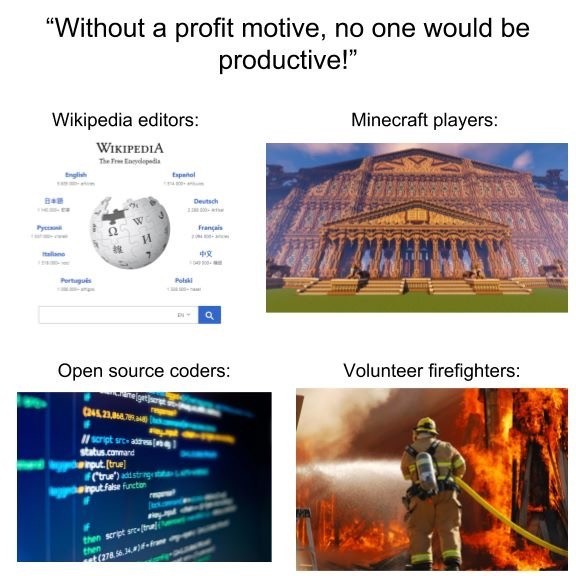
There are larger scale examples of anarchist communities, such as the Zapatistas in Mexico for example, and there’s a section on an Anarchist FAQ about anarchist projects.
Of course, we’ve never had long term national scale anarchism implemented in recorded human history, with the Spanish commune coming the closest, tragically crushed by civil war and external authoritarian dictatorial rule supported by the Nazi regime - so you’re absolutely correct that there might be unforeseen issues and flaws, but the underlying principles is that the fundamentals of the system is that we need to collaborate to build the best functional society we can, and that means a society that adapts, grows as we do, and is responsive to our changing needs as our civilizations and communities themselves change.
It’s really important to emphasize that anarchism isn’t some blueprint for a society that we follow by rote and dogmatically implement, but rather a base layer of ideas we can use. As per an anarchist FAQ
Anarchists have always been reticent about spelling out their vision of the future in too much detail for it would be contrary to anarchist principles to be dogmatic about the precise forms the new society must take. Free people will create their own alternative institutions in response to conditions specific to their area as well as their needs, desires and hopes and it would be presumptuous of us to attempt to set forth universal policies in advance.
Thank you for the engaging and civil discussion and for sharing your ideas, it’s nice to chat with someone where we clearly both want the best for everyone, and we all have our ideas of how we can get there. That’s how we build a better world, I think, by discussing, learning, and working together productively to build consensus.


Thanks for the link to the anarchist FAQ, seems very interesting, I’ll have a deeper look.
That said, we know that society-scale capitalism has led to the rise of fascism because it has happened before and we can empirically observe it.
We have no idea what e.g. society-scale anarchist economics would look like, how to implement it peacefully and sustainably in the real world and which pathologies or injustices might emerge as a result - because we have never observed it on a large scale (so we must be careful to not fall subject to the argument from ignorance fallacy here).
So yea in theory it’s interesting and I’m always glad to see housing communes, community gardens and various kinds of collectives that people experiment with - But such experiments are always local and highly limited in scope. They certainly improve the quality of life for those involved, but imo the experiments of small groups of idealistic and altruistic people say little about the feasibility on a larger scale and so not prove that it’s a valid mechanism to distribute resources in large and diverse societies with antagonistic actors.
Maybe the anarchist FAQ might be a good basis for our descendents to rebuild society once 95% have died in one apocalypse or another^^
Edit: Interesting discussion btw, thanks for sharing and taking the time to explain your opinion :)
There are larger scale examples of anarchist communities, such as the Zapatistas in Mexico for example, and there’s a section on an Anarchist FAQ about anarchist projects.
Of course, we’ve never had long term national scale anarchism implemented in recorded human history, with the Spanish commune coming the closest, tragically crushed by civil war and external authoritarian dictatorial rule supported by the Nazi regime - so you’re absolutely correct that there might be unforeseen issues and flaws, but the underlying principles is that the fundamentals of the system is that we need to collaborate to build the best functional society we can, and that means a society that adapts, grows as we do, and is responsive to our changing needs as our civilizations and communities themselves change.
It’s really important to emphasize that anarchism isn’t some blueprint for a society that we follow by rote and dogmatically implement, but rather a base layer of ideas we can use. As per an anarchist FAQ
Thank you for the engaging and civil discussion and for sharing your ideas, it’s nice to chat with someone where we clearly both want the best for everyone, and we all have our ideas of how we can get there. That’s how we build a better world, I think, by discussing, learning, and working together productively to build consensus.
Much love and solidarity, all the best!