Honestly if people didnt need to take the first job they could under threat of homelessness i truly believe enough people will just end up doing everything we need done out of the sheer need to do something
Yeah for sure, it took me a couple decades but i finally got a data job, where i really just enjoy the work, after starting from the bottom minimum wage and working up a bit in two other careers first lol
Finally im somewhere where if i get laid off inwould literally just happily work on a data analysis portfolio while applying to jobs. My two prior careers (law and education) I left them because i just hated the day to day work.
I dream of swimming in data with a few clear questions, a rudimentary sketch of the preferred output format and the side quest to note patterns or things that stick out and offer suggestions for improvement in SHORT FORM (caps needed)
As long as you enjoy data cleanup lol, that’s the unglorious part, getting a shitshow of manually entered data from a few different sources and then answer some clear questions lol. AI helps a lot with that though nowadays, you feed it a bunch of manually entered garbage and it does like 80-90% of the job for you!
I think it serves as an illustration that people will do difficult and tedious computer work for reasons other than money it specifically being Minecraft isn’t really the point to me
For sure, but people have lots of incentives to do farming and stuff even without the profit motive, otherwise human civilization wouldn’t have made it out of the paleolithic era. Humans are actually the most co-operative species on the planet, it’s biologically hard wired into us to work together to improve our living conditions for our communities and to share what we have with others.
This altruistic instinct rapidly tapers beyond one’s immediate community. Sure, we have the instinct to try helping others, even those who are very distant. But without reinforcement of our good behaviors, any given behavior will peter out.
Like, suppose you are making enough money to live comfortably. You then hear about a charity that builds wells to provide clean drinking water to people in impoverished parts of the world, and decide you can spare $5 per month to help them. So you donate $5. However, this charity focuses entirely on doing the actual charitable work, so you have to remember to donate and manually type in your credit card information each month. And they don’t do any PR. No monthly emails with personal stories about the people they helped or anything like that. Instead, they simply have a publicly accessible spreadsheet that has data on wells built and people served. Almost everyone would stop donating to this charity after a month or two, simply because they would forget or procrastinate until they forget, because our brains don’t assign relevance to things which don’t create an emotional impression on us. Compare this with, say, helping your child and their new partner build a home with your own hands. This kind of project provides lots of positive reinforcement - exercise, time outside, time spent with others, seeing progress being made day by day, the appreciation of others, the knowledge that you have helped someone who is important to you.
Hence why most people find most jobs to be unpleasant in one way or another. Not many people want to spend their days pumping a stranger’s septic system. The unpleasant work (aka, “work”) is what is left over after everyone does the pleasant work for free.
Also, some anthropologists theorize that the beginning of labor intensive agriculture and large permanent settlements was only possible via forced labor, coerced by violent, authoritarian leaders. Evidence shows that early agrarian life was significantly worse in just about every way than nomadic hunter-gatherer life, which explains why hunter-gatherer tribes almost universally fought against or fled from agrarian settlements.
Do you not believe that we can structure society in such a way that our best instincts are leveraged for the benefit of as many people as possible, rather than leveraging our worst instincts for the benefit of a select few?
If you say so! I think the claims implied by my statement are pretty self-evident, but if there’s something specific you take issue with, I’d welcome a discussion on it. I am always more than willing and able to defend my positions.
I think the more automated the job is, the easier it is for people to get started. So with better farming technology I would expect more people interested on it.
We already have better farming technology. People prefer to grow gardens in their back yard with compost made from their coffee grounds instead. Iirc, John Green calculated that - even excluding the cost of his own labor - one tomato that he grew in his garden cost him $18.
There are certainly a lot of problems with modern agriculture. But food is far cheaper than it has been for pretty much all of human history, when the collection and preparation of food took up the vast majority of most people’s time.
I think that’s a disingenious estimate to say that food is far cheaper now than it was previously in human history. Before industrialization, growing food did take up a large portion of people’s time but their yearly work hours were much smaller.
As the other commenter said, even if your claim about having more free time is true (I highly doubt it, more likely we simply aren’t counting the various tasks historical peoples had to do which were still “work”, but not their main job, and overcounting the “work” that modern people do when they are actually just scrolling tiktok), as a society we spend far less time making food than we used to. This is obvious by the fact that in the past century, worldwide levels of famine and hunger have dropped lower than they have ever been in recorded history.
What do work hours of people not in the farming industry have to do with the raw costs of food?
The “cost of food” has been abstracted from the “amount people have to pay downstream to afford food” by companies’ desire for profit. One guy can manage acres of land with a few good machines. Food is cheap: that is why people can afford to ship it around the world to be processed in one country and then sold across the ocean in another country. We don’t have to work as many hours as we do to sustain ourselves to the level they did back then. Industrialists have just countered work efficiency improvements with…more work.


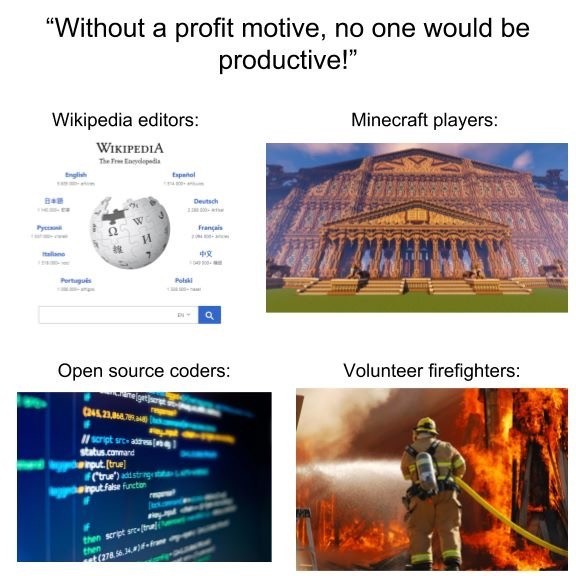
My Minecraft survival world is awesome, but I think in this context “productive” is usually referring to, you know, farming and stuff.
Its a thing!
Honestly if people didnt need to take the first job they could under threat of homelessness i truly believe enough people will just end up doing everything we need done out of the sheer need to do something
Yeah for sure, it took me a couple decades but i finally got a data job, where i really just enjoy the work, after starting from the bottom minimum wage and working up a bit in two other careers first lol
Finally im somewhere where if i get laid off inwould literally just happily work on a data analysis portfolio while applying to jobs. My two prior careers (law and education) I left them because i just hated the day to day work.
I dream of swimming in data with a few clear questions, a rudimentary sketch of the preferred output format and the side quest to note patterns or things that stick out and offer suggestions for improvement in SHORT FORM (caps needed)
As long as you enjoy data cleanup lol, that’s the unglorious part, getting a shitshow of manually entered data from a few different sources and then answer some clear questions lol. AI helps a lot with that though nowadays, you feed it a bunch of manually entered garbage and it does like 80-90% of the job for you!
Excel helper columns tend to show complexity in data cleanup through their breadth
If I’m 15 columns deep iterating it’s as if you can see the top of the mountain but weather can turn at any moment
I think UBI would give us a lot more artists.
I think it serves as an illustration that people will do difficult and tedious computer work for reasons other than money it specifically being Minecraft isn’t really the point to me
For sure, but people have lots of incentives to do farming and stuff even without the profit motive, otherwise human civilization wouldn’t have made it out of the paleolithic era. Humans are actually the most co-operative species on the planet, it’s biologically hard wired into us to work together to improve our living conditions for our communities and to share what we have with others.
This altruistic instinct rapidly tapers beyond one’s immediate community. Sure, we have the instinct to try helping others, even those who are very distant. But without reinforcement of our good behaviors, any given behavior will peter out.
Like, suppose you are making enough money to live comfortably. You then hear about a charity that builds wells to provide clean drinking water to people in impoverished parts of the world, and decide you can spare $5 per month to help them. So you donate $5. However, this charity focuses entirely on doing the actual charitable work, so you have to remember to donate and manually type in your credit card information each month. And they don’t do any PR. No monthly emails with personal stories about the people they helped or anything like that. Instead, they simply have a publicly accessible spreadsheet that has data on wells built and people served. Almost everyone would stop donating to this charity after a month or two, simply because they would forget or procrastinate until they forget, because our brains don’t assign relevance to things which don’t create an emotional impression on us. Compare this with, say, helping your child and their new partner build a home with your own hands. This kind of project provides lots of positive reinforcement - exercise, time outside, time spent with others, seeing progress being made day by day, the appreciation of others, the knowledge that you have helped someone who is important to you.
Hence why most people find most jobs to be unpleasant in one way or another. Not many people want to spend their days pumping a stranger’s septic system. The unpleasant work (aka, “work”) is what is left over after everyone does the pleasant work for free.
Also, some anthropologists theorize that the beginning of labor intensive agriculture and large permanent settlements was only possible via forced labor, coerced by violent, authoritarian leaders. Evidence shows that early agrarian life was significantly worse in just about every way than nomadic hunter-gatherer life, which explains why hunter-gatherer tribes almost universally fought against or fled from agrarian settlements.
Do you not believe that we can structure society in such a way that our best instincts are leveraged for the benefit of as many people as possible, rather than leveraging our worst instincts for the benefit of a select few?
You managed to cram an impressive amount of false dichotomies and unfounded assumptions into a single sentence.
If you say so! I think the claims implied by my statement are pretty self-evident, but if there’s something specific you take issue with, I’d welcome a discussion on it. I am always more than willing and able to defend my positions.
You might like this initiative: https://www.minecraft.net/en-us/article/uncensored-library
I think the more automated the job is, the easier it is for people to get started. So with better farming technology I would expect more people interested on it.
We already have better farming technology. People prefer to grow gardens in their back yard with compost made from their coffee grounds instead. Iirc, John Green calculated that - even excluding the cost of his own labor - one tomato that he grew in his garden cost him $18.
There are certainly a lot of problems with modern agriculture. But food is far cheaper than it has been for pretty much all of human history, when the collection and preparation of food took up the vast majority of most people’s time.
I think that’s a disingenious estimate to say that food is far cheaper now than it was previously in human history. Before industrialization, growing food did take up a large portion of people’s time but their yearly work hours were much smaller.
As the other commenter said, even if your claim about having more free time is true (I highly doubt it, more likely we simply aren’t counting the various tasks historical peoples had to do which were still “work”, but not their main job, and overcounting the “work” that modern people do when they are actually just scrolling tiktok), as a society we spend far less time making food than we used to. This is obvious by the fact that in the past century, worldwide levels of famine and hunger have dropped lower than they have ever been in recorded history.
What do work hours of people not in the farming industry have to do with the raw costs of food?
The “cost of food” has been abstracted from the “amount people have to pay downstream to afford food” by companies’ desire for profit. One guy can manage acres of land with a few good machines. Food is cheap: that is why people can afford to ship it around the world to be processed in one country and then sold across the ocean in another country. We don’t have to work as many hours as we do to sustain ourselves to the level they did back then. Industrialists have just countered work efficiency improvements with…more work.
Yes, exactly. Before industrialisation people worked on average less hours than we do now.
I…what?
In your mind, what happened to the rest of my comment that preceded the literal final line you quoted?
I thought there was a ton of farming in Minecraft
Farming Patreon support for your Minecraft streaming gig.