I’m actually very familiar with the idea of the tragedy of the commons.
Rather than re-cover well tread ground, I hope that you don’t mind if I quote from a relevant section of an Anarchist FAQ, and I encourage you to check the link I shared, as it goes into far more detail:
In reality, the “tragedy of the commons” comes about only after wealth and private property, backed by the state, starts to eat into and destroy communal life. This is well indicated by the fact that commons existed for thousands of years and only disappeared after the rise of capitalism – and the powerful central state it requires – had eroded communal values and traditions. Without the influence of wealth concentrations and the state, people get together and come to agreements over how to use communal resources and have been doing so for millennia. That was how the commons were successfully managed before the wealthy sought to increase their holdings and deny the poor access to land in order to make them fully dependent on the power and whims of the owning class.
[…]
In fact, communal ownership produces a strong incentive to protect such resources for people are aware that their offspring will need them and so be inclined to look after them. By having more resources available, they would be able to resist the pressures of short-termism and so resist maximising current production without regard for the future. Capitalist owners have the opposite incentive… unless they maximise short-term profits then they will not be around in the long-term (so if wood means more profits than centuries-old forests then the trees will be chopped down). By combining common ownership with decentralised and federated communal self-management, anarchism will be more than able to manage resources effectively, avoiding the pitfalls of both privatisation and nationalisation.
If you want a modern, real-world example of this which you may have actually experienced yourself, look no further than this medium we are using to communicate. The Internet is a great example. The Internet was a fantastic common space lovingly maintained and curated by individuals, with services and content provided freely. Corporations encircled it, and turned it into the torment nexus we have today. It wasn’t because of us, collectively, that spoiled the commons of the Internet - it was capitalism itself.
I feel like that entire passage completely ignores the fact that last time the bulk of humanity lived a communal lifestyle, the number of humans on the planet was a few orders of magnitude smaller. It’s a fairly easy setup to maintain when settlements are small and the bulk of people’s time is spent as hunter-gatherers or subsistence farmers. As soon as you put a very large number of people into a city, the communal arrangement falls apart. And many people like living in cities. That genie is out of the bottle, and people are not going to be willing to go back to being a subsistence farmer in a commune.
I don’t see why we would need to give up modern agriculture, fertilizer, heavy machinery, or automation in order to abolish capitalism, can you explain why you feel that way?
There are many things that people are willing to do for their own satisfaction, I don’t disagree with that. I don’t think waste disposal is one of them.
The “communal life” you’re talking about cannot exist in an urbanised society, because most people you affect in a city are not personally known to you, and there will be no opportunity for the social mechanisms we evolved to pressure us into doing the right thing. In a village of 200 people, if you throw your shit in the street, your neighbour, whom you know personally and whose opinion you likely care about, will complain. In a city of 2 million, if someone throws shit in the street you have no idea who it was, they’ve never met you, and what are you gonna do about it anyway?
Anyway, I should bow out now. I have no interest in discussing politics or economics with an anarchist.
Do you really believe everyone would act like a psychopath if they aren’t always directly accountable for their actions? And how does that differ from our current system?
I have no interest in discussing politics or economics with an anarchist.
That’s really too bad, because I’m sure you’d learn a lot! Anarchism is not what you think it is. Either way, have a great day, I wish you all the best. Solidarity forever!
because most people you affect in a city are not personally known to you, and there will be no opportunity for the social mechanisms we evolved to pressure us into doing the right thing
That’s a demonstrable bullshit. Believing that the only motivation people can have is the fear of repercussions is the same level of that christian psychotic “if it wasn’t for the fear of god everyone would be raping and killing all the time” that says more about you than about supposed issue you’re afraid of.
It’s not fear of repercussions; it’s social glue. Crime is much more common in cities, out of proportion with how many people there are, because people who are willing to commit crime are not willing to commit it against people they know personally. Urbanisation allows depersonalisation allows bad behaviour.
It also allows effects to be transmitted that are simply way less direct than you have any hope of instinct being able to reckon with. Like, you can work out that tossing shit out of your window will piss off your neighbour, but the knock-on-effects of what you do can be harder to figure out than that. Did you buy a little bit more of anything at the start of COVID, “just in case”?


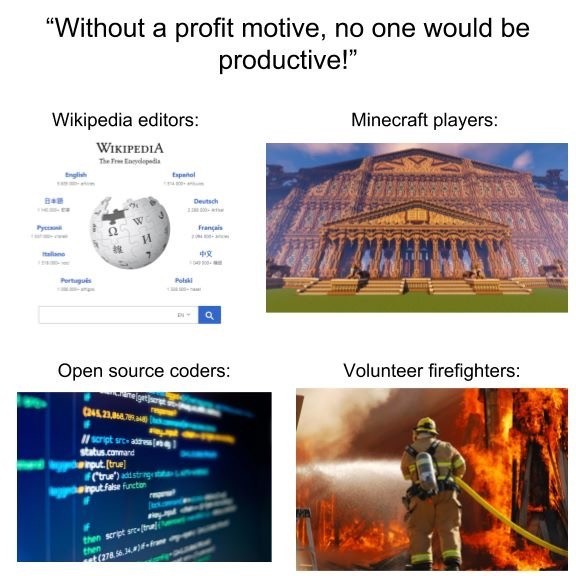
I’m actually very familiar with the idea of the tragedy of the commons.
Rather than re-cover well tread ground, I hope that you don’t mind if I quote from a relevant section of an Anarchist FAQ, and I encourage you to check the link I shared, as it goes into far more detail:
If you want a modern, real-world example of this which you may have actually experienced yourself, look no further than this medium we are using to communicate. The Internet is a great example. The Internet was a fantastic common space lovingly maintained and curated by individuals, with services and content provided freely. Corporations encircled it, and turned it into the torment nexus we have today. It wasn’t because of us, collectively, that spoiled the commons of the Internet - it was capitalism itself.
I feel like that entire passage completely ignores the fact that last time the bulk of humanity lived a communal lifestyle, the number of humans on the planet was a few orders of magnitude smaller. It’s a fairly easy setup to maintain when settlements are small and the bulk of people’s time is spent as hunter-gatherers or subsistence farmers. As soon as you put a very large number of people into a city, the communal arrangement falls apart. And many people like living in cities. That genie is out of the bottle, and people are not going to be willing to go back to being a subsistence farmer in a commune.
I don’t see why we would need to give up modern agriculture, fertilizer, heavy machinery, or automation in order to abolish capitalism, can you explain why you feel that way?
There are many things that people are willing to do for their own satisfaction, I don’t disagree with that. I don’t think waste disposal is one of them.
The “communal life” you’re talking about cannot exist in an urbanised society, because most people you affect in a city are not personally known to you, and there will be no opportunity for the social mechanisms we evolved to pressure us into doing the right thing. In a village of 200 people, if you throw your shit in the street, your neighbour, whom you know personally and whose opinion you likely care about, will complain. In a city of 2 million, if someone throws shit in the street you have no idea who it was, they’ve never met you, and what are you gonna do about it anyway?
Anyway, I should bow out now. I have no interest in discussing politics or economics with an anarchist.
Do you really believe everyone would act like a psychopath if they aren’t always directly accountable for their actions? And how does that differ from our current system?
That’s really too bad, because I’m sure you’d learn a lot! Anarchism is not what you think it is. Either way, have a great day, I wish you all the best. Solidarity forever!
No.
That’s a demonstrable bullshit. Believing that the only motivation people can have is the fear of repercussions is the same level of that christian psychotic “if it wasn’t for the fear of god everyone would be raping and killing all the time” that says more about you than about supposed issue you’re afraid of.
It’s not fear of repercussions; it’s social glue. Crime is much more common in cities, out of proportion with how many people there are, because people who are willing to commit crime are not willing to commit it against people they know personally. Urbanisation allows depersonalisation allows bad behaviour.
It also allows effects to be transmitted that are simply way less direct than you have any hope of instinct being able to reckon with. Like, you can work out that tossing shit out of your window will piss off your neighbour, but the knock-on-effects of what you do can be harder to figure out than that. Did you buy a little bit more of anything at the start of COVID, “just in case”?