T. rex was unfeathered (or at least the adults were) but other members of the Tyrannosaurus family were partly or fully feathered. Yutyrannus, for example.
Well, no, not that fast due to it’s size & weight of the head, but maybe having it’s eyes closed while moving the head to not tax the brain too much (that chicken bobbing was a solution to allow the brain to be smaller & more efficient bcs the effort to simply stabilise the head & process only the image/objects in 3D space while only those objects are moving is way simpler & more efficient than calculating the POV’s movements & accounting for those in real time too - it’s why hunting predators usually have large brains, if you miss data at high speeds you’ll just run into a tree).
This doesn’t make any sense when you consider that birds hold their heads still while flying and are very good at spotting things on the ground while doing it. The reason I know for why birds bob their heads is that they can’t move their eyes in their sockets. So they both their head forward the same way our eyes will jump from position to position rather than move smoothly, it minimizes the blur you get from rapid movements.
When flying all objects are fairly far so it’s like their POV isn’t really moving (it’s not a yes/no, it’s by how much).
(A stupid example: you can read big road signs while shaking you head but not as easily from a paper in front of you. The movement of your head is smaller relative to the sign. Or why when taking pics of the stars it doesn’t matter if the exposure is 12+h even if Earth has moved so much around the sun in that time.)
On the ground the distances are a lot smaller & more relevant. So chickens stabilise their had in fixed spots as much as possible (and “don’t look” while bobbing).
If they bobbed their had bcs of their limited eye socket movement (they can move them a little, some species a lot) they wouldn’t do it when not changing the direction of where they are looking.
(It’s prob also why you can hypnotise a chicken in a second with one move of your finger but not eg a parrot with more brain buffer.)
But we all do it, humans (prob mammals) have this trick when you “lose time” when calm & moving the eyes and/or head from one object to another. We don’t perceive it as such unless you look for it (you don’t remember the details of the panning even when you know it took you a few tenths of a second - but you do when eg playing sports). A bit like you stop processing your nose in your fov. Or how you don’t really remember having your eyelids closed when blinking.
Ikr? A big chicken would eat me like a snack just opportunistically (maybe some ultra specialised species like pigeons wouldn’t, but chickens def would, they eat everything).

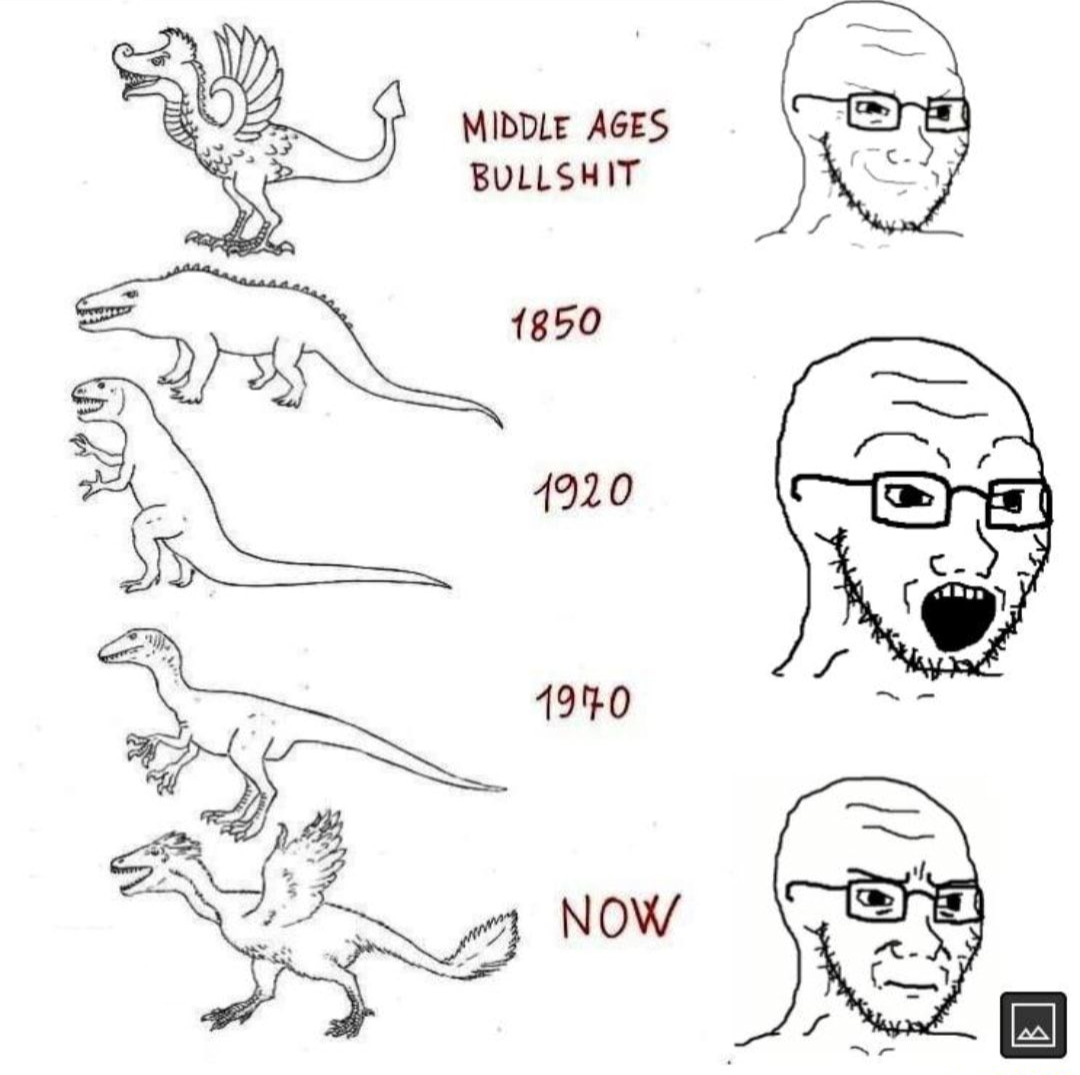
I for one like theropod chickens.
Scaling up a regular chicken always seemed more realistic & intimidating.
From my understanding, existing fossilized skin evidence suggests that T. rex had few feathers, if any.
Edit: I mean adult T. rex
T. rex was unfeathered (or at least the adults were) but other members of the Tyrannosaurus family were partly or fully feathered. Yutyrannus, for example.
It was the trend then.
10/10 would revenge-crap on your car.
Imagine a T-Rex, bobbing its head while walking around, like a chicken
Well, no, not that fast due to it’s size & weight of the head, but maybe having it’s eyes closed while moving the head to not tax the brain too much (that chicken bobbing was a solution to allow the brain to be smaller & more efficient bcs the effort to simply stabilise the head & process only the image/objects in 3D space while only those objects are moving is way simpler & more efficient than calculating the POV’s movements & accounting for those in real time too - it’s why hunting predators usually have large brains, if you miss data at high speeds you’ll just run into a tree).
This doesn’t make any sense when you consider that birds hold their heads still while flying and are very good at spotting things on the ground while doing it. The reason I know for why birds bob their heads is that they can’t move their eyes in their sockets. So they both their head forward the same way our eyes will jump from position to position rather than move smoothly, it minimizes the blur you get from rapid movements.
When flying all objects are fairly far so it’s like their POV isn’t really moving (it’s not a yes/no, it’s by how much).
(A stupid example: you can read big road signs while shaking you head but not as easily from a paper in front of you. The movement of your head is smaller relative to the sign. Or why when taking pics of the stars it doesn’t matter if the exposure is 12+h even if Earth has moved so much around the sun in that time.)
On the ground the distances are a lot smaller & more relevant. So chickens stabilise their had in fixed spots as much as possible (and “don’t look” while bobbing).
If they bobbed their had bcs of their limited eye socket movement (they can move them a little, some species a lot) they wouldn’t do it when not changing the direction of where they are looking.
(It’s prob also why you can hypnotise a chicken in a second with one move of your finger but not eg a parrot with more brain buffer.)
But we all do it, humans (prob mammals) have this trick when you “lose time” when calm & moving the eyes and/or head from one object to another. We don’t perceive it as such unless you look for it (you don’t remember the details of the panning even when you know it took you a few tenths of a second - but you do when eg playing sports). A bit like you stop processing your nose in your fov. Or how you don’t really remember having your eyelids closed when blinking.
Anybody that’s grown up around chickens knows how terrifying a territorial rooster can be.
Werner Herzog would agree.
Ikr? A big chicken would eat me like a snack just opportunistically (maybe some ultra specialised species like pigeons wouldn’t, but chickens def would, they eat everything).