

- cross-posted to:
- [email protected]
- cross-posted to:
- [email protected]
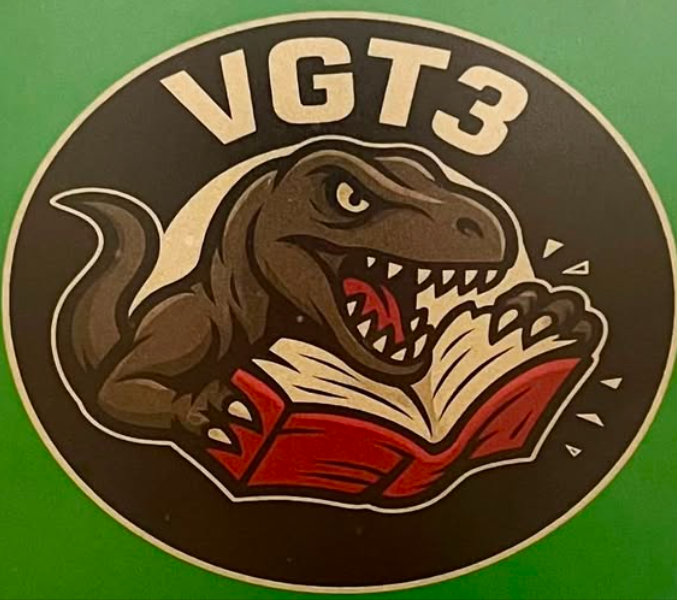
 The symbol for Amazon’s VGT3, the Las Vegas facility where it scans book for AI training data.
Amazon is buying massive quantities of books, scanning them for AI training data, and destroying them in the process.
A 404 Media investigation was able to reveal Amazon’s book buying operation, which hasn’t been previously reported, by placing a tracking device in a rare book we suspected would be acquired by an AI company for training data, and following it around the country to its final destination.
That final destination was an Amazon warehouse in Las Vegas, Nevada. Amazon employees who work at this location say all they do is receive massive shipments of printed books which they then cut the bindings off in order to scan the books more quickly. The printed book is destroyed in the process. The logo of the Amazon team that works at this warehouse, called VGT3, is a dinosaur, brandishing its teeth and with a book in its hands.
“Amazon purchases books through commercial channels to help develop and improve the products and services our customers use,” an Amazon spokesperson told me in a statement.
The world’s AI companies are constantly looking for, and spending extreme resources to locate, more material to train their AI models. With books, that sometimes means destroying them in the process, something that large parts of the public have spoken up against, and which we can now confirm Amazon is doing.
In July, I published a story about booksellers who reported a historical spike in sales starting in the past year. They suspected this spike in sales was due to AI companies acquiring any books they can in search of new training data. Printed books are valuable as training data because a lot of the text they contain is not readily available on the internet, which AI companies have already scraped. The data is also conveniently organized and, if the book was printed before 2022, is guaranteed to be free of AI-generated text, which can make any AI model that is trained on it worse via a recursive process called “model collapse.”
📖 Do you know work at a facility where you scan books? I would love to hear from you. Using a non-work device, you can message me securely on Signal at @emanuel.404. Otherwise, send me an email at [email protected].
These booksellers suspected AI companies were behind these large bulk purchases because of the high number of books they were buying, the seemingly random choice of books, and the fact that these buyers, unlike libraries and universities, did not seem price sensitive at all. But booksellers couldn’t say for certain who was behind the large purchases because the marketplaces where they sell their books keep the buyers anonymous. When an order comes in, a bookseller ships the sold books to a warehouse operated by the marketplaces, where books are sorted and then sent to the buyer.
In July, one bookseller told me they received a very large order of around 1,000 books on Biblio, one of these marketplaces. The seller agreed to put an Apple AirTag provided by 404 Media in one of the books included in this order so we could see where the book was going. And by extension, which company, AI or otherwise, was behind this massive order. 404 Media granted the bookseller anonymity because they worried sharing this information would harm their business. Biblio did not respond to a request for comment.
This is what I believe they are doing:
https://finance.biggo.com/news/37a2899b-5f1a-4571-9bb5-1156c0ac4605
_**The owner of MW Books in Ireland also reports that since May, the shop has been receiving large orders with wildly varied content. “The orders are piecemeal, presumably machine-driven, and there’s very little thematic rhyme or reason to them: everything from 18th-century African agricultural implements to biographies of 1950s racing drivers,” he says. “Personally, I don’t think we have the right to dictate what customers do with books after they buy them, but the selection is certainly intriguing.”
Another anonymous UK used bookseller reveals that some seemingly random orders, possibly from different buyers, all end up being shipped to the same address. He provided a delivery postcode used by different buyers, which corresponds to a cluster of freight warehouses near London Heathrow Airport. The bookseller says that since January, he has received orders covering 6,000 books from similar buyers, amounting to thousands of pounds. These buyers are willing to pay “top prices” and haven’t asked for discounts even when purchasing large quantities at once. “That doesn’t happen very often. It’s disruptive to the used book trade.”**_
They are probably buying books that don’t have any digital copies since they are perfect for training AI. As for why they are using destructive scanning, I believe it is because either destructive is cheaper and faster or they don’t want the competition to have access to the training data. Since these are not easy to find books, Amazon sells books, any book they try to obtain is probably extremely hard to find anywhere.
Thank you. That article gave me some insights.