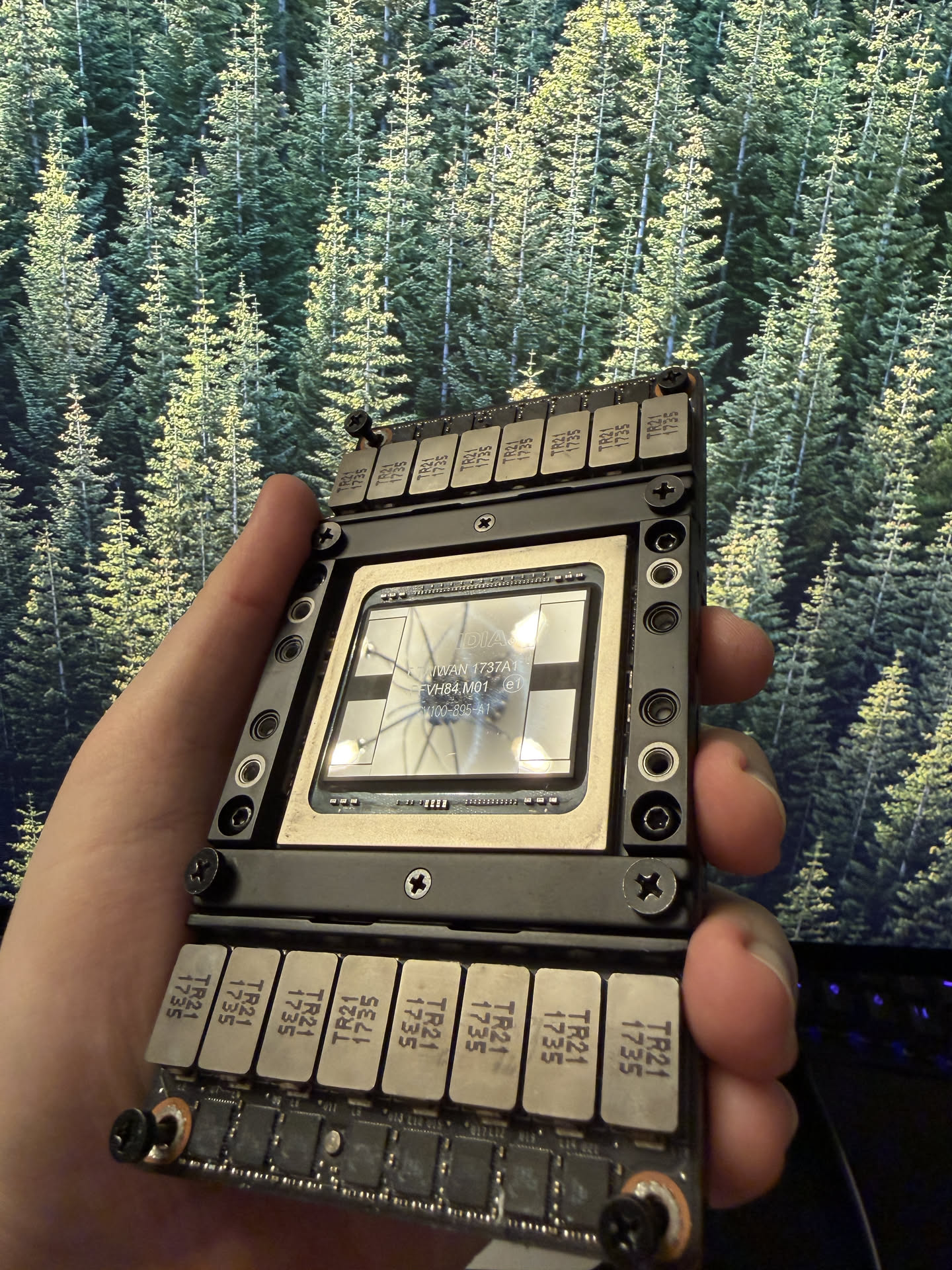
I bought a datacenter GPU that doesn't fit in a normal motherboard, macgyvered the fan with jumper wires, and now I'm running a model that ties with Claude Sonnet 4.6 on benchmarks, all for £200.
Okay. So, imagine I’m an indie game developer. I’ve got no artistic talent, no funds, and am just making a game that I want to play, not one I think will make any money.
With me so far? I download a free, open source, open weights model on my laptop. I install the open source tools to allow the LLM to read my project files, and I give it a thorough description of the game I’m designing. I work on some aspect in the foreground, while in the background my GPU is utilized to achieve some task I’ve assigned the AI. When it’s done, I review the work, commit the changes, and assign it a new task.
What are the ethical aspects you can’t ignore in my use case?
If you don’t intend to sell or distribute that game, the only aspects left that I can think of are:
you’re not helping yourself by using AI, you’re just making yourself dumber, so if your goal is simply to make a game, fine, but if you want to maintain your coding skills, it’s a bad idea.
the extra energy consumption, which happens regardless if you’re using your GPU or someone else’s GPU. Might even be worse if everyone uses their own GPU, because there’s a whole ass PC system built around that GPU that also consumes power. But I dunno if that’s the case, actually. I guess this is moot if you’re off the power grid with your own power source, such as full solar or something.
how has the open source model been trained? On what data?
Even if I did intend to sell the game, what change is there? Everything created was something that did not exist prior my prompt to create it.
I’m making myself dumber in the same sense that learning to read & write weakens my memory skills, using a calculator weakens my math skills, or driving a car weakens my physical stamina. Everything is a trade off, and like in everything else, balance is the key consideration.
Correct, I personally have a solar array with a battery system. I typically have an overage, and feed my power back into the network. Even if I didn’t, though, using my GPU for AI uses less electricity than playing a game with it, and even that is dwarfed by microwaving food, using a hair dryer, clothes dryer, etc. Power consumption is a common concern that is shared with everything, so there’s no justification to make it an ethical one just for AI.
In my case, I’m using Qwen, and Kimi, which are both models trained by other models - essentially compressing the original training so a good analogy, if these were people, is my models were trained by professors who themselves trained themselves by reviewing the entirety of the Internet. It’s important, though, to highlight the fact that as neural networks this training is not retention of data - it’s simply adjusting the weights of simulated synapses based on the tagging of input.
So many people seem to think that training means the model has like a compressed database of source material, but that is not the case - even on the original models that trained using pirated data, at no point is the training data incorporated into the model. It informs the model, in the same way you are informed about art by watching a Disney movie. Sure, you might be able to recreate something you saw from memory if you focused on doing that, but it’s not like you can make a perfect copy from your memory. The LLM are NOT idetic.
You keep making your case around a veeeeeeeeeryyyyy specific type of user. It’s hard not to think it’s actually a specific person you’re talking about lol. Hardly a common scenario. 😆
You say you are being swept up like some sort of unrelated bystander but it doesn’t look like your justification is too different from the typical ai user’s justification.
Justification of what? Using the incredible technology created via the shared culmination of all human knowledge, on personally owned hardware, using clean, renewable energy? What needs to be justified in that?
A good amount without their consent yeah. You tried to justify it earlier in the comment chain by saying it’s not an exact reproduction and that the cat’s already out of the bag, which is what ai bros typically say to cope with that aspect.
You don’t need consent to learn from something, yeah? Or do artists need consent to learn by watching their movies? Do authors need consent to learn by reading books? It’s machine LEARNING, not machine copying.
I was talking about using AI as a tool during software development, always have been. You, and others, are determined to turn it into a discussion about the ethics of data centers. You’re not discussing the usefulness of AI as a tool to developers, you’re instead distorting the conversation to a tangent, blaming me for it, and you know it.
Power consumption for AI is way higher than for games…your gpu is rarely at full usage when running a game, only really if you’re one of the few people that tries to get every single bit out of your game with the highest level graphics and even then you’re not using the full amount because the game would stutter. It doesn’t matter if an llm stutters. They use the full power of your gpu no matter what you’re doing.
And the models being trained on other models mean that local LLMs use more energy than a model like Claude. You have all the energy of multiple data centers training one model and then you go and train a model off of that.
You are mistaken. Power consumption is lower because the VRAM is what’s primarily being utilized, not the GPU. Not only that, but GPU & VRAM are used non-stop while gaming, but only intermittently while performing LLM inference. And it’s asynchronous, only processing when replying, while the rest of the time it’s idle, while waiting for the next prompt. Gaming uses a LOT more electricity than local LLM usage.
If you’re going to count the processes that had to occur prior to the current usage, then gaming uses a magnitude more electricity because of all the electricity of the developers who made the game, and the artists, and the sound designers, and the composers, and the compilers, etc.
Let’s just leave it at both use substantial energy, and both are difficult to justify. I still personally love and will use both, as a game developer with a focus on novel AI usage in games.
The temperature my computer room gets to when gaming vs using a local model says otherwise. I’ll gladly plug in a measuring tool and show you the data if you want.
That depends entirely on the hardware, the game, the model, and the prompt. I’m sure you could find a combination where the LLM power usage is higher than the game, just as I could do the opposite. The point is, they both use power, but only one of them is disparaged.
The one you’re using with power in your own house already used enough power to run a city, so yeah…of course that one is getting disparaged.
And no, it doesn’t depend on the hardware. Thinking that a local llm only uses a portion of your gpu while games max them out is just ignorant. Games do not have to load up the entire vram and run the gpu at full power just to run a basic visual novel. An llm does both of those things, anytime you are using it. It’s absolutely nothing like a game.
Yeah, and the games you’re playing spent literally years in development, with hundreds, if not thousands of developers, using their computers to create it. Not to mention rendering CGI for FMV, nor the servers to host multiplayer.
It definitely does depend on the hardware. You can use a local LLM without even a GPU, and using only a CPU. You’ve obviously never played Doom: Eternal, or Final Fantasy VII, or Grand Theft Auto V. What kind of lame person is paying a visual novel on a gaming PC? Talk about ignorant.
I’m just going to block you now. I’m tired of your ignorance claiming false things. Have a nice, AI-free life while playing your visual novels.


Okay. So, imagine I’m an indie game developer. I’ve got no artistic talent, no funds, and am just making a game that I want to play, not one I think will make any money.
With me so far? I download a free, open source, open weights model on my laptop. I install the open source tools to allow the LLM to read my project files, and I give it a thorough description of the game I’m designing. I work on some aspect in the foreground, while in the background my GPU is utilized to achieve some task I’ve assigned the AI. When it’s done, I review the work, commit the changes, and assign it a new task.
What are the ethical aspects you can’t ignore in my use case?
If you don’t intend to sell or distribute that game, the only aspects left that I can think of are:
Even if I did intend to sell the game, what change is there? Everything created was something that did not exist prior my prompt to create it.
I’m making myself dumber in the same sense that learning to read & write weakens my memory skills, using a calculator weakens my math skills, or driving a car weakens my physical stamina. Everything is a trade off, and like in everything else, balance is the key consideration.
Correct, I personally have a solar array with a battery system. I typically have an overage, and feed my power back into the network. Even if I didn’t, though, using my GPU for AI uses less electricity than playing a game with it, and even that is dwarfed by microwaving food, using a hair dryer, clothes dryer, etc. Power consumption is a common concern that is shared with everything, so there’s no justification to make it an ethical one just for AI.
In my case, I’m using Qwen, and Kimi, which are both models trained by other models - essentially compressing the original training so a good analogy, if these were people, is my models were trained by professors who themselves trained themselves by reviewing the entirety of the Internet. It’s important, though, to highlight the fact that as neural networks this training is not retention of data - it’s simply adjusting the weights of simulated synapses based on the tagging of input.
So many people seem to think that training means the model has like a compressed database of source material, but that is not the case - even on the original models that trained using pirated data, at no point is the training data incorporated into the model. It informs the model, in the same way you are informed about art by watching a Disney movie. Sure, you might be able to recreate something you saw from memory if you focused on doing that, but it’s not like you can make a perfect copy from your memory. The LLM are NOT idetic.
You keep making your case around a veeeeeeeeeryyyyy specific type of user. It’s hard not to think it’s actually a specific person you’re talking about lol. Hardly a common scenario. 😆
Yes, it’s me! I’m the very specific type of user, and I’m being swept up in the discrimination in the mad rush to hate everything AI.
You say you are being swept up like some sort of unrelated bystander but it doesn’t look like your justification is too different from the typical ai user’s justification.
Justification of what? Using the incredible technology created via the shared culmination of all human knowledge, on personally owned hardware, using clean, renewable energy? What needs to be justified in that?
A good amount without their consent yeah. You tried to justify it earlier in the comment chain by saying it’s not an exact reproduction and that the cat’s already out of the bag, which is what ai bros typically say to cope with that aspect.
You don’t need consent to learn from something, yeah? Or do artists need consent to learn by watching their movies? Do authors need consent to learn by reading books? It’s machine LEARNING, not machine copying.
That’s not the scenario we’re complaining about and you know it.
I was talking about using AI as a tool during software development, always have been. You, and others, are determined to turn it into a discussion about the ethics of data centers. You’re not discussing the usefulness of AI as a tool to developers, you’re instead distorting the conversation to a tangent, blaming me for it, and you know it.
Power consumption for AI is way higher than for games…your gpu is rarely at full usage when running a game, only really if you’re one of the few people that tries to get every single bit out of your game with the highest level graphics and even then you’re not using the full amount because the game would stutter. It doesn’t matter if an llm stutters. They use the full power of your gpu no matter what you’re doing.
And the models being trained on other models mean that local LLMs use more energy than a model like Claude. You have all the energy of multiple data centers training one model and then you go and train a model off of that.
You are mistaken. Power consumption is lower because the VRAM is what’s primarily being utilized, not the GPU. Not only that, but GPU & VRAM are used non-stop while gaming, but only intermittently while performing LLM inference. And it’s asynchronous, only processing when replying, while the rest of the time it’s idle, while waiting for the next prompt. Gaming uses a LOT more electricity than local LLM usage.
If you’re going to count the processes that had to occur prior to the current usage, then gaming uses a magnitude more electricity because of all the electricity of the developers who made the game, and the artists, and the sound designers, and the composers, and the compilers, etc.
Let’s just leave it at both use substantial energy, and both are difficult to justify. I still personally love and will use both, as a game developer with a focus on novel AI usage in games.
The temperature my computer room gets to when gaming vs using a local model says otherwise. I’ll gladly plug in a measuring tool and show you the data if you want.
That depends entirely on the hardware, the game, the model, and the prompt. I’m sure you could find a combination where the LLM power usage is higher than the game, just as I could do the opposite. The point is, they both use power, but only one of them is disparaged.
The one you’re using with power in your own house already used enough power to run a city, so yeah…of course that one is getting disparaged.
And no, it doesn’t depend on the hardware. Thinking that a local llm only uses a portion of your gpu while games max them out is just ignorant. Games do not have to load up the entire vram and run the gpu at full power just to run a basic visual novel. An llm does both of those things, anytime you are using it. It’s absolutely nothing like a game.
Yeah, and the games you’re playing spent literally years in development, with hundreds, if not thousands of developers, using their computers to create it. Not to mention rendering CGI for FMV, nor the servers to host multiplayer.
It definitely does depend on the hardware. You can use a local LLM without even a GPU, and using only a CPU. You’ve obviously never played Doom: Eternal, or Final Fantasy VII, or Grand Theft Auto V. What kind of lame person is paying a visual novel on a gaming PC? Talk about ignorant.
I’m just going to block you now. I’m tired of your ignorance claiming false things. Have a nice, AI-free life while playing your visual novels.