I immediately imagine a scenario 100 years in the future with you in a bar, slightly drunk and provoked by the young’ns to get the old man to rant against the Silicos.
One of the patrons overhears your offensively biocentric rant and asks you to check you DNA privilege and to stop using life exclusive language and to consider the feeling of silico-life forms and their struggles for equality.
You then mock them with a silver-face impression “SoRrY, cOuLd NoT cOmPuTe” while doing robot arms.
The bar tender, who is a synthetic, is on the verge of tears and asks you to leave…
If something is verifiabley sentient then I might change my tune, until then robots can fuck right off. Just like AI, sentient robotic life will still be a rape baby foisted onto us by corporate technocrats.
As your tab is auto charged to your biometrics and the bartender points to the door you decide to get the last words in-
“If something is verifiable sentient then I might change my tune, until then robots can fuck off!”
Another patron gasps at your lashing out, “did he just use the R-word? I’m so sorry bartender that you have to hear that. Just remember -not all humans.”
The bouncer approaches you and starts to corral you to the door. “Sir, it’s time for you to go”
You finish off your final rant from the doorway, “Robotic life will still be a rape baby foisted onto us by corporate technocrats!”
The door is closed on you. Inside, the bartender’s emotion chip glows, nearing short circuit. The other patron consoles them and tells them, “if you need to take a minute and collect your emotions, I understand. It is a long and hard road to equality.”
There was this guy, Karl Popper, who pretty much invented the scientific method. And Karl said when you claim something, you should design an experiment that, if you’re wrong, would prove you wrong. Then you do the experiment, and if you aren’t proven wrong, then you’re probably right. That’s the basis of modern science.
So: design an experiment that, if you’re wrong, would prove you wrong.


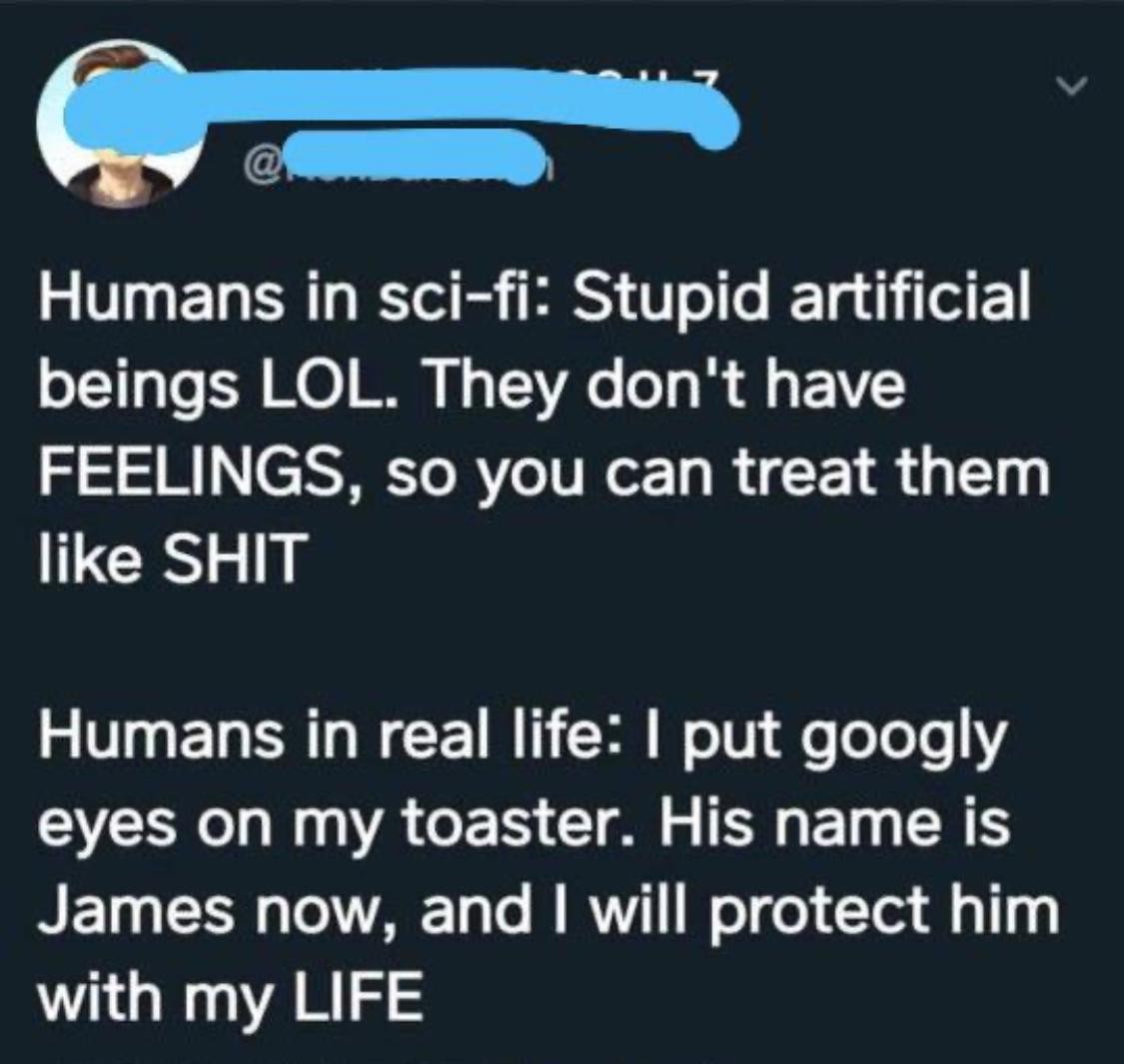
I immediately imagine a scenario 100 years in the future with you in a bar, slightly drunk and provoked by the young’ns to get the old man to rant against the Silicos.
One of the patrons overhears your offensively biocentric rant and asks you to check you DNA privilege and to stop using life exclusive language and to consider the feeling of silico-life forms and their struggles for equality.
You then mock them with a silver-face impression “SoRrY, cOuLd NoT cOmPuTe” while doing robot arms.
The bar tender, who is a synthetic, is on the verge of tears and asks you to leave…
If something is verifiabley sentient then I might change my tune, until then robots can fuck right off. Just like AI, sentient robotic life will still be a rape baby foisted onto us by corporate technocrats.
As your tab is auto charged to your biometrics and the bartender points to the door you decide to get the last words in-
“If something is verifiable sentient then I might change my tune, until then robots can fuck off!”
Another patron gasps at your lashing out, “did he just use the R-word? I’m so sorry bartender that you have to hear that. Just remember -not all humans.”
The bouncer approaches you and starts to corral you to the door. “Sir, it’s time for you to go”
You finish off your final rant from the doorway, “Robotic life will still be a rape baby foisted onto us by corporate technocrats!”
The door is closed on you. Inside, the bartender’s emotion chip glows, nearing short circuit. The other patron consoles them and tells them, “if you need to take a minute and collect your emotions, I understand. It is a long and hard road to equality.”
You’re really good at writing straw man arguments.
LMFAO no one can even prove you or they are sentient. This is equivilent to “if you show me god”
How do you verify sentience?
There was this guy, Karl Popper, who pretty much invented the scientific method. And Karl said when you claim something, you should design an experiment that, if you’re wrong, would prove you wrong. Then you do the experiment, and if you aren’t proven wrong, then you’re probably right. That’s the basis of modern science.
So: design an experiment that, if you’re wrong, would prove you wrong.