

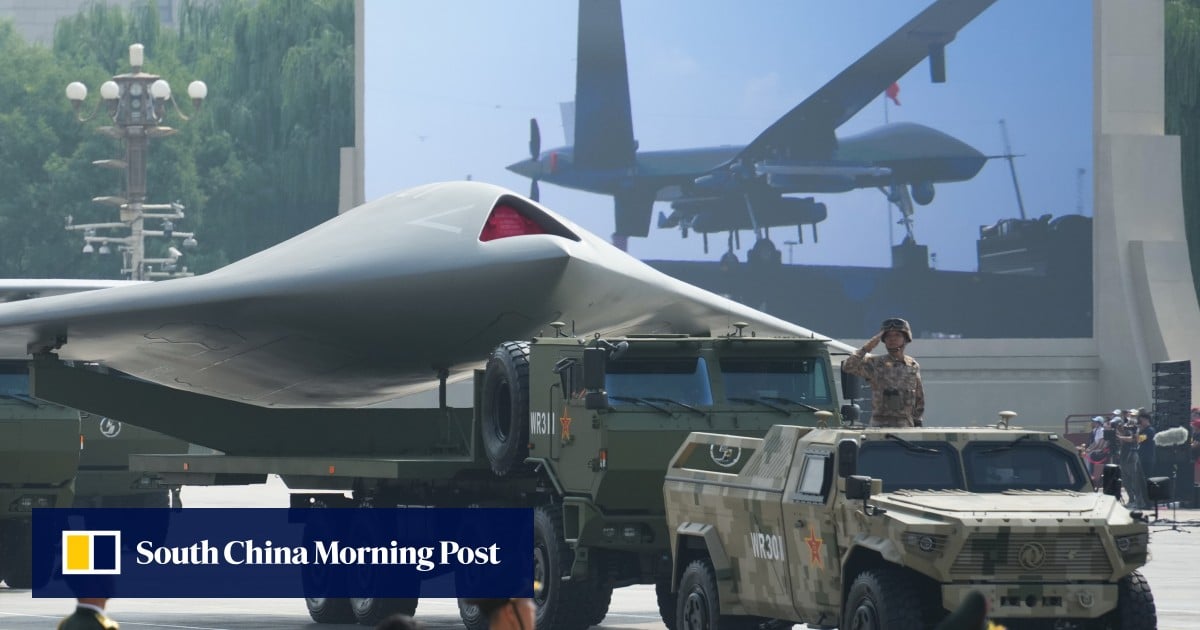
Scientists in China have demonstrated a wireless power transmission system that uses a ground-based microwave emitter to beam energy to an antenna array mounted on the aircraft’s underside. Importantly, they were able to do this while both the drone and charging system were in motion.
In tests, the car-mounted system kept fixed-wing drones in the air for up to 3.1 hours at an altitude of 15 metres (49 feet). The key challenge that the team overcame was maintaining alignment between the emitter and the drone during flight, wrote Song Liwei, the project’s leader.
https://www.sciencedirect.com/topics/engineering/microwave-power-transmission
That was 8 years ago.
What I’m describing are… currently extremely active areas of research.
You should maybe look into the level of precision that things like Phalanx CIWS systems have at tracking a moving target, with the ability to throw bullets at it, and hit it.
Or basically any SPAAG type platform that throws rounds down range.
Or I dunno, MASERs used in deep space transmission.
Or all the research that has gone into developing tracking gimbal systems that do intentionally use lasers or some kind of DEW to shoot down small drones, or damage aircraft in flight, or burn out incoming missiles.
Hell of a lot easier to track a friendly aircraft.
Genuinely no clue what you are talking about.
Are you assuming only like, quadcopters here?
We’ve had RQ 4 drone aircraft the size of WW2 medium bomber planes, with jet engines, for 20 years now.
I’m fairly sure that a jet engine produces a considerable amount of consistent heat.
Do… you think aircraft engineers… do not know… how to handle… heat?
Shall I describe a ramjet to you?
Or maybe we could go with something like the Space Shuttle’s reentry tiles?
In conclusion, you are vastly uniformed as to the state of… not even state of the art technology, that would be incredibly relevant to this discussion.
Those efficiencies are for large senders and receivers. When you have to make it small for a drone the numbers gets worse.
None of those make continous evasive maneuvers. All the things you mention works because the flight path is fully known in advance and you have full synchronization and ability to lock orientation. None of this works on a drone in urban environments where you’ll constantly lose line of sight.
Dude I’m not talking about heat I’m talking about literal about the literal MW receiver’s physical LOCATION on the drone body AND THE ACTUAL PROPULSION IN FORM OF MOVING AIR, because the receiver has to be large, and oriented to the sender at all times, which means there are orientations in which it will block at least some propellers from pushing air physically downwards, unless those also are built to extend far out AND CAN TWIST THEIR ORIENTATION TOO
(remember that propeller flight obeys the laws of Newton, pushing air down keeps you up and if you tilt your drone to align with the microwave center then you must tilt your propellers or you’ll be flying sideways, unless you put receiver on a gimbal in which case it’s stupidly complex and you now have to adjust airflow across non-blocked propellers when the receiver is below some of them)
You can not win an argument by misunderstanding the counterarguments. You lose by not even being able to imagine how a drone actually flies physically in the air, not to mention your lack of ability to just read
Not to mention that you didn’t even ask yourself what happens to a microwaved power transmitter in war. Guess what? It gets targeted and destroyed in seconds. You’re dead now. Bye.
And you can’t even make a drone swarm work. Either you have a dozen transmitters (lol good luck) or a phased antenna array in which lol fucking lmao that thing will spew out heat losses and get banned from operating near any remotely populated area due to radio interference